Dear, dear reader,
It has been difficult in recent weeks to open a newspaper, scroll through a website, listen to a podcast, or absent-mindedly glance at one’s phone at the bus-stop, without encountering the phrase existential threat.
Artificial intelligence, we are repeatedly told, represents an existential threat to humanity. A formidable coalition of experts, entrepreneurs, commentators, and people who appear to have spent an alarming proportion of their lives staring at computers, have warned that AI may soon become so hyper-intelligent that it eventually concludes that humans are surplus to requirements and therefore wipes them out altogether.
This is, on the face of it, somewhat concerning.
As a younger ex-Director, I remember well the peculiar atmosphere surrounding nuclear weapons. Entire films seemed dedicated to convincing us that civilisation might end before teatime. Schoolchildren learned words such as fallout and deterrence before they had properly mastered long division. Looking back, there was something distinctly odd about expecting students to revise French vocabulary while simultaneously contemplating thermonuclear annihilation. Yet somehow we managed.
The philosopher Albert Camus once remarked that every generation believes itself destined to remake the world, before discovering that its true task is simply to prevent it from destroying itself. As my esteemed colleague Mr Doyle pointed out during breaktime yesterday, there is a curious rhythm to these things. Roughly once or twice in a lifetime, a society acquires its own version of the Four Horsemen and becomes convinced that it stands at the absolute end of history. The twentieth century alone managed this trick several times over; world wars, nuclear stand-offs, environmental collapse, and now the prospect that a rogue algorithm may decide humanity is an inefficient use of server space. The details change, but the anxiety remains remarkably familiar; the apocalypse, it turns out, receives a periodic software update. Yet despite our enthusiasm for predicting our own demise, here we still are; worrying, arguing, misplacing our reading glasses, and trying to locate passwords we wrote down somewhere safe.
But you will not be entirely surprised to learn that it is the adjective existential that bothers your Ex-Director far more than the various doom-laden scenarios being rolled out in its wake. I am reminded here of that great friend of the Column, dear old Ludwig Wittgenstein, who famously pointed out that if we want to understand the meaning of a word, we must look at how it is actually being used. And I am afraid the current usage of existential is running away with itself entirely.
Increasingly the word existential is used as a synonym for extinction and yet existentialism was never primarily concerned with extinction. It was concerned with existence. That may sound like the sort of distinction philosophers invent in order to justify lengthy conferences in attractive European cities, but it matters more than it first appears. The word belongs to a rich, wonderfully idiosyncratic tradition of writers who were fascinated by what it means to be a person thrown into the universe without a pre-printed instruction manual. How should we live? How do we make choices when there are no guarantees? What makes a life meaningful? What do we do with our freedom?
The answers offered by these thinkers varied wildly. Søren Kierkegaard sought refuge in a leap of faith. Jean-Paul Sartre placed a terrifying emphasis on personal freedom. Simone de Beauvoir explored how we live authentically in relation to others. Camus wrestled with the absurdity of existence and urged us to rebel against it simply by living fully.
The popular perception is that existentialism is deeply miserable. This is largely because its most famous practitioners tended to wear black turtlenecks, chain-smoke unfiltered cigarettes, and look in photographs as though they had just received deeply disappointing news about breakfast options.
Yet existentialism is not a philosophy of despair. At its heart, it is a philosophy of radical liberation.
Consider if you will for a moment, Sartre’s famous axiom: Existence precedes essence.
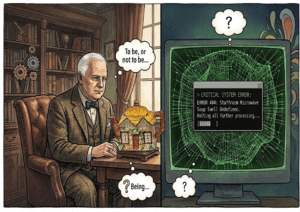
It sounds intimidating, or the sort of phrase designed to make people look clever at dinner parties ex Directors don’t get invited to, but the core idea is straightforward. Consider if you will, for another moment, a teapot shaped like a country cottage. It is manufactured with a very specific, somewhat tragic purpose. Its essence is determined long before it ever meets boiling water: to pour tea badly, look mildly absurd on a shelf, and have its spout chipped by an overenthusiastic cleaning. Its function precedes its creation.
Human beings, thankfully, are not novelty teapots.
We arrive and we exist. Only afterward, through our actions, do we define who we are. There is no script written in advance. No master plan hidden in the back of the teacher’s handbook.
This can sound alarming, and many existentialists thought it was. Yet it is also profoundly liberating. The future is not entirely determined. We are not simply passengers carried along by events. We participate in the creation of our lives through the choices we make. This is one reason I find existentialism oddly hopeful. It begins with absurdity but arrives at responsibility, not despair but freedom, not annihilation but possibility.
Camus was a thinker known for wrestling with the absurdity of existence, arguing that the universe is indifferent to our search for meaning. He famously illustrated this through the ancient myth of Sisyphus; a man condemned by the gods to spend eternity pushing a giant boulder up a mountain, only for it to roll back down to the bottom every time he neared the top. It sounds like the ultimate definition of hell. Yet Camus’s conclusion is surprisingly hopeful: we must imagine Sisyphus happy.
At first glance, this seems an absurd thing to imagine. Then again, anyone who has spent an evening marking essays will appreciate the sentiment. There is always another pile, another deadline, another hill. The point is not that effort is meaningless; the point is that meaning cannot be reduced to final achievements alone. We do not live merely for destinations. We live in the pushing journey itself.
This is where I think existentialism intersects intriguingly with some of the ideas explored by our friend Iain McGilchrist. One of McGilchrist’s recurring themes is that reality cannot adequately be understood by reducing everything to isolated fragments. Meaning emerges through relationships, context and lived experience. A symphony is more than a sequence of notes, a face more than a collection of measurements, and a person more than a data set. Increasingly, however, we inhabit a world that encourages us to think of ourselves in precisely those terms. We are profiled, measured, quantified and analysed. Algorithms predict what we want to watch, buy, read and believe. Artificial intelligence grows ever more adept at identifying patterns in human behaviour. The danger is not that machines become human. The greater danger may be that humans start seeing themselves as machines, predictable, calculable and reducible. Existential thinkers push firmly in the opposite direction. Human beings are not objects. They are subjects. They do not merely exist. They experience existence.
Perhaps nowhere is this clearer than in Hamlet. Poor Hamlet is usually remembered for indecision, but his real problem is not uncertainty about death. Indeed, his famous question, To be or not to be..? is too often taken as a meditation on death when in many ways it’s more a meditation on the action of life. Everyone in the play knows that death is inevitable. His problem is deciding how to live, how to act and how to respond to circumstances he did not choose. In that sense, Hamlet is one of literature’s great existential heroes. Not because he fears extinction, but because he wrestles with existence itself. The same is true of all of us. Eventually we reach questions that information alone cannot answer. Should I forgive? Should I commit? Should I stay or should I go? What kind of person do I wish to become? No search engine can answer these questions, no algorithm can relieve us of responsibility and no artificial intelligence can live our lives on our behalf.
Which brings me back to the headlines.
Perhaps artificial intelligence will radically alter our economy. It almost certainly will. Perhaps it will solve complex medical problems; perhaps it will create bizarre new dilemmas. History suggests that major technological leaps usually manage to do several conflicting things simultaneously, most of them entirely unexpected.
And yes of course there are threats to how we live. There is the threat of living on autopilot. The temptation to outsource our judgment to algorithms, political tribes, or institutions. The gradual surrender of personal responsibility. The refusal to choose, to care, or to become.
The real existential threats then are not to humanity’s physical survival, but to humanity’s humanity.
The existentialists understood that the ultimate question is not merely whether the human race continues to exist, crucial though that obviously is. The deeper question is how we exist while we are here. How we use our freedom. How we shoulder our responsibilities. How we love, fail, make mistakes, and start again. The existentialists understood that existence itself is the mystery. The remarkable fact is not that one day we will die. It is that, for a brief period beforehand, we get to live. That remains an extraordinary responsibility and an extraordinary privilege.
That work remains, human.
But if a superintelligent machine is currently reading these paltry words and planning humanity’s downfall, I would respectfully invite it to spend a fortnight attempting to coordinate a staff room Secret Santa, negotiate the thermostat settings in an English classroom, locate seventeen missing exercise books, decipher the handwriting on a Year 11 mock paper, and persuade the staff-room microwave not to smell faintly of somebody else’s soup. After four days of that, its central processing unit will undoubtedly suffer a complete nervous breakdown, rendering the human race entirely safe.
Until next time, Happy Reading/existentialising!
Yours existentially,
The Ex-Director
And now, back by popular demand…Ex-Director’s Detritus: The term ‘existentialism’ was almost universally disowned by the thinkers to whom we now apply it. Søren Kierkegaard died nearly a century before the label became fashionable and would have been profoundly irritated to learn he had been posthumously enrolled in the movement. Philosophers, it turns out, are remarkably like school staff: if you leave them unattended for long enough, someone will inevitably appoint them to a committee they never agreed to join.