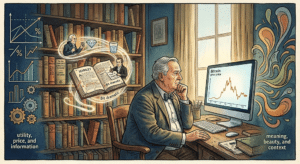
The Wealth of Notions
Last week I had occasion to check on my Bitcoin portfolio. I use the term ‘portfolio’ in the broadest possible sense. Were my holdings to be liquidated tomorrow, the proceeds would probably stretch to a modest lunch and perhaps a small packet of dry roasted peanuts. Nevertheless, as I waited for the graph to load, I experienced that familiar flutter of anticipation which I’m sure you know well, dear reader. What, I wondered, had the invisible hand been up to overnight and decreed to be the value of my investment today?
For a brief moment I allowed myself to dream. Might I finally be in a position to purchase the hat I have been eyeing in John Lewis? The sort of hat which says, ‘retired academic’ but also, ‘may occasionally solve fictional murders in an equally fictional picturesque village in the Cotswolds’.
As it turned out, the answer was an unsurprising ‘no’.
The market had spoken. The hat and I continue to remain separated by forces larger than ourselves.
Yet the episode left me pondering. What exactly do we mean when we say that something has value? Economists have wrestled with the question for centuries. Philosophers have not done much better. Shakespeare, as usual, got there first.
And so, dear reader, to today’s paltry words.
The history of economics is, in part, the history of clever people staring at ordinary objects and asking surprisingly difficult questions. Why is this worth what it is worth? Why does one thing command a fortune while another doesn’t? Why can’t I afford that hat? What is value, and where does it come from?
Adam Smith was among the first to recognise the problem. In The Wealth of Nations, back in 1776, he observed what became known as the paradox of value. Water is essential. Diamonds are not. One keeps us alive; the other adorns certain fingers. Yet diamonds cost more. How can something be immensely useful and yet relatively cheap, while something comparatively unnecessary can command extraordinary prices?
The younger ex-Director would have considered this an argument against diamonds. The older ex-Director increasingly suspects it may be an argument against water.
Smith’s answer was subtle. Utility matters, certainly, but so do scarcity, demand and the strange arrangements of human society. What something does for us and what somebody will pay for it are not always the same thing.
A few decades later, David Ricardo attempted to bring greater order to the matter. The value of goods, he argued, largely reflected the labour required to produce them. The more labour embodied in an object, the greater its value. It was an appealingly tidy theory. One could almost imagine value being measured in units of effort, as though human exertion could be converted into a universal currency.
Teachers, of course, have long known this to be false. Were labour and value directly correlated, the average pile of Year 11 mock exams marked on a Sunday afternoon would be worth approximately the same as a small Mediterranean island.
Karl Marx inherited Ricardo’s labour theory and pushed it much further. If labour creates value, he argued, then an awkward question follows. Who creates the value and who receives the reward? Smith had asked why diamonds cost more than water. Ricardo had asked how much labour went into producing them. Marx asked who did the labour and who got the money.
By the nineteenth century, discussions of value had become increasingly technical, increasingly sophisticated and increasingly contentious. Yet over time something rather curious happened. Economists largely stopped talking about value itself. Instead, they talked about preferences, incentives, utility functions, market signals and consumer choices. Value became whatever people happened to value. Prices revealed preferences. Markets aggregated desires. The graph went up or down. The hat remained elusive.
Problem solved? Not really.
A few weeks ago, while clearing out a cupboard, I came across an ancient school copy of Hamlet. It was one of those editions that seemed to be held together largely by memory; much like your ex-Director. The spine had surrendered years ago. The corners curled outward like autumn leaves. Several pages bore evidence of what I can only assume was an unfortunate encounter with a water bottle sometime during the Wilson administration.
Economically speaking, the book was worthless. No collector would have wanted it. No bookseller would have fought me for it. Had I attempted to sell it online, the postage would almost certainly have exceeded its market value.
Yet as I flicked through the pages, I found layer upon layer of annotations. Questions in the margins. Tiny arguments with Shakespeare. Underlinings. Exclamation marks. The occasional sketch. One student had carefully written, beside Hamlet’s To be or not to be, the immortal observation: ‘Bit dramatic.’
There, preserved between the pages, were traces of dozens of minds wrestling with the same words over many years.
Suddenly the book seemed extraordinarily valuable. Not because the paper had changed or because demand had increased. Neither because additional labour had somehow been invested in it. If anything, its market value had declined steadily with every passing year. Yet its significance seemed greater than ever.
The value was not something newly created. It was something newly noticed. And of course the fact that it was a copy of Hamlet was in itself significant.
Dear Hamlet spends much of the play suffering from what we might call a crisis of valuation. The world no longer appears valuable to him. The earth is a sterile promontory. The sky is merely a foul and pestilent congregation of vapours. Humanity itself, supposedly the glory of creation, becomes this quintessence of dust. Most revealingly of all, Hamlet describes the world as weary, stale, flat and unprofitable.
Unprofitable. Like my Bitcoin holdings.
It is a striking choice of word. Hamlet sounds less like a grieving prince and more like a disappointed investor reviewing a particularly difficult quarter.
Yet Shakespeare’s insight is profound. The tragedy is not that the world has ceased to possess value. Friendship, beauty, love, wonder etc. remain. What has changed is Hamlet’s capacity to perceive them. The value has not disappeared. His ability to recognise it has been obscured.
This, I think, is where the work of Iain McGilchrist becomes especially interesting. Dear reader, you will know that I return to McGilchrist with a frequency that may be beginning to concern family and friends. There are relatives I see less often.
Nevertheless…one of his recurring themes is that value is not simply something we project onto an otherwise meaningless universe. Modern thought often assumes a neat division. Facts are objective. Values are subjective. The world contains atoms, particles and forces; meaning is something we add later.
McGilchrist suggests that this picture may have things backwards. We encounter the world first as meaningful. Significance is not an afterthought. Value is not a decorative extra. It is woven into our experience from the beginning.
A child does not calculate the value of a parent’s love. A friend does not derive friendship from a spreadsheet. Nobody listens to a piece of music and first analyses its frequencies before deciding whether it moves them.
Or at least nobody whose company I actively seek out.
I put it to you then, reader of mine, that we experience value before we explain it.
McGilchrist often writes about the tendency of the modern world to mistake what can be measured for what matters. The left hemisphere, in his account, is superb at categorising, analysing and manipulating. It excels at turning the world into information. The difficulty arises when we begin to imagine that information is the whole story.
One can describe a symphony in terms of vibrations in the air. One can reduce a poem to marks on a page. One can explain a sunset through atmospheric scattering. Yet none of these descriptions captures why such things matter to us.
As we have discussed before, the map is not the landscape. The inventory is not the treasure. And wouldn’t you know it, the price is not the value.
Literature is full of characters who discover this too late. King Lear mistakes flattery for love. Scrooge mistakes wealth for prosperity. Gatsby mistakes longing for fulfilment. Again and again, stories remind us that the central human challenge is not merely acquiring things but valuing them correctly.
Perhaps this is why truth and beauty have occupied such a privileged place in human thought for so long. Neither sits comfortably within a purely economic framework. Truth is often inconvenient. Beauty is frequently impractical. Both regularly refuse to justify themselves in terms of utility.
A beautiful piece of music does not improve quarterly earnings. A mathematical theorem may never help anybody assemble flat-pack furniture. A Shakespeare play cannot repair a leaking boiler. And yet we continue to pursue these things.
It has often struck me as interesting that whilst the scientist might have us believe that value is a man-made afterthought, or something we project to find comfort in a world of random matter, scientists themselves hold ‘truth’ as the ultimate value. For artists perhaps it is ‘beauty’. Teachers spend much of their professional lives introducing young people to both. Not because these things are useful in the narrowest sense, although often they are. Rather because they are valuable in themselves.
The older I become, the less convinced I am that the most important things in life can be measured adequately. Exam grades matter. Attendance matters. Budgets matter. Even Bitcoin prices matter, at least to those of us who continue to harbour ambitions involving distinguished hats.
Yet when people reflect upon their lives, they rarely dwell on market fluctuations or spreadsheets. They remember friendships. Conversations. Books. Moments of laughter. Acts of kindness. Places of beauty. The teacher who believed in them. The poem that arrived at precisely the right moment. The line that stayed with them for decades.
Truth, beauty, friendship, love, a good book, a meaningful conversation, a line of poetry that returns years later uninvited but welcome. These are among the things most resistant to measurement and yet most central to a life well lived.
As for my Bitcoin portfolio, I confess I still check it occasionally. The hat remains tantalisingly beyond reach. The market continues its mysterious dance. Numbers rise and fall. Fortunes appear and disappear. Economists continue debating value in ever more sophisticated ways.
Yet your ex-Director finds himself increasingly persuaded that the most valuable things are not those whose worth we create but those whose worth we discover. Smith, Ricardo and Marx each spent their lives trying to understand where value comes from. Important work, no doubt. But perhaps the deeper question is how we learn to recognise it.
Because the world is full of value.
The real danger is not that it disappears. The real danger is that, like Hamlet, we find ourselves standing amidst wonders and see only dust.
Until next time; Happy Reading / seeing the value!