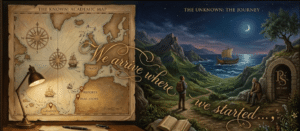
The Unfinished Sentence
One of the occupational hazards of being your Director is spending an inordinate amount of time thinking about sentences. A surprising number arrive without capital letters. Others wander off without a full stop. Some become so entangled in subordinate clauses that they resemble a particularly unfortunate knot in a fishing line. Yet despite these occasional frustrations, I remain rather fond of sentences. They are among humanity’s most remarkable inventions. With a handful of marks on a page, we can preserve a thought, share an idea, tell a story, or bridge centuries.
And yet, as this academic year draws to a close, I find myself wondering whether we have perhaps become a little too fond of endings.
Schools, after all, are full of them. End of lessons. End of exams. End of reports. End of terms. End of year. We mark them with ceremonies, speeches, prizes, photographs and farewells. We place neat full stops where life, untidy as ever, prefers commas.
The truth is that education rarely ends where we think it does.
Many years ago, I encountered a line from T. S. Eliot which has remained lodged somewhere in the attic of my mind ever since. In Little Gidding, he writes that the end of all our exploring will be to arrive where we started and know the place for the first time. It is a curious thought, particularly as we often imagine learning as a journey away from ignorance towards knowledge. Eliot suggests something stranger and it is the same idea found in one of our oldest adventure stories. As cinemas gear up this summer for Christopher Nolan’s blockbuster adaptation of The Odyssey, we are reminded that epic journeys are rarely a straight line. Odysseus spends ten years crossing oceans and fighting all manner of monsters, to get back home. But he does not return unchanged.
Many centuries after Homer, Alfred Lord Tennyson picked up the thread in his lovely poem Ulysses (using the Roman name for Homer’s wandering king). He imagined the aging hero back in Ithaca, restless and realising that a quiet retirement was its own kind of stagnation. As Tennyson famously wrote, How dull it is to pause, to make an end, / To rust unburnish’d, not to shine in use! For Ulysses, arriving home wasn’t a final full stop; it was merely a prelude to the next voyage. His journeying did not only change what he knew, it changed who he was. Like Homer’s wanderer, we eventually return to familiar things with entirely new eyes, as well as the realisation that our exploring is never truly done.
I do hope that many students have experienced something similar this year. A book that seemed baffling in September suddenly reveals its shape in July. A poem that appeared obscure begins to whisper meanings. A historical event acquires significance. A scientific principle starts to illuminate the world beyond the classroom.
The knowledge may have been there all along. What changed was the person encountering it.
This is one reason why education can be such a humbling enterprise. We often assume that understanding arrives in a single triumphant moment. In reality, it tends to arrive in instalments, usually long after we have convinced ourselves that the lesson is over.
I still remember a number of things I was taught at school. Unfortunately, I can also remember a number of things I was taught incorrectly by my own overconfident younger self. There are few experiences quite so educational as discovering that one has been explaining something with great authority for several years while being entirely mistaken. And of course, one of the benefits of age, if not necessarily wisdom, is the gradual recognition that certainty is frequently overrated.
Friend of the Column, Socrates, famously claimed that his wisdom consisted in knowing that he knew nothing. This was either a profound insight or a remarkably effective strategy for avoiding difficult questions. Either way, there is something admirable about the sentiment. Genuine learning often begins not with certainty but with curiosity.
The novelist E. M. Forster once wrote, How do I know what I think until I see what I say? The remark captures something important. Thinking is not merely the expression of finished ideas. Quite often it is the process by which unfinished ideas become visible to us. We speak, write, revise, question and discover that our thoughts are still under construction. Your Director, you may have noticed dear reader, rarely has any idea where his Columns are going.
Perhaps that is why literacy and oracy matter so much. They are not simply vehicles for displaying knowledge. They are tools for creating it.
A conversation, at its best, is a form of collaborative thinking. A book is a conversation that somehow survives its author. Every time a student opens Shakespeare, Austen, Dickens or Orwell, a dialogue resumes that has been waiting patiently for years. The remarkable thing is that the conversation changes because the reader changes.
The sixteen-year-old Hamlet is not the same Hamlet encountered at thirty, and the forty-year-old Hamlet is not the same Hamlet encountered at sixty. The words remain identical. The reader does not.
This is why I have been known to occasionally smile when students ask whether they will ever need a particular text again.
The honest answer is that I have no idea. They may never open it again. Or it may return unexpectedly twenty years from now when a single line suddenly illuminates an experience that previously seemed inexplicable. Books are rather like seeds. Most disappear from view for long periods before surprising us by growing somewhere unexpected.
Which brings me, inevitably, to Iain McGilchrist (Bingo!), whose work has appeared in these here Columns often enough that some readers may suspect he has taken up permanent residence here.
McGilchrist argues that the two hemispheres of the brain attend to the world differently. One tends towards focus, categorisation and certainty. The other remains open to context, ambiguity and relationship. His central insight is not really about neuroscience at all. It is about attention. The way we attend to the world shapes the world we experience. As he puts it, what we find depends partly upon how we look.
Schools necessarily require a degree of focused attention. We analyse, classify, define and measure. These are valuable activities. They allow us to learn languages, solve equations, understand historical events and build coherent arguments. But education is diminished if it becomes only that.
The deepest forms of learning often emerge from a different mode of attention. They arise when we wonder rather than merely calculate. When we encounter a poem and recognise something we cannot quite explain. When we stand beneath a night sky and experience the peculiar mixture of insignificance and awe that accompanies the contemplation of infinity. When we realise that another human being’s experience is as rich and complex as our own.
McGilchrist warns that the map can sometimes mistake itself for the territory. The representation can begin to eclipse the reality it was intended to describe. Education, at its best, helps us avoid that mistake.
Examinations, grades and qualifications matter. But they are maps. Useful and important maps, certainly. And in some cases, no doubt beautiful maps.
Yet a map, no matter how exquisitely drawn, is still an abstraction. You can admire its contours, trace its lines, and stand speechless before its design. But nobody ever fell in love with a map alone. You fall in love with the landscape it represents. You don’t live in the grid lines; you live in the valleys and the peaks.
The territory is always larger.
The territory includes the books that make us rethink our assumptions. The conversations that change our minds. The friendships that shape our character. The moments of failure that teach resilience. The unexpected interests that emerge from an apparently ordinary lesson on an apparently ordinary Tuesday.
If I have learned anything from working in schools for the years that I have, it is that the most significant educational moments are almost entirely invisible when they occur. They happen in the unscripted margins of the day; a teacher making a casual, passing remark at the end of a lesson, a student stumbling across a strange and unfamiliar idea in an essay, or a library book finally falling into the hands of the right reader. In the moment, nothing appears to happen. There are no sudden epiphanies, no immediate shifts in perspective, and certainly no metrics to capture the exchange. Yet beneath the surface, a seed has been planted. Years later, long after the classroom has been forgotten, that quiet interaction quietly resurfaces, and something genuinely extraordinary emerges.
The American writer Marilynne Robinson once observed that education is a process of giving people access to their own minds. I have long liked that description. It suggests that learning is not the accumulation of facts but the gradual discovery of one’s own intellectual landscape.
The destination of this journey, if indeed there is one, remains perpetually beyond the horizon, which brings us back inevitably to the matter of endings. Every July, schools perform a curious and familiar ritual: we declare an academic year complete. In a purely administrative sense, of course, it is; the progress reviews have been reviewed, the final assessments are graded, and the lockers have been emptied with varying degrees of enthusiasm and success. Yet the genuinely important aspects of these past ten months remain defiantly unfinished. The books are still being digested, the deepest questions remain unanswered, the conversations are ongoing, and the people themselves are happily incomplete.
Thankfully so, for human beings are not projects to be finalised, but stories still being written. The philosopher Alasdair MacIntyre argued that we understand our lives through narrative, making sense of our choices and identities through the framework of a tale. If that is true, then education should never be viewed as the writing of a final chapter; it is, rather, the steady addition of new possibilities to the chapters yet to come. The students leaving us this summer may well imagine they are reaching the end of something, when in reality they are only arriving at the middle, just as the students returning in September may believe they already know exactly who they are, when it is far more likely that they are only beginning to find out.
Shakespeare understood this paradox well. Hamlet’s final words, The rest is silence, are often quoted as though they represent an ending.Yet the remarkable thing is that the play itself refuses to end there. Fortinbras enters, the story continues, and audiences have spent more than four centuries arguing about what Hamlet meant. Even Shakespeare’s endings have a habit of becoming beginnings.
As for your Director, he intends to spend part of the summer reading books he has been meaning to read for years, pretending he understands poetry more thoroughly than he actually does, and making ambitious plans which reality will no doubt revise by the second week of August, or possibly by lunchtime on the day two of the holidays.
For all of us, however, the most important work remains perpetually unfinished. There are still questions to ask and books to read, just as there are still conversations to have, mysteries to contemplate, and sentences left to write. And that, perhaps, is the real gift of education. It’s not that it provides us with the final word, but that it teaches us to recognise that the final word never truly arrives.
For now, these paltry words must do what all school years eventually do. They cannot offer a final full stop, nor even a tidy conclusion; they must simply trail off into the summer break. The long inviting comma before the conversation resumes.
Until next time, Happy reading / ,
PS: On the subject of endings, this column happens to be my last as your Director; come September, I will be parting ways with that august title. Yet if the past few pages have argued anything, it is that departures are rarely absolute. I certainly hope our paths cross again, dear reader, even if I return in a different guise, seeing the world, as Homer’s wanderers do, with entirely new eyes.