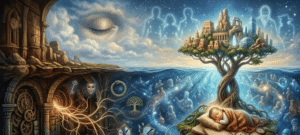
In recent days we have celebrated a new addition to the Director’s extended family. The arrival of a brand new life into the world has been a cause of great excitement and celebration, and rightly so of course. A baby can bring out the best in those around it, offering as it does a chance to see the world anew. For your Director, a new human also invites a return to ponder once again dear old Carl Jung’s ideas of archetypes.
With all the oohing and ahhing that accompanies gathering round a newborn it is easy to align oneself with the romantic view that we are looking at a completely blank slate of possibility. In the hospital delivery ward last week, I could not help but to bring to mind Thomas Hardy’s poetic reflection in Tess of the d’Urbervilles, where he describes children as young souls… moving on a vessel of which they knew nothing… players who had indefinitely many years to weapon themselves, a tabula rasa upon which time was to write. Now dear old Thomas saw things far more deeply than your myopic Director, but I’m not entirely convinced that we are all born as blank canvases. Mary Shelley showed us, for one thing, how that might be a very tricky state of affairs. The Creature in Frankenstein is perhaps the ultimate literary embodiment of the tabula rasa. He is literally born as a giant, adult-sized infant with absolutely no language, culture, or concepts of right and wrong and is therefore forced to learn how to exist entirely from external, often cruel stimuli. Poor thing.
This question of whether the newborn mind is indeed a tabula rasa awaiting external stimuli to obtain structure, or whether it possesses a preformed template that influences how it experiences reality, has long exercised philosophers and storytellers alike. And hence my thoughts of Jung’s ideas of archetypes.
Jung believed there are identical psychic structures common to all of us which are heritable and precede human experience, influencing the way we all experience the world. He called these structures archetypes. With your kind indulgence, I would like to offer today’s paltry words in having a look at what they are and what the idea of them has to offer.
To understand where these structures live, we have to look at how Jung viewed the psyche. The word originally meant ‘soul’ or ‘spirit,’ but Jung used it to encompass our whole personality: every thought, feeling, behaviour, and emotion. He carved this inner landscape into three interacting realms.
First is consciousness, at the centre of which sits the Ego acting as the gatekeeper of our firsthand awareness and the manager of our daily personality.
Directly beneath the Ego lies the personal unconscious, which is pictured as a kind of subliminal basement where the Ego puts the stuff it deems insignificant, forgets, or actively represses because they register too highly on the ick scale. But these things do not merely sit there gathering dust. In fact they gather energy. They cluster together into what Jung called complexes. When a complex gets triggered, it acts like a temporary sub-personality, hijacking our thoughts and emotions before our conscious Ego even realises what has hit it. We’ve all been that guy.
While Jung’s mentor and one-time long-term pal, Sigmund Freud, believed these complexes were purely the result of personal childhood traumas, Jung noticed something deeper. He found that the roots of his patients’ hang-ups often mirrored ancient mythological motifs and religious symbols shared by cultures across history. What intrigued him most was that these identical patterns arose in societies completely isolated from one another.
Take, if you will, the Ouroboros; the ancient image of a serpent eating its own tail. This potent symbol of eternity, the cyclical nature of life, and the containment of opposites appears spontaneously in the funerary texts of Tutankhamun in ancient Egypt, the Norse myth of the world-encircling serpent Jörmungandr, the creation myths of the Aztecs, and the meditative traditions of ancient India. Similarly, the archetype of the World Tree, a massive, sacred tree connecting the heavens, the earth, and the underworld, is found rooted just as deeply in the Yggdrasil of Germanic mythology as it is in the Mayan tree of life, the cosmic Ashvattha of the Hindu Upanishads, and the shamanic traditions of Siberia.
Even the familiar story of Adam and Eve in the Garden of Eden serves as a great example of this shared psychological geography. The narrative of a pristine primordial couple, a forbidden tree of knowledge, and a deceptive serpent is not a solitary cultural artefact; it echoes a much older, universal human archetype of the ‘Fall’ from blissful, unconscious innocence into the painful world of conscious moral choice. We find this exact same thematic framework playing out centuries earlier in the Mesopotamian Epic of Gilgamesh, where a serpent steals the plant of rejuvenation, and in ancient Persian creation myths where the first couple are tempted by a demon in the guise of a snake.
In our modern, endlessly cynical age, we often hear the argument that because these stories exist in so many different guises across the globe, they are therefore undermined or debunked. At this point, we hear the galloping of our old friend Prof. Richard Dawkins riding over the fields on his evolutionary biologist charger. He looks at these overlaps and dismisses the idea of an inherited collective unconscious entirely. To his way of thinking, our shared cultural symbols are not innate blueprints wired into our biology, but merely memes (a term he coined in The Selfish Gene): contagious, unoriginal fabrications recycled, imitated, and passed from mind to mind across time simply because they are catchy or useful.
Dawkins argues that if different cultures share similar flood myths, creation stories, or dragon legends, it is not because they share a mystical, heritable subconscious map. Instead, it is for two main reasons. Firstly, certain narratives are incredibly good at surviving in the human mind, so they get copied, modified, and passed along trade routes over millennia. And secondly, humans face similar environments. Every culture experiences rivers that flood, the sun rising, and a fear of predators like snakes. Therefore, they independently invent similar fictional explanations based on common external experiences, not a shared internal blueprint.
But for Jung, this global repetition points to the exact opposite idea: it makes them infinitely more profound, and in a psychological sense, undeniably true. If a narrative were unique to just one culture, we might dismiss it as a local invention. But when the same motifs emerge independently across continents and millennia, they cease to be merely fiction. They become psychological facts. They reveal that these stories are not arbitrary bedtime tales, but the structural grid lines of the human mind itself. Our ancestors were not copying each other’s homework; they were simply looking into the same internal mirror.
So if it’s not memes and shared floods, how could peoples separated by vast oceans and millennia of history dream up the exact same images? Well, this is perhaps Jung’s grandest discovery: a third, deepest layer of the mind called the collective unconscious. These symbols are not merely historical curiosities; they are the common vocabulary of our species, proving that there is a shared psychic map of what it means to be a human being. It was this startling universality that led Jung to declare that, in a very real sense, all cognition is akin to recognition. We do not merely learn the world from scratch; we recognise patterns that we are already internally wired to perceive.
This collective unconscious is the place where our archetypes live. Jung’s student Erich Neumann called them our psychic organs suggesting that in the same way we are born with physical organs that function automatically to sustain the body, the mind possesses pre-formed, heritable cognitive categories. We cannot directly see these inner structures, but we constantly witness their footprints projected into our consciousness as universal themes, symbols, and dreams. Jung found the global, historical recurrence of these mental blueprints interesting. And if it was interesting enough for Carl, it’s interesting enough for your Director.
While Jung suggested a vast gallery of these inner blueprints, including the Father, the Mother, the Wise Old Man, and the Trickster, Jungian psychology primarily focuses on what are regarded as the four major archetypes: the Self, the Persona, the Shadow, and the Anima or Animus. These are the primary actors in our internal theatre, and they spend their lives having a rather noisy dialogue with our conscious Ego.
When it comes to the first archetype, the Self, your Director likes to think of the Ego as the captain of a ship, while the Self is the entire ocean and the ship. While our Ego is just the conscious personality we acquire during our lifetime, the Self is the grand sum of both our conscious awareness and the vast, uncharted waters of our unconscious. Achieving the Self was, for Jung, the ultimate purpose of being alive. He called this lifelong quest individuation, or self-realisation, which is the slow, deliberate process of sorting through our inner clutter to become a whole, indivisible psychological unity. In literature, we see this particular archetype in classic quest narratives. Think of J.R.R. Tolkien’s Aragorn in The Lord of the Rings; his entire journey is not just about winning a crown, but about stepping out of the wild and integrating his fragmented past to become the complete, unified King he was always meant to be.
We see the exact same psychological architecture in Harry Potter. Harry’s journey across seven books is not merely about defeating an external villain, but about the painful integration of the various, fragmented parts of himself, including the dark piece of Voldemort living inside him, to ultimately emerge as a whole, balanced Master of Death.
But before we can find the Self, we have to deal with the gatekeepers of our unconscious, starting with the Persona. Known as the conformity archetype, the Persona is simply the collection of social masks we wear for reasons of adaptation or personal convenience. We all have them: the professional colleague mask, the polite dinner guest mask, the capable leader mask or the competent Director. One cannot help but wonder what dear old Carl would make of our modern digital landscape, where the industry of self-cultivation on social media has turned the curation of this mask into a competitive sport. There are those who celebrate the creation of an entirely false identity online, mistaking a polished, algorithmic facade for true personal growth. The danger, of course, is when we forget we are wearing a mask and begin to believe the Persona is who we actually are, which leaves our negative traits completely hidden. In F. Scott Fitzgerald’s The Great Gatsby, Jay Gatsby is the ultimate literary Persona. He invents a flawless, glittering mask of old-money sophistication to please the world and hide his humble origins, but because he clings too tightly to the mask, his real self is entirely consumed by it.
We see this exact tragedy play out in the musical Wicked, where Glinda traps herself in the glittering, manufactured Persona of Glinda the Good to win the adoration of Oz, sacrificing her true self to maintain the public mask. For a classic cinematic example, one needs only to look behind the curtain at the Wizard of Oz himself. He constructs a massive, booming, terrifying projection to serve as his leader Persona, fooling the entire kingdom into believing he is an all-powerful magician, while desperately hiding the ordinary, fragile man behind the screen.
When we use our Persona, or indeed our Insta feeds if you have such things, to present only our best, most agreeable traits to society, those discarded, negative traits that contradict our real selves have to go somewhere. So they drop straight into the basement of our mind, forming what Jung called the Shadow, which is the unknown dark side of our personality. The Shadow is probably the easiest archetype to experience because it lives right under the surface of our personal memories. It contains the qualities we absolutely cannot stand in other people, which, in a twist of psychological irony, are usually the very traits we refuse to see in ourselves. Your Director suffered an excellent reminder of this dynamic only last Tuesday. I spent a good five minutes trapped behind a mid-sized saloon car, loudly and righteously lambasting the driver ahead for their breathtaking, utterly self-absorbed obstinacy because they were refusing to bully their way onto a roundabout. I was practically standing on the horn, delivering a masterclass in moral superiority to my passenger, who happened to be my long-suffering spouse. It was only when she quietly looked up from her phone and asked, And who exactly is being self-absorbed and obstinate right now? that the mirror was shattered over my head. It turns out I am remarkably adept at identifying the tiny speck of dust in my neighbour’s eye whilst remaining blissfully oblivious to the massive joist of structural timber protruding from my own. Jung warned that when we fail to recognise our psychological projection, we deny these impulses in ourselves and attribute them to others. This eventually creates an illusory environment, effectively changing the world into a replica of our own unknown face.
This of course brings us to the tale of Robert Louis Stevenson’s Dr. Jekyll and Mr. Hyde. Mr. Hyde is the untamed, autonomous Shadow personified. The tragic mistake Jekyll makes is trying to sever himself from his dark side completely rather than doing the hard moral work of integrating it. For a healthy psyche, it must be Jekyll, the conscious personality, who tames and incorporates the shadow, and not the other way around. Otherwise, as poor Jekyll finds out, you become the helpless slave of the monsters living it up in your own basement. We see this precise dynamic played out in so many cinematic blockbusters. Star Wars for example, where Darth Vader is the galactic projection of Luke Skywalker’s own potential for darkness. Luke’s ultimate triumph in The Return of the Jedi is not that he destroys his enemy, but that he looks at Vader, looks at his own mechanical hand, and recognises the Shadow within himself, famously declaring, I am a Jedi, like my father before me. He integrates the dark rather than being consumed by it.
Finally, tucked even deeper within the Shadow, we encounter two contrasexual figures: the Anima and Animus. Jung saw that the human psyche is inherently balanced by internal opposites; thus, in every man’s psyche there is an unconscious feminine aspect called the anima, which is a personification of all feminine psychological tendencies, while in every woman’s psyche there is an unconscious masculine aspect called the animus. Man’s anima is often characterised by the feminine Eros, remaining passive like a child seeking the protecting and nourishing charmed circle of the mother. Because these archetypes sit so far away from our daily consciousness, they are rarely realised, yet they dictate how we love, how we react emotionally, and how we balance our internal energies.
In literature, we see this beautifully illustrated in Emily Brontë’s Wuthering Heights. When Catherine famously declares of Heathcliff, “Whatever our souls are made of, his and mine are the same,” she is describing the profound, terrifying shock of encountering her own masculine animus walking around in the physical world. For a modern, playful look at this concept, Pixar’s animated blockbuster Inside Out serves as a perfect visual aid. When the film peeks inside the mind of the young girl’s father, his internal emotional console is led by a group of male emotions, but they are flanked by distinctly feminine traits, while the mother’s internal council includes masculine ones, a clever nod to the idea that our minds naturally house these contrasexual internal guides. If you prefer your cinema a bit darker, Christopher Nolan’s film Inception provides a warning. The character of Mal, the protagonist’s deceased wife who haunts his subconscious dreams, is a brilliant personification of a repressed, unintegrated anima. She sits in the deepest basement of his mind, constantly breaking out to sabotage his conscious plans because he refuses to do the hard psychological work of confronting and accepting her, illustrating Jung’s point that what we ignore in the dark will eventually hijack our reality.
Which brings me right back to the beginning of our Journey, and to our family’s newest, tiniest addition. This newborn child is not haunted by a basement of repressed memories just yet; they are currently sleeping peacefully, blissfully unaware of the vast internal theatre they have just inherited. But the blueprint is already there. This child is not a blank slate, but a beautifully complex, ancient ecosystem waiting to unfold. As they grow, their conscious Ego will inevitably have to grapple, clash, and dance with these deep contents of their unconscious.
Jung warned that if these realms are split apart or dissociated, psychological disturbance follows. But if they move on parallel lines, cooperating in a dynamic harmony, the individual undergoes that lifelong journey of becoming a truly whole, indivisible psychological unity. Time will write this child’s specific, unique story, filling in the framework that evolution has so carefully gifted them. Our ultimate task as human beings, and perhaps our highest wish for the next generation as they begin to navigate their own internal depths, is exactly as Jung beautifully summarised: to kindle a light in the darkness of mere being.
Until next time, Happy Reading / archetyping!
Director’s Detritus #39.6
Jung’s concept of the personal unconscious absorbing things that register too highly on the ick scale is actually mirrored in our physical evolution. Neuroscientists have discovered that the insular cortex, the part of the human brain that lights up when you smell rotten meat or look at bodily fluids, is the exact same region that activates when you experience moral disgust or social hypocrisy. Your brain treats bad driving and bad ethics precisely like rotten food.