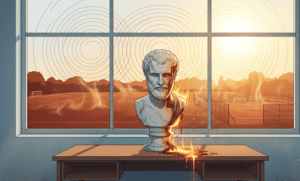
The Shape of Things to Come Bust
Gosh, it’s hot. Indeed, as I type these paltry words, much of the country is labouring under a very rare red heat health alert. The MUGAS artificially shimmer in the distance like a mirage; classrooms have acquired the atmospheric qualities of a moderately successful pizza oven, and conversations have become dominated by the three great British summer topics: weather, weather, and whether it might possibly be even hotter tomorrow. There is a specific kind of paralysis that accompanies a British heatwave; a collective, unaccustomed slowing down of a culture fundamentally engineered for drizzle, stiff upper lips, and grey skies. And your Director sits looking out at the landscape through undulating waves of distorted air, watching familiar environments warp under an unyielding sun, all whilst wondering if it is socially acceptable to eat a third Calippo before break time.
Yet heat is one of those curious things that extends far beyond thermometers and weather forecasts. Few physical phenomena have left such a permanent mark on our language, our literature, our religions, and our profound understanding of ourselves. We warm to people. We cool towards them too. We are fired by enthusiasm, inflamed by anger, consumed by ambition, and occasionally burned by our own decisions. The temperature outside may be unusually high this week, but human beings have been thinking about heat for a very long time. Almost as if the external climate is merely a mirror to the perennially fluctuating weather of the human soul.
To understand how deeply heat is baked into our intellectual history, one must return to the very cradle of Western thought, long before anyone had invented the linen suit. The ancient Greek philosopher and friend of the Column, Heraclitus, famously asserted that fire was the fundamental substance of the universe. For Heraclitus, as we have discussed, the cosmos was not a static collection of objects, but a living process. Everything, he argued, was in flux, forever changing, shifting, and transforming. You could not step into the same river twice, because new waters were constantly flowing over you, and you yourself were changing in the process. Fire seemed to embody this restless, dynamic reality. It was the ultimate agent of transformation; it consumed, it converted, it danced, and it refused to remain still.
Centuries later, the Stoics took Heraclitus’s primal fire and expanded it into a comprehensive cosmic cycle known as Ekpyrosis. They envisioned a universe that was periodically consumed by a magnificent, purifying fire and subsequently reborn from the ashes, entirely cleansed of its flaws. Yet the Stoics added a crucial human dimension to this cosmology: they believed that a tiny, fractional spark of this divine cosmic fire, the logos, resided inside every human being as our capacity for reason. When the world around us grew chaotic, or when our circumstances became unbearably oppressive, it was this internal spark that allowed us to maintain our dignity. Whether or not they were right about the physical cosmos, they certainly put their finger on something profound about human nature. It suggests that when things get hot, it is a test of that internal, rational spark.
This ancient intuition has found an echo in modern cosmology, offering yet another example of the suspicion that if one waits long enough, science eventually catches up with poetry. Sir Roger Penrose has proposed that our universe may be only one in an endless succession of cosmic ages, each emerging from the ashes of its predecessor. The details are fearsomely mathematical, and beyond the capacity of a Director of small brain currently melting into his chair. Nevertheless the underlying image is surprisingly familiar. Across thousands of years, from Heraclitus’s fire to contemporary physics, thinkers have repeatedly returned to the same vision: that reality is not a fixed structure but an ongoing process of transformation. The end of one thing becomes the beginning of another. Existence itself may be less like a completed building and more like a flame, forever flickering between destruction and renewal.
Perhaps this cosmic connection explains why we so routinely describe our emotional lives in terms of temperature. We speak of hot-headedness, heated arguments, simmering resentment, burning desire, fiery passion, and warm affection. A person may be cold-hearted or warm-hearted; a relationship may cool over; an idea may spark excitement. These expressions are so deeply woven into the fabric of our daily vocabulary that we scarcely notice them. Yet they reveal something extraordinary about the architecture of human thought. We do not merely think abstractly with our minds; we experience, interpret, and map the world through our bodies, a fact that is painfully obvious to your Director trying to maintain a professional demeanour while a line of sweat slowly trickles down the aged forehead.
In modern psychology and linguistics, this is known as embodied cognition, the recognition that our conceptual systems are grounded in our physical, bodily experiences. Long before neuroscience arrived with advanced scanners, statistical data, and neural mapping, human beings had already observed these intimate connections and woven them into language. Anger really does make our blood boil, causing our peripheral blood vessels to dilate and making us feel physically hot. Embarrassment brings a sudden rush of colour to the face. Excitement, so I am reliably informed, quickens the pulse and raises metabolic output. Your Director these days might be more often experiencing an attack of the vapours than excitement, so it’s hard to tell. But I digress…
Physiologically, humans are homeotherms (warm-blooded), a design choice I find myself questioning at current temperatures. We expend massive amounts of energy just to keep our internal temperature perfectly stable at 37 degrees, regardless of whether it’s freezing or a red-alert heatwave outside. This physiological reality makes heat a beautiful metaphor for character. Emotional maturity might then be psychological homeostasis, the ability to maintain internal coolness, balance, and decency even when the external environment is boiling over with outrage. The homeothermic person is not throwing a thermometer out the window to match the climate; they carry their own climate within them, although achieving this state of zen is admittedly harder when the classroom fan is broken. Being cool therefore means being cool.
The phrase hot-headed itself is revealing. It suggests not simply anger, but a dangerous kind of systemic imbalance. Heat, in its proper measure, has indispensable uses. Without it, there would be no molecular movement, no chemical reactions, no energy, and no life. A frozen universe is a dead universe. Yet too much heat invariably creates turbulence. Water gently warmed becomes a pleasant, comforting cup of tea; water heated excessively becomes high-pressure steam capable of powering an industrial engine, or blowing the heavy iron lid clean off the kettle. The very same principles might be usefully applied to the psychology of human communities. Passion can inspire great cultural achievements, fuel social justice movements, and spark artistic genius. But unmanaged, uncalibrated passion clouds judgement, warps perception, and melts away the guardrails of civilised behaviour.
One does not have to look particularly far for evidence of this melting point in contemporary life. Much of modern public discourse appears to operate on the bizarre assumption that the hottest, most incandescent opinion is automatically the most important or the most valid. Our digital ecosystems are intentionally engineered to capitalise on this vulnerability. Social media rewards raw heat far more readily than it rewards light. A measured, nuanced observation that requires contemplation rarely goes viral; it is buried by algorithms that feed on engagement. An outrage, however; a perfectly targeted missile of cultural resentment or political fury, can circle the globe and inflame millions before the kettle has boiled.
In physics, entropy is a measure of disorder, and the Second Law dictates that in an isolated system, entropy (disorder and wasted heat) always increases. Without conscious effort, human systems, like social media, naturally default to maximum entropy. We are literally watching the Second Law of Thermodynamics play out in our politics: high heat, massive disorder, and very little useful work being done. In Leviathan, Thomas Hobbes compared political factions and fiery demagogues to solitary pockets of heat or inflammation in the body politic, warning that they lead to the fever of civil war. It seems we have long been warned that inflammatory rhetoric is a distinct societal health hazard.
The distinction between heat and light has occupied the minds of thinkers for generations. Light helps us see; it provides clarity, perspective, distance, and vision. Heat helps us act; it provides the kinetic energy, the drive, the momentum, and the force of execution. Both are entirely necessary for a functioning civilisation, but they are absolutely not the same thing. Some people possess immense conviction, a blazing furnace of zeal, but little to no wisdom. They are all heat and no light, blundering through the world setting fire to institutions they do not understand. Others possess exquisite wisdom, brilliant intellectual clarity, but insufficient courage or energy to act upon it. They are all light and no heat, illuminating the problems perfectly while remaining frozen in academic paralysis. The great challenge of leadership, education, and personal development is to somehow combine both: to keep the furnace of human passion burning hot down in the engine room, while ensuring the cool, steady light of reason has a steadying hand on the steering wheel.
Fire has always embodied this fundamental, double character. It is simultaneously profoundly creative and terrifyingly destructive. The ancient myth of Prometheus tells of humanity receiving the gift of fire stolen from the gods. It was the absolute turning point for our species; fire brought warmth to survive the winter, protection from apex predators, the ability to cook food and unlock nutrition, craftsmanship, metallurgy, and civilisation itself. Yet the same force that allows us to forge tools can also reduce cities to ashes. This tension is wonderfully explored in Mary Shelley’s masterpiece, Frankenstein, which she pointedly subtitled The Modern Prometheus. When the Creature first discovers fire in the woods, he is captivated by its warmth, but promptly burns his hand when he thrusts it into the embers. He remarks on the paradigm shift: How strange man is, that the same cause should produce such opposite effects! Fire remains a wonderful servant, but it is a terrible, merciless master.
Our literary tradition is thoroughly haunted by these shifting ambiguities of temperature. Lovers burn with passion; warriors burn with bloodlust; visionaries are fired by transcendent ideals. In the plays of Shakespeare, human emotions do not merely exist; they regularly blaze, scorch, and consume the characters. We watch Othello overheat with jealousy, his mind inflamed by Iago’s carefully dropped sparks, until his reason is entirely incinerated. In John Milton’s Paradise Lost, the sulphurous fires of Hell become magnificent symbols not merely of physical suffering, but of the psychological reality of rebellion, unyielding pride, and spiritual alienation. Satan walks across a burning marl, but his true torment is internal: Which way I fly is Hell; myself am Hell. Long before Milton, Dante Alighieri mapped out the entire geography of the afterlife in his Inferno based on the precise regulation of temperature. As Dante descends through the circles of punishment, we see that Hell is shaped entirely by the disordered, overheating desires of the soul. The upper circles are filled with the tempestuous, hot winds of lust and gluttony; sins of incontinence where human passion simply ran too hot for reason to handle.
Popular culture often reduces Hell to a giant, cosmic medieval torture chamber complete with physical sulphur flames, pitchforks, and red demons. Yet the mystical and philosophical traditions tend to be far more subtle. Fire, in these traditions, is not interpreted as an externally imposed instrument of physical torture; it is seen as the inescapable encounter with ultimate reality. Fire is transformative. It consumes everything that is false and so strips away pretence, illusions, and vanity.
Some theologians have suggested a profound, radical idea: that the fire associated with Hell is not fundamentally a different physical substance from the light and fire associated with Heaven. Both, they argue, represent the exact same thing, the overwhelming, unmediated presence of ultimate truth, ultimate goodness, and ultimate love. The difference lies entirely in how that reality is encountered by the individual soul. The same fire that warms a person who is open to love will terribly burn a person who has spent their entire life cultivating hatred, selfishness, and pride. The same absolute truth that liberates one individual will feel like an unbearable, scorching furnace to someone who is stubbornly determined to avoid it. As T.S. Eliot observed in Four Quartets, our only real choice in life is between the purifying flame of self-reflection or the consuming fire of resentment. In Little Gidding, he beautifully argues that we are ultimately consumed by either the fire of destructive passion or the fire of divine love:
The only hope, or else despair
Lies in the choice of pyre or pyre
To be redeemed from fire by fire.
This idea appears throughout the allegorical writings of C. S. Lewis. In his lovely book The Great Divorce, Hell is not depicted as a sensational land of physical fire, but rather as a gray, drizzly, infinite city where inhabitants live in a state of ever-increasing isolation, pettiness, and self-absorption. Lewis famously suggested that the doors of Hell are locked on the inside. The image is haunting because it completely shifts our attention away from literal, external flames and redirects it toward something far more troubling: the stark, everyday possibility that human beings can gradually, choice by choice, become irreversibly trapped within the consuming, unredeemed fires of their own resentments, pride, and private desires. Hell is not where God puts you; it is where you put yourself when you can no longer tolerate the cool light of truth.
Perhaps that is why fire remains an irreplaceable symbol across human culture. It captures both supreme danger and beautiful possibility. Fire can destroy a sprawling ancient forest in an afternoon, yet ecologists know that certain specialised pine forests absolutely require the intense heat of a wildfire to melt the resin on their cones and release the seeds for the next generation of growth. Gold is not ruined by the furnace; it is refined in it, as the extreme heat forces the dross to rise to the surface so it can be skimmed away. The mythical phoenix does not simply die; it intentionally builds its nest of spices, ignites it, and rises renewed from its own ashes. Many religious and initiatory traditions across history employ fire not as a symbol of final destruction, but as the primary agent of purification. It is the force that burns away the superfluous to reveal the indestructible core.
And here we arrive at a thought that seems particularly apt for us to ponder in a week of unusually high, exhausting temperatures. We live in a comfort-obsessed culture that routinely imagines the ideal good life as one of permanent coolness, ease, indulgence, and luxury. We want a life with the air conditioning turned perpetually up. Yet, if you look closely at human history and personal biography, most of the qualities we genuinely admire in ourselves and others are never formed in the shade. They are forged under immense pressure and intense heat. Courage does not emerge when everything is safe and comfortable; it emerges when circumstances are terrifying and difficult. Patience does not develop when everything goes perfectly according to our schedule; it develops when our patience is tested to its absolute limit. True character, rather inconveniently for our comfort, tends to be formed in conditions that are rather warmer than we might prefer. We are the psychological software that requires the hardware of struggle to run.
As these paltry words come to an end, the temperature outside remains stubbornly high. The air in the room is thick, and the school is still dancing in the haze. But before very long, this extreme alert will pass. The familiar Atlantic clouds will inevitably return, the rain will fall, and Britain will resume its traditional, comforting relationship with meteorological disappointment, and we will all go back to complaining that it is too damp.
Yet the enduring symbolism of heat will remain long after the thermometers drop. Human beings have always lived, and will always live, suspended between different kinds of fire. We walk a tightrope between the fire of love and the fire of anger; the fire of clear knowledge and the fire of blinding pride; the fire that beautifully illuminates and the fire that utterly consumes.
The challenge before us is not to try and extinguish these volatile flames altogether. A world entirely devoid of heat would be a frozen, static, lifeless wasteland. The true challenge is to ensure that the fires we choose to tend are steady hearth fires rather than rampaging wildfires. We must ensure they are reliable sources of warmth, light, fellowship, and deep understanding, rather than engines of polarisation and destruction.
After all, civilisation did not really begin when humanity first discovered how to make a fire. It began when somebody first learned how to keep one going.
Until next time, Happy reading / being hot
Director’s Detritus #92
The Ghost of Summer’s Past: In the legendary hot British summer of 1976, the heatwave was so intense and prolonged that it actually acted as a time machine for archaeologists. As the grass across the UK completely dried out and died, it revealed “parch marks” in the soil. Because buried stone walls retain heat differently than regular dirt, the grass above ancient ruins died first. Flying over the countryside, pilots could suddenly see the perfect, glowing floor plans of long-lost Roman villas and medieval villages mapped out in the fields like spectral blueprints