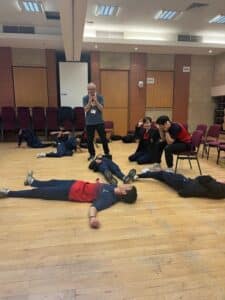
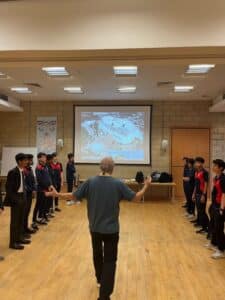
During our focus week on Tuesday 9th June, the Y10 Classics Students took part in a workshop run by the Actors of Dionysus, in which we explored two Greek tragedies and learnt about ancient Athenian culture and customs. We began with a series of engaging activities building teamwork between the group and putting us in an ancient actor’s mindset. We worked together in a game of Heracles, Lion, Omphale (Rock, Paper, Scissors), and had to focus on a game where you could not drop the beanbag.
Focused and ready, we dove into the mechanics of Greek theatre. We had some knowledge of ancient theatre but were surprised to learn that there were usually only about 3 actors playing all the roles! We then moved on to the play “Antigone” where power corrupts all. But first, we had to learn about the prequel: “Oedipus”, the iconic play where an abandoned child kills his father and marries his mother, and sets up the tragedy of “Antigone”.
After learning more about the story of Antigone, we reenacted particular moments of the story as freeze-frames, grasping the tale with motionless images. Despite the lack of any movement or voice, we almost immediately recognised every scene; even when disrupted by giggling or confusion, the tale of Antigone was captured perfectly by each and every group.
One key aspect of Classical theatre was the chorus: not the catchiest part of your favourite song, but a group of performers, who sang, danced and spoke in unison, driving the narrative onwards. We next explored how choruses interacted and moved throughout Greek theatre by reading verses straight from Antigone itself. Whether dancing, singing or moving as a team, the individual groups continued to perform with creativity and commitment.
After lunch, we began preparing for a performance of the opening of “Trojan Women” by Euripides, centred around Hekabe (or Hecuba) – the former queen of Troy- and a chorus of other women who are being shipped from Troy to be enslaved in Greece after the men had all been slaughtered in the war. We practiced segments of the play in groups for a while, before putting them all together for a full run-through of the opening of the play.
It began with a short conversation between Poseidon and Athena, the gods who had supported opposing sides during the conflict, before a short monologue from Hekabe, and a few verses from the chorus. With an array of mistakes, laughs and lessons learned, it’s hard to say things ran smoothly, but we eventually managed to perform the entire opening of the play just like ancient Athenians.
As the day drew to a close, we left after a successful, educational, and enjoyable workshop.