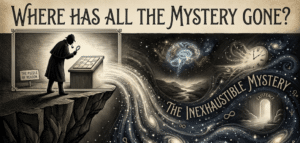
The Truth, the Whole Truth, and Something More
One of the most famous lines in detective fiction comes from Sherlock Holmes and if memory serves, it’s something along the lines of:
When you have eliminated the impossible, whatever remains, however improbable, must be the truth.
The sentence is much like Holmes himself; crisp, elegant, logical, and reassuringly confident. Faced with a baffling mystery, Holmes gathers clues, eliminates alternatives, and eventually reveals that what appeared mysterious was, in fact, perfectly explicable all along. The mystery was never really a mystery; it was simply a puzzle awaiting solution.
And what’s not to admire about such a sentiment? Well, therein lies a Column…
As a young Director I entertained dreams of becoming a great detective. I quite fancied myself gathering clues, seeing through the fog of the red herring and revealing the truth of the matter to the sounds of bafflement and applause from the assembled suspects. Sadly such things, along with many such other things have proved beyond the reach of your Director. Faced with a baffling set of clues, Holmes arrives at the truth through rigorous deduction. Faced with a baffling set of clues, your Director generally arrives at three plausible explanations, rejects the correct one, and eventually discovers that my glasses have been on my head throughout the investigation. Holmes, confronted with a perplexing situation, notices the dog that did not bark in the night. I, confronted with a perplexing situation, often fail to notice the dog, the bark, and occasionally the situation itself. But I digress…
There is something deeply appealing about Holmes’ confidence. He inhabits a universe in which everything ultimately makes sense. The impossible can be eliminated. The improbable can be identified. The truth can be known.
But the more the old tempes, fugits its way along, the more I wonder whether Holmes’ maxim has escaped the pages of detective fiction where it gloriously belongs and has now instead become one of the governing assumptions of modern life. We increasingly seem to behave as though every mystery is ultimately a puzzle in disguise. You know the idea: given enough information, enough computing power, enough data, enough scientific progress, everything will eventually yield its secrets.
In many respects, as we have discussed, this confidence has served us extraordinarily well. Modern science has illuminated vast territories that would have been unimaginable to our ancestors. Diseases have been cured, planets discovered, genomes mapped, and forces measured with astonishing precision. Ignorance has retreated on countless fronts, and humanity is immeasurably better for it. I am grateful that when I board an aeroplane, I am relying upon aerodynamics rather than optimism, and that medical procedures depend upon anatomy rather than educated guesswork. Explanation is not the enemy. It is one of the great achievements of human civilisation.
The trouble begins when we start to assume that mystery and ignorance are the same thing.
They are not.
Ignorance is what we do not yet know. Mystery is what remains astonishing even after we know.
Indeed, some mysteries seem to become more profound the more deeply we understand them.
Consider the night sky. As a very young Director I would often be found in the garden gazing upwards wondering why the stars shine. An astrophysicist can come along and explain nuclear fusion, stellar evolution, gravitational collapse, and the formation of galaxies. Yet astrophysicists are not generally characterised by disappointment that the stars have turned out to be explainable. Quite the reverse. They often sound like people who have discovered that the universe is considerably stranger than they had previously imagined.
The mystery has not disappeared. It has deepened.
And this raises a possibility that would have been deeply inconvenient for Sherlock Holmes: (whisper it quietly) perhaps some mysteries are not puzzles at all.
Perhaps they are not things to be solved but realities to be encountered.
The philosopher Gabriel Marcel drew a distinction between a problem and a mystery. A problem stands before us as an object. We can analyse it, manipulate it, solve it. A mystery is something in which we ourselves participate. We cannot stand outside it because we are already inside it.
A broken photocopier is a problem. Existence itself is not.
Which brings us to what may be the strangest mystery of all…Why is there something rather than nothing?
It is a question so familiar to philosophers that it risks sounding abstract, yet it is difficult to think of anything more concrete. Every tree, every conversation, every galaxy, every awkward staff meeting, every piece of music, every student who assures you that they definitely submitted the homework all presuppose the same astonishing fact: that there is a reality in which such things can occur.
Most of the time we are too busy navigating existence to notice the peculiar fact that existence exists. We worry about deadlines, meetings, examinations, traffic, and the increasingly optimistic assumptions made by online calendars. Meanwhile, the most extraordinary fact of all sits quietly in the background: this exists.
Friend of the Column, Ludwig Wittgenstein observed that it is not how things are in the world that is mystical, but that the world exists at all. As he wrote: Nicht wie die Welt ist, ist das Mystische, sondern dass sie ist. It is one of those statements that initially appears obvious and then becomes increasingly unsettling the longer one sits with it. Why should there be something rather than nothing? Absolute nothingness seems at least conceivable. Yet here we are, surrounded by stars, sparrows, sonnets, spreadsheets, and people arguing on the internet.
No sooner do we become accustomed to that mystery than another presents itself.
Not only is there stuff, there is somebody experiencing the stuff. Consciousness is a thing. And, dear reader, despite claims to the contrary, nobody knows where that comes from.
For all our advances in neuroscience, consciousness remains one of the most mysterious features of reality. The brain can be scanned, measured, mapped, and studied in remarkable detail. We know more about neural activity than any previous generation. And yet we are no nearer to accounting for the phenomenon of consciousness. David Chalmers frames this as the so-called ‘Hard Problem’ of consciousness. Even if we were to map out every single neuron and chemical reaction associated with seeing a sunset for example, it doesn’t explain the feeling of awe or the subjective experience of the colour of the blessed thing. The essence of the Chalmers’ problem is bridging the gap between objective matter (a chunk of brain tissue) and subjective experience (what it is like to actually be you).
Of course, between you, me and the gatepost, dear reader, there is a very short answer to the question: How does physical matter give rise to subjective experience? which is: It doesn’t. It is entirely the wrong question to ask in the first place.
If that sentence has just caused you to glance nervously at the length of the remaining column, fear not. That particular rabbit hole must await another occasion.
The mystery of consciousness is not about a gap or lack of knowledge, it’s a mystery embedded in every moment of our lives. We do not simply process information; we experience a world. There is something it is like to be conscious, and that simple fact continues to resist easy explanation.
The mystery deepens still further when we consider the curious capacities of the human mind itself. We are finite creatures inhabiting a finite lifespan, and yet we are capable of conceiving ideas that exceed anything we can actually imagine. We speak of infinity. We discuss eternity. We contemplate endless space and limitless time.
And yet none of us can genuinely picture infinity.
We can write the symbol. We can reason about it mathematically. We can discuss it philosophically. But we cannot truly imagine what an endless quantity would be like. Our minds seem capable of reaching beyond themselves, gesturing towards realities they cannot fully contain. It is rather like standing on a shoreline and realising that the horizon is simultaneously visible and unreachable.
This peculiar relationship between understanding and mystery appears throughout human experience. The more we learn, the more we discover realities that exceed our capacity to fully grasp them. A state of affairs which gets my vote.
Time is perhaps the most familiar example. We live entirely within it, yet struggle to say what it actually is. The past no longer exists. The future does not yet exist. The present moment seems to vanish as soon as we attempt to identify it. We speak of time flowing, but what exactly is flowing? And through what?
The philosopher Saint Augustine famously remarked that he knew what time was until somebody asked him to explain it. Most of us can sympathise. We organise our lives around time, complain about its shortage, celebrate its passing, and occasionally waste it spectacularly, yet the closer we examine it, the stranger it becomes.
Literature, as you and I have come to expect, has long understood this distinction between puzzles and mysteries.
A detective novel begins with confusion and ends with explanation. By the final chapter, the clues have been assembled, the culprit identified, and the mystery dissolved. We would be rather irritated if Poirot gathered everyone together in the drawing room only to announce that the crime would remain permanently inexplicable.
Great literature often works differently.
Take Hamlet. We undoubtedly understand Hamlet better at the end of the play than at the beginning. We have watched him grieve, hesitate, philosophise, love, rage, and despair. Yet does he become less mysterious? Hardly. If anything, he becomes more so. The same could be said of Lear, Anna Karenina, Sethe (from Toni Morrison’s Beloved), or Mrs. Dalloway. We do not finish these works feeling that the characters have been solved. Rather, we feel that we have encountered depths we had not previously noticed.
Human beings, it turns out, are not crossword clues.
This becomes particularly apparent in our relationships. One of the more curious assumptions of modern culture is that sufficient information will eventually make everything transparent. Yet anyone who has spent many years with another person knows the opposite. The better we know people, the more we appreciate both their familiarity and their inexhaustibility. Understanding and mystery grow together.
Indeed, some of the most meaningful experiences in life seem to involve precisely this sense of encountering something that exceeds our descriptions of it. People have reported such experiences in music, literature, nature, prayer, art, and moments of profound silence. Different traditions describe these experiences differently, but they share a common feature: those who have them often insist that they are simultaneously real and impossible to put into words.
One hesitates to speak too grandly about such things. The modern British instinct is generally to apologise if reality becomes too meaningful. Yet it is difficult to ignore the persistence of these experiences across cultures and centuries. There appears to be something in human beings that responds to mystery not with frustration but with wonder.
Perhaps that is because wonder is not the enemy of knowledge but its companion.
Newcomer to the Column, Albert Einstein wrote in his 1931 essay, The World As I See It:
The most beautiful experience we can have is the mysterious. It is the fundamental emotion that stands at the cradle of true art and true science. Whoever does not know it and can no longer wonder, no longer marvel, is as good as dead, and his eyes are dimmed.
Similarly, the biologist J. B. S. Haldane observed that the universe is not only queerer than we suppose but queerer than we can suppose. The more deeply we investigate reality, the more reality exceeds the categories we bring to it.
And of course this sense is precisely why your Director remains steadfastly unconvinced by the notion that education is fundamentally the process of removing mystery from the world. At its best, education does something much more interesting. It replaces shallow mysteries with deeper ones. A good education turns us away from being bad detectives looking for easy culprits, and turns us instead into wonder-filled observers
A child wonders why the stars shine.
A student learns about nuclear fusion.
An adult looks up at the night sky and finds that the question has not disappeared but expanded.
The same pattern repeats itself everywhere. The more we learn about consciousness, the more remarkable consciousness appears. The more we learn about language, the more astonishing it is that meaning can be communicated at all. The more we learn about time, the stranger time becomes. The more we understand other people, the more aware we become of the depths that remain beyond our grasp.
So where has all the mystery gone?
Perhaps nowhere.
The mystery of being remains. The mystery of consciousness remains. The mystery of time remains. The mystery of infinity remains. The mystery of those moments of beauty, love, meaning, and transcendence that seem to disclose more than they explain, remains.
Perhaps, then, the question is not where all the mystery has gone but whether we have become less attentive to it. We live amid extraordinary realities so continuously that we mistake familiarity for understanding. We become accustomed to consciousness, to language, to other people, to the passing of time, and to the astonishing fact that there is a world at all. Yet none of these things becomes less remarkable simply because we encounter them every day. If anything, the opposite is true. The closer we look, the stranger they become. The challenge is not to recover mystery, as though it had somehow wandered off and misplaced itself, but to recover our sensitivity to it; to notice once again what children notice instinctively and philosophers spend entire careers attempting to articulate.
The danger is not that mystery has vanished from the world. The danger is that we have become so accustomed to explanations that we mistake them for replacements. Explanation is one of humanity’s greatest achievements, but it is at its best when it deepens wonder rather than displacing it. Education, science, literature, philosophy and art all begin from the same impulse: not to make reality smaller and more manageable, but to encounter it more fully. Reality, after all, is not merely intelligible, which is remarkable enough, it is inexhaustible.
Sherlock Holmes was quite right. Once we eliminate the impossible, whatever remains, however improbable, must be the truth. The delight, however, is that some truths turn out to be far more mysterious than the puzzles that led us to them in the first place.
Until next time, Happy Reading/ being mysterious!
Director’s Detritus #73
The Inexhaustibility of Pi: The number 𝜋 (Pi), used to calculate the area of a circle, is irrational (it never ends and never repeats) and transcendental (it is not the root of any non-zero polynomial obvs). In 2021, a supercomputer calculated 𝜋 to 62.8 trillion decimal places. And yet, scientists have confirmed that if you wanted to measure the observable universe to the precision of a single hydrogen atom, you would only need to know 𝜋 to a mere 39 decimal places. Alll those trillions of digits are practically useless to humanity, serving only to confirm that even the simplest, most foundational numbers in mathematics are, themselves, inexhaustible mysteries.