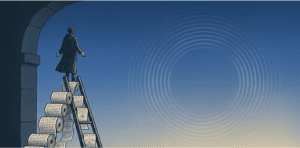
Now what? anon, circa just now
Least said, soonest attended
As a young Director I remember being immensely struck by the final line of Wittgenstein’s Tractatus Logico-Philosophicus which is: Whereof one cannot speak, thereof one must be silent.
The suggestion here is that attempting to speak about the unsayable is about as useful as putting wheels on a tomato.
Immediately before this, Wittgenstein declares his own propositions as being nonsensical, describing them as a ladder to be thrown away after it is used to get you up where you need to be. Philosophy therefore is seen as a tool to reach a point of clarity. Once you reach that point, you don’t need the tool and it’s pointless to hold on to it. Or to put it another way, there is a particular liberation in realising that one does not need to carry the architecture of the argument once the view has been attained. On this point, Wittgenstein keeps rather distinguished company.
In the Alagaddupama Sutta the Buddha tells his monks that his teachings (the Dharma) are to be used to cross the river of Samsara (suffering and delusion) in order to reach Nirvana (liberation). But he explicitly warns them not to cling to the teachings themselves. The Buddha says, Thus, monks, you must understand that the Dhamma is similar to a raft, intended for crossing over, not for grasping.
Both Wittgenstein and the Buddha, then, seem to circle around the same insight: that language, doctrine, and even philosophy itself are provisional. They point; they do not possess. They indicate; they do not contain. And perhaps most importantly, they must give way. Related to this is the Mahayana concept of Upaya (Skillful Means), which suggests that doctrines are adaptable tools suited to the learner’s level, and that higher truths often require abandoning the literal interpretations of lower ones. It is tempting to see here a rather venerable precursor to our modern preoccupation with ‘adaptive teaching’, though with a slightly more austere end point: not merely that the teaching fits the learner, but that the learner eventually outgrows the teaching altogether. Or, as the early twentieth-century educational theorist Thomas Carruthers is said to have put it, a teacher is one who makes themselves progressively unnecessary. An ambition which, depending on the day, feels either deeply noble or mildly alarming. What unites these perspectives is the recognition that understanding cannot be fully contained within the words or structures that first give rise to it. To my eyes, such teachings are attempts to protect the importance of the unspoken.
With your indulgence, then, dear reader, I shall deploy a few paltry words in the general direction of the unsayable.
If nothing else, I think we can agree that we are creatures of language. Much of our time is spent naming, defining, and categorising. It is no coincidence that in the Book of Genesis once the business of world-making is finished (in some sense), God brings all the animals to Adam and asks him to name them. In the story this is not just an exercise in taxonomy but the beginning of a journey towards understanding of how we relate to the universe.
The problem of course is that in the business of naming we create the reassuring impression that the world has been neatly parcelled into manageable units. If it has a name, it must be understood. If it can be explained, it must be mastered. Beneath this lies a particular picture of knowledge: that it is something we can fully articulate, delimit, and therefore possess. But this picture leaves little room for those forms of understanding that are tacit, intuitive, or inarticulate. Precisely the forms which you will agree dear reader, may be the most fundamental of all.
As anyone who has tried to describe grief, or indeed love, will know, language has its limits. The most important aspects of human experience seem always to lie just beyond its reach. We gesture towards them, circle them, approximate them, but they resist capture. They remain, stubbornly, themselves.
The poet T.S. Eliot understood this well. In Four Quartets he writes: Words strain, / Crack and sometimes break, under the burden… Language, here, is not a transparent medium but a fragile vessel, liable to fracture under the weight of what it is asked to carry. Similarly, Samuel Beckett, whose characters often speak in order to fill a silence that they cannot bear, once wrote: Every word is like an unnecessary stain on silence and nothingness. You sense in Beckett not merely a frustration with language, but a kind of suspicion. Words do not simply fail to capture reality, they actually may obscure it.
This suspicion is not confined to our modern existentialists. We see it in the Negative Capability of John Keats which we have discussed in previous Columns, namely the ability to exist within a mystery without an irritable reaching for certainties. To Keats, and perhaps to the best of us, the most beautiful part of a poem is the resonance it leaves in the air after the final words are read. The words are merely the strike of the flint. The glow happens in the dark and the silence that follows. In many ways, a great poem, theatrical performance, or piece of music exists to make possible the moments of silence that follow. In that silence, meanings are born.
It is perhaps in literature that this tension between the said and the unsaid is most fruitfully explored. Good writing is not, as one might suppose, the art of saying more and more, but often the art of leaving things unsaid. Consider Jane Austen, whose novels are masterpieces not only of dialogue but of omission. In Pride and Prejudice, entire emotional landscapes are conveyed through what is not articulated. A pause, a hesitation, or a carefully avoided phrase speaks volumes.
And of course our old friend Virginia Woolf also seeks to portray the luminous halo of life, that flicker of consciousness that escapes formal narrative. Or we might turn to Ernest Hemingway and his famous ‘iceberg theory’, according to which the bulk of meaning lies beneath the surface; the visible text supported by an invisible depth. In drama too, silence can be the most eloquent element of all. I think of the pauses in Harold Pinter, those pregnant silences in which meaning accumulates rather than dissipates. A Pinter pause is not an absence of communication, but its intensification.
I hope it is not too much of a Director stretch at this waypoint of the Column to suggest that all meaningful communication depends on what remains unspoken. Which is of course why I take a certain pride in all the dazzlingly brilliant things I have never actually said.
If everything were spelled out, there would be no room for the reader, the listener, or the other. It’s not just that brevity is elegant, or that mystery is fashionable, but something rather more fundamental about how understanding itself works. Communication is not the transfer of a finished object from one mind to another, like passing a parcel across a desk. It is, rather, a collaborative act, something more akin to a meeting.
When everything is made entirely explicit; every motive explained, every implication unpacked, every ambiguity resolved, the reader is left with nothing to do. There is no interpretative work required, no imaginative participation invited. One is not so much engaged as processed. The experience becomes oddly inert. You might call it complete, perhaps, but lifeless might be the better word.
By contrast, when something is left unsaid, when there is a pause, a gap, a silence, it creates a space into which the reader or listener must step. Meaning is not simply received; it is realised. We infer, we intuit, we supply connections, we feel our way into what is being suggested rather than stated. And in doing so, we become, in a small but significant sense, co-authors of the meaning.
This is why suggestion so often proves more powerful than declaration. A half-finished thought can linger in the mind far longer than a fully resolved one, precisely because it continues to unfold within us. What is withheld is not absent; it is active.
There is also, I think, an ethical dimension to this. To leave room for the other is to acknowledge that they are not merely a passive recipient of our words, but a presence with their own perspective, their own freedom, their own capacity to see. To spell everything out is, in a way, to pre-empt them or to deny them the opportunity to respond, to interpret, to bring themselves into the exchange.
In this sense, restraint is not a failure of expression but a form of generosity. It trusts the other to meet us halfway. It recognises that meaning does not reside wholly in what is said, but emerges in the space between what is said and what is heard.
And perhaps this is why the most memorable conversations, like the most memorable works of art, are not those that leave us with nothing more to think about, but those that leave us with something still to discover.
Philosophy, too, has long grappled with this paradox. The later Wittgenstein, in his posthumously published Philosophical Investigations, moves away from the austere silence of the Tractatus and towards a more humane recognition of the messiness of language. Meaning, he suggests, is not a matter of strict logical correspondence but of use. And yet even here, there remains an acknowledgement that not everything can be neatly articulated. Some things can only be demonstrated, enacted, or lived.
The philosopher Martin Heidegger takes this further, arguing that language is the house of Being itself. And yet, for Heidegger, the most profound truths are those that are most deeply disclosed through poetry rather than conventional statement. Similarly, the negative theology of figures such as the 5th-century Christian theologian and Neoplatonic philosopher Pseudo-Dionysius the Areopagite, who was (according to some accounts) runner-up in the 496 Most Names for a Philosopher competition, suggests that the divine can only be approached through negation. One says what God is not, precisely because any positive statement risks reducing the infinite to the finite. This is not unlike the way I am told, a sculptor works; they do not create the statue so much as they remove everything that is not the statue. Silence, here, is not ignorance but reverence.
At this point, the sceptical reader might reasonably object that all this talk of the unsayable is itself suspiciously verbose. If the point is that some things cannot be said, why all the words?
The answer lies in the idea of indirection. We do not speak the unsayable directly, because we cannot. Instead, we gesture towards it. We create conditions in which it might be glimpsed. This is what metaphor does. It does not define; it illuminates. It is a linguistic equivalent of Wittgenstein’s ladder: useful, but ultimately disposable.
And it is also what education, at its best, seeks to do. There is a temptation to believe that knowledge consists in the accumulation of explicit statements: facts, definitions, and formulae. These are, of course, important. But understanding often involves a tacit dimension, a kind of knowing that cannot be fully articulated. The philosopher Michael Polanyi famously expressed this as ‘we know more than we can tell’.
A skilled teacher, like a skilled writer, recognises this. They do not merely transmit information; they curate the conditions for an epiphany. And sometimes, this involves restraint. There is a moment in many classrooms when the most valuable thing a teacher can do is not to speak. To allow a silence to open. To resist the urge to fill it. In that silence, something may happen that no amount of explanation could produce.
We have all experienced moments in which words feel either inadequate or inappropriate. A bereavement. A moment of profound joy. An encounter with beauty. In such moments, language can feel like an intrusion, a flattening of something that ought to remain whole. And yet, paradoxically, it is often through shared silence that we feel most connected. To sit with another person without the need to speak is no small achievement. It suggests a mutual understanding that does not require articulation.
In a culture that prizes constant communication, constant expression, and constant noise, this can feel almost radical. The idea that silence might not be a void to be filled, but a space to be honoured, is not one that sits easily with us. And yet, perhaps, it should.
None of this is to suggest that language is unimportant. On the contrary, it is the medium of our humanity. But it is not everything. To recognise the limits of language is not to diminish it, but to place it in its proper context. It is to see it as one tool among others, one ladder among many, one raft among several. And, crucially, it is to know when to let it go.
Which brings us back to Ludwig Wittgenstein. Whereof one cannot speak, thereof one must be silent is a line so often repeated that it risks becoming a cliché in its own right. Yet to treat it simply as an injunction to say less is to miss its force. The point is not silence for its own sake, but a more exacting form of attention: an awareness that language does not exhaust what it refers to, and that meaning often resides precisely at its edges. It is, in that sense, less a prohibition than a redirection of focus. And perhaps it suggests that occasionally, we should have the good sense to stop talking.
On that note, and to collective sighs of relief all round, your Director will now endeavour to do so.
Until next time, Happy Reading/ Shhh!
The Director’s Detritus #10
The anechoic chamber at Orfield Laboratories in Minnesota is so quiet that the background noise level is measured in negative decibels (−9.4 dBA). In total silence, the human ear becomes the primary source of sound; visitors can eventually hear their own lungs moving, the rushing of blood in their veins, and even the high-pitched “hiss” of their own nervous system. Most people cannot endure more than 45 minutes inside before the sensory deprivation causes hallucinations. Your Director, on the other hand, sees such a chamber as something of an idyllic holiday destination.