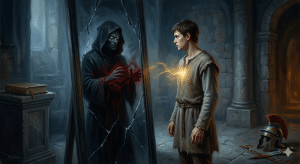
You Looking at Me? 2026, Anon
Let me tell you a story…
It begins with an orphan who believes himself to be entirely ordinary. He lives with an aunt and uncle, leads a life of mild obscurity, and has no particular reason to suspect that destiny has taken an interest in him. Until, of course, it does. One day, he discovers that he is not only extraordinary, but perhaps the most extraordinary person who has ever lived. With the help and guidance of a wise old mentor, he learns to harness his gifts, confront a great evil, and, in due course, save the world.
It is, I suspect, a story you have heard before. Many several times over the years. Take Harry Potter, for example or the uncannily similar Ged from the Wizard of Earthsea. You could add to these two, the eyewateringly lucrative franchise stories: Star Wars and Spiderman, a couple of my favourite examples of the same story.
And wouldn’t you know it, the familiar pattern of this story has a name: The Hero’s Journey, also known as the Hero Archetype.
Your Director has been much given to thinking about the hero archetype over the last week. Across my classes, it seems I have been circling the same idea from multiple directions. Not an easy thing for a man of my very limited flexibility these days. But nonetheless.
My A Level students have been wrestling with the provocative suggestion that Satan is the actual hero of Milton’s Paradise Lost story of Adam, Eve and the Fall. Such an idea stems from our friends the Romantics, in particular William Blake who thought that since Milton was a true artist he could not help but be of the Devil’s party without knowing it. My Year 9 students are grappling with the collapse of the hero in Othello, trying to decide whether tragedies can meaningfully sustain heroism at all. My Year 10s and 11s, immersed in Power and Conflict poetry, are encountering figures who look very little like traditional heroes; isolated, traumatised, and often quietly broken. Meanwhile, my Year 8s, studying Julius Caesar, are discovering that Shakespeare, being Shakespeare, cannot stop himself from complicating matters by distributing the heroic qualities across not one, but three figures: Brutus, Caesar, and Mark Antony.
There’s a grand literary question here which of course means it is deeply human at the same time: why are we so obsessed with this hero figure? Why does every generation, around the firesides of ancient Greece and the surround sound of the IMAXes today, insist on telling and retelling the same story?
Permit your Director a few paltry words on the matter.
To begin to answer this question (and of course many others), it helps to look beneath the surface of plot and into the workings of the human mind. The Swiss psychiatrist Carl Jung proposed that we share what he called a collective unconscious, by which he was referring to a deep reservoir of inherited patterns and images, which he termed archetypes. The Hero is among the most powerful of these. For Jung, the Hero represents the ego’s search for identity, meaning, and wholeness. We are drawn to the Hero not simply because we admire them, but because we recognise something of ourselves in them, or perhaps something we might become, if we were a little braver.
Jung’s ideas were later developed by Joseph Campbell, whose The Hero with a Thousand Faces identifies what he calls the ‘Monomyth’: a universal narrative structure underpinning stories across cultures and centuries. Whether we follow Odysseus across the wine-dark sea, Katniss Everdeen into the arena, or Frodo Baggins toward Mount Doom, the broad pattern is strikingly familiar. There is a Call to Adventure, a Crossing of the Threshold, a series of Trials, an Ordeal, and, finally, a Return (often with some form of elixir, a hard-won insight or gift brought back to the world).
So far, so reassuring. The structure is elegant, the pattern recognisable and the outcome more often than not, is lovely and uplifting.
But of course there’s a catch, and it is one my students are currently navigating with admirable persistence. Contrary to appearances and often our own plans, the journey is not, at its core, about defeating an external monster. What it’s really about is confronting and dealing with the internal one.
Sometime friend of the Column and troubled genius, Nietzsche, never one for understatement, suggests that what we call ‘morality’ is sometimes not much more than a polite word for cowardice. We like to think of ourselves as ‘good’ because we do not do bad things. But, as Nietzsche might point out, it is not especially virtuous to refrain from wrongdoing if one lacks the capacity, or the courage, to do otherwise. The sheep is not ‘virtuous’ because it doesn’t eat the lion; it just has neither the inclination nor the necessary equipment.
This pushes the understanding of the whole business a little further by raising another question: what if genuine virtue requires not the absence of darkness, but the capacity for it? What if the truly moral individual is not the one who has no shadow, but the one who has learned to live with it?
This is where Jung’s notion of the Shadow becomes particularly useful. Jung writes about how the Shadow represents those aspects of ourselves that we would rather not acknowledge: our aggression, our selfishness, our envy, our capacity for harm. In other words, it’s the monster within.
At this point it may be worth addressing the female elephant in the room. The version of the Hero we have inherited is, more often than not, a conspicuously male one. The ‘ordinary boy’ who discovers his destiny has had a remarkably long run of things. This is not simply a question of representation, but of emphasis. The traditional hero archetype tends to privilege conquest, assertion, and outward victory which are qualities historically coded as masculine. Yet many of the most compelling modern stories complicate this picture, offering figures for whom the journey is less about domination and more about relationship, endurance, or understanding. If the Hero’s Journey is ultimately about integration, then it may be that the fullest version of the archetype is not exclusively male at all, but human, requiring the reconciliation of qualities we have too neatly divided between the two.
But that being said, the great hero stories endure because, at their best, they dramatise the encounter with the monster inside us all.
Warning! Spoilers Ahead!
Harry Potter for example, cannot defeat Voldemort without recognising that he carries a fragment of him within. Ged spends an entire novel fleeing a shadow creature, only to discover that it is himself. In the story his naming of the creature is the first step toward becoming whole.
Time and time again, we see that the hero is not heroic because he is spotless, but because he is integrated. He has teeth and claws, and chooses deliberately, and often with difficulty, not to use them destructively.
There is, perhaps, an older word for this kind of strength. In the Beatitudes, we are told that the meek shall inherit the earth. This is a phrase which, in certain modern settings such as the manosphere, can sound suspiciously like an endorsement of weakness and a massively naive tactical error. Yet it is nothing of the sort. The Greek word often translated as ‘meek’ is praus, which refers to a sword in a scabbard or a powerful warhorse brought under control. So meekness is best understood not as passivity, but restraint. It is power held in check; strength that does not need to announce itself. The meek are not those without teeth, but those who have them and quietly choose not to bite.
These ideas have been playing out, in various guises, in classrooms across the school this week.
Take Othello. At the start of the play, Othello appears to embody the classical heroic ideal: composed, articulate, and assured. Yet there is a sense in which his apparent perfection conceals a dangerous absence. He has spent his life performing the role of the ‘noble soldier,’ and in doing so, has never quite learned to recognise or manage his own darker impulses. When Iago, who can be read as a kind of externalised Shadow, begins to whisper, Othello has no internal framework with which to resist. He does not recognise jealousy in himself, and so cannot control it. The result is not simply tragedy, but collapse. The hero falls, not because he is corrupt, but because he has refused to acknowledge his own shadow.
A similar fragmentation is visible in Julius Caesar. Brutus possesses honour and principle, but lacks the ruthlessness required to act effectively in a political world. Antony, by contrast, demonstrates formidable rhetorical skill and strategic cunning, but is not obviously guided by moral restraint. Caesar himself, meanwhile, has begun to drift toward something resembling divinity, dangerously convinced of his own invulnerability. Shakespeare seems to suggest that when these elements of honour, power, and self-awareness are separated rather than integrated, the result is instability. A society, like an individual, may depend upon a kind of internal coherence.
And then, of course, there is Milton’s Satan. It is not difficult to see why the Romantics found him compelling. He is energetic, articulate, and defiantly individual. In a world that often appears to demand conformity, his declaration that it is Better to reign in Hell than serve in Heaven can sound uncomfortably like a manifesto for self-determination. He is, undeniably, a villain. But he is a villain who moves with the energy of a hero. That, perhaps, is precisely what makes him so dangerous.
It is this very difficulty of the psychological cost of carrying one’s own darkness, that our Year 10 and 11 students are currently unpicking in the AQA Power and Conflict anthology. By the time we reach modern voices like Simon Armitage, the hero archetype has been subjected to a sustained and brutal scrutiny. In his poem Remains, we see the potentially ‘heroic’ act of a soldier killing an enemy looter in a zone of conflict, completely stripped of its epic veneer. In the poem Armitage gives us a literal, modern manifestation of the Jungian Shadow. He writes of the blood-shadow that stays on the street and, more devastatingly, in the soldier’s mind.
This isn’t just a clever metaphor; it is a bridge across two centuries of thought. It connects 19th-century psychology to 21st-century grit. The blood-shadow is the unintegrated element of the self. It is the ‘monster’ that was summoned for duty but cannot be dismissed once the uniform is taken off. The poem ends not with a medal or a parade, but with the harrowing realisation that the hero must face a darkness that nothing can dispel.
The whole tone contrasts sharply with Tennyson’s The Charge of the Light Brigade, where we see the vestiges of the older heroic ideal: courage, obedience, and collective identity. It is stirring, certainly, but even there, it is shadowed by the quiet acknowledgement that the charge itself was the result of a blunder. In both poems, whether through the Victorian lens of collective sacrifice or Armitage’s raw individual trauma, heroism is shown to be inseparable from its cost.
At this point, it may be tempting to ask why we persist in exposing students to such unsettling material. Why not remain with the simpler narratives, in which good and evil are clearly delineated and the hero’s victory is unambiguous?
Because life, rather inconveniently and at the same time, thankfully, refuses to follow the script.
Our students, whether they realise it or not, have already set sail upon their own versions of the Hero’s Journey. They are moving from the relative simplicity of childhood toward the more complex terrain of adulthood. Along the way, they are encountering not only external challenges, but internal ones. They are discovering that they are capable of kindness and cruelty, diligence and indifference, generosity and selfishness. In other words, they are discovering their Shadow.
The task of education, it seems to your Director, is not to persuade them that this Shadow does not exist, nor to encourage them to suppress it entirely. It is to help them recognise it, understand it, and, ultimately, integrate it. To borrow again from A Wizard of Earthsea, the goal is not to destroy the shadow, but to name it, and, in doing so, to become whole.
This is why we read these texts. Not because they offer easy answers, but because they ask the right questions.
We might hope that our students develop something of Brutus’s integrity, Antony’s eloquence, and Othello’s resilience. But we also hope that they acquire the self-awareness that those figures, at crucial moments, lack something. We want them to understand that being a hero is not about perfection, nor even about success in the conventional sense. It is about coherence. It is about the ongoing, often uncomfortable process of becoming a person who can hold together strength and restraint, ambition and humility, power and responsibility.
As this term, like all the others, continues to unfold its merry way, I hope our students continue to recognise themselves in the stories they study. I hope they begin to see that the Call to Adventure is not confined to distant lands or fictional worlds, but occurs in quieter forms each day; in the decision to attempt something difficult, to persist after failure, to act with integrity when it would be easier not to. For the sake of all the teachers out there, the wise mentor, I should add, does occasionally take the form of the person standing at the front of the classroom, though in the case of your Director, I would be the first to admit that the resemblance is, at times, wholly imperfect.
After all, the most extraordinary thing about being human may be this: that we are all, in our own way, the ordinary person who discovers that they might change the world if only they first have the courage to face themselves.
Until next time, Happy Reading!/Being a Hero
Director’s Detritus #6
The Spartan ‘Meek’: The concept of ‘power held in check’ was a literal military discipline for the Spartans. They were famously taught to speak in laconic phrases i.e.short, sharp, and minimalist, because they believed that a man who could control his tongue was more likely to control his sword in the heat of battle. Go Spartans!