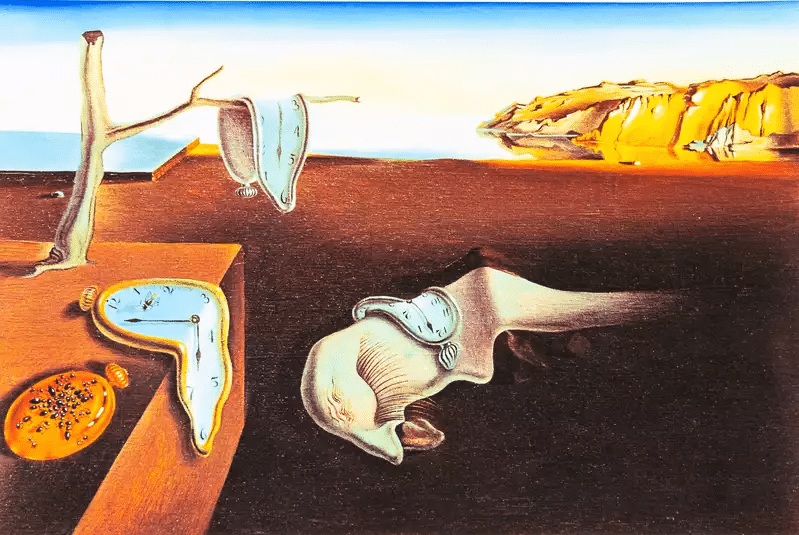
Salvador Dalí, The Persistence of Memory (1931)
Now then
In 1964, Mick Jagger and chums gave us their first top ten smash Time is on my side. And if the longevity of the stoney rollers is anything to go by, he was right. This week your Director has been much preoccupied by Time with a capital T. And so I thought why not spend a few paltry words on the subject; what it is, where it is and of course when it is. Hopefully I won’t take up too much of yours.
I am fortunate indeed to be currently teaching Macbeth, which is a play much preoccupied with the strange elasticity of Time. As Frank Kermode points out, it begins with all sorts of shenanigans around ideas of the present and the future. The weïrd sisters open the play with a question: When shall we three meet again? / In thunder, lightning, or in rain? This seems to offer a choice but of course such a choice is illusory. Where there is thunder, there’s often lightning and where there’s thunder and lightning there’s often rain. The Sisters continue with When the hurly-burly’s done, When the battle’s lost and won… but certainly in my experience, where there’s a hurly there’s a burly and a battle lost is also a battle won. From the beginning of his play, Shakespeare is exploring how we are affected by our understanding of what it means to be in Time as well as our desire to feel the future now and so be transported beyond the ignorant present as Lady Macbeth feels she has been when she hears about the ‘prophecies’ for her husband. When Macbeth asks the Sisters, what are you? they reply by telling him what he will be. Macbeth himself is eventually lost in this ‘future-now’ world, famously left in his meaningless loop of Tomorrow, and tomorrow, and tomorrow.
Shakespeare is not alone in imagining this temporal trap. In Mikhail Bulgakov’s masterpiece The Master and Margarita, Pontius Pilate is condemned to wash his hands for eternity, endlessly replaying the moment he handed Jesus over to be executed. Like the sleepwalking, handwashing Lady Macbeth, Bulgakov’s Pilate is left suspended in a perpetual now, unable to move forward or find peace.
Speaking of washing hands reminds me of Augustine’s famous thought about Time: What then is time? If no one asks me, I know. If I wish to explain it to one that asks, I know not. Trying to pin down what Time is means it slips away like water between the fingers. By the time you finish saying ‘now,’ it’s already ‘then’. The handwashing Pilate of Bulgakov is caught in this paradox eternally: the present moment fixed in place, yet always already past.
Virginia Woolf captures this brilliantly in Mrs Dalloway, where Clarissa moves through a single day in London, but her now is constantly interrupted by memories, associations, and half-formed future hopes. The present moment is less a solitary point than a web. Woolf knew, as neuroscience confirms, consciousness is temporal: we can’t have now without then and next.
T.S. Eliot speaks often of the layered rather than linear nature of Time. In The Waste Land, for example, a pub conversation collides with Sanskrit scriptures and medieval ballads. The poem’s meaning emerges not from any isolated fragment but from the intricate interplay of temporalities. The ‘present’ does not stand alone but is always haunted by echoes of the past, and anticipatory shadows of the future.
Literature is indeed packed full of reminders that this thing called Time is what gives life its drama and its sense of possibility. From Odysseus’ journey home mattering precisely because of its long delay, to Proust dipping his madeleine in a cup of tea and being hurled backwards decades in an instant. Shakespeare, as we have seen, likes to get in on this temporal act, playing with ideas of duration in everything he writes. For example, there’s Hamlet complaining How weary, stale, flat, and unprofitable seem to me all the uses of this world to give voice to how time drags in melancholy, and there’s Juliet wanting time to gallop apace so her night with Romeo arrives more quickly. And then there’s the oft-quoted monologue in As You Like which is practically a meditation on the stages of life as temporal markers:
All the world’s a stage,
And all the men and women merely players;
They have their exits and their entrances;
And one man in his time plays many parts…
I suppose the thing that might make time a tricky business is not that time passes, but that we so often try to step outside it like poor Macbeth. We’re straining to feel the future in the instant, and so losing the present altogether.
This loss of the now is, of course, where the philosophers step in…
For our friend Heidegger, human beings are being-in-time, always already thrown into a temporal flow. We cannot experience a moment in isolation, nor can we fully grasp the past or the future except as they relate to the present. Every now is inseparable from what came before and what may yet come. He also, perhaps somewhat less cheerily, suggests that to be human is to be being-toward-death or in other words, that our finitude, the very fact that our time is limited, is what gives shape and urgency to our whole existence. Far from being an enemy, time is the very horizon against which life comes into focus. Without the shadow of an ending, our beginnings would blur into nothingness. Kierkegaard, with his characteristic irony, observed that life can only be understood backwards but must be lived forwards. Not for nothing is dear old Søren considered by some to be the first existential philosopher.
Iain McGilchrist, as we have come to expect, makes a similar point in his own way. He argues that the left hemisphere way of attending to the world tends to treat time as something to be captured, frozen and turned into a snapshot. The right hemisphere attention, by contrast, experiences time as a continuous unfolding flow; the lived now in which music, poetry, and relationship make sense. Think of listening to a symphony: its meaning is not in a single note isolated on the page, but in the way notes flow into one another. Chop up the melody, and the music dies. In the same way, chopping up our lives into a static seemingly endless series of points, we risk losing the melody of living. And as Eliot might have said, nobody really ought to measure out their lives in coffee spoons.
In much the same way, if we chop up our institutions into a static, seemingly endless series of deadlines and data points, we risk losing the melody of living together. Many an earnest administrator believes that what really matters can be measured, that if you collect enough spreadsheets and KPIs you will arrive at truth. But the success of a school, or any institution worth its salt, lies not in the accumulation of figures but in the quality of relationships that grow within it. These cannot be quantified, however many boxes you tick. Indeed, by worshipping the data, we mistake the pointing finger for the moon and miss the very thing that makes the whole enterprise worthwhile: the trust, laughter, and shared purpose that are only ever found in the flow of time lived with others.
It is perhaps no surprise but still a sadness, that we inhabit a world increasingly dominated by data centres: vast, humming cathedrals to information, expensively cooled, endlessly backed up, and promising insight, efficiency, and order. Indeed we are meant to celebrate the news that more and more will be built in the coming years. For all their sophistication, they are no Camelot. No server rack will inspire loyalty, no algorithm can nurture trust, and certainly no dashboard will generate the laughter or camaraderie that binds colleagues together. Just try putting the nuances of a whispered encouragement, the spontaneous sigh over a deadline, or the shared delight at a minor triumph into a spreadsheet or wellbeing survey. I would love to know how you get on.
Sadly, in many organisations it seems as though the true purpose of human beings has been reduced to nodes feeding information into systems. Meetings become scorecards, interactions become metrics, and the texture of experience is flattened into pie charts. All the while, the melody of collective life; the coffee-room conversation, the shared joke over a printer jam, the quiet moment when a colleague is simply listened to, quietly fades into silence. Our own clichés betray this left-brained attention to the business of living. We talk of ‘killing time’ and ‘saving time,’ though neither is possible. We ‘waste time’ as though it were a bank account, and yet some of our most treasured memories come from hours that were, in utilitarian terms, utterly wasted: staring at the sea, listening to music, talking nonsense with friends, or indeed, writing silly Columns.
Time, it seems, is not a fixed commodity but a deeply subjective experience. And of course, it is relative too. Even the great physicist Albert Einstein recognised this. When asked to illustrate the relativity of time, he reportedly said, Put your hand on a hot stove for a minute, and it seems like an hour. Sit with a pretty girl for an hour, and it seems like a minute. That’s relativity. There are those who might wince at such a comparison today; social attitudes, like our experience of time itself, are not fixed. What was said in one era may strike a different chord in another; and, in keeping with the theme of this column, it is worth noticing how context shapes our perception, even decades later. Einstein’s point remains, of course: the subjective experience of time stretches and contracts depending on circumstance, feeling, and perspective.
Enter another physicist: Lee Smolin. Unlike many of his colleagues who seek to reduce time to an illusion or a by-product of deeper laws, Smolin insists that time is not only real but the most real thing. The passage of time; the felt flow from past to present to future, is not an emergent trick but the fundamental texture of reality itself. If he is right, then those who treat the now as somehow secondary, a mere by-product of timeless equations, have it upside down. The now, and the flow into which it opens, is what is most true.
It is striking that a physicist, of all people, should remind us of this. We often think of science as stripping away our subjective experience, revealing a cold, mechanistic clockwork beneath. Smolin suggests the opposite: that our lived experience of time’s passage is not a delusion to be explained away, but a clue to the deepest truth of the universe. In this he stands with the poets and mystics. As all good scientists do. If Smolin is right, time’s elasticity is not a flaw in perception but a window into what Time actually is: not a rigid container, but a dynamic flow.
It also explains why children are so often better philosophers than we are. To a child, an afternoon of my lessons can feel like a lifetime whilst summer holidays stretch into an endless golden season. Grown ups can look back in envy and say that time speeds up as you get older. Perhaps it does. Or perhaps we simply lose the ability to inhabit now with the same intensity.
All of this circles back to the theme of context which we discussed when we were last together. The now does not exist in splendid isolation. It is shaped by what comes before and after, by the story we tell. A single sentence can mean opposite things depending on its context. A gesture can wound or heal depending on when it happens. A silence can be awkward, or reverent, or comforting. In the same way, a moment in time only has its significance because of the narrative thread in which it sits.
Woolf’s Clarissa, Shakespeare’s Juliet, Beckett’s tramps, they all remind us that Time is lived as story. Smolin, to your Director’s non-scientific and feeble understanding, seems to agree: reality itself is not a frozen block of timeless laws but a narrative unfolding. If so, then perhaps the task of life is not to flee from Time into some imagined timelessness, but to learn how to live well in the flow; to play our part in the story, with all its beginnings, endings and indistinguishable in betweens.
Good friend of the Column, Jorge Luis Borges, writes of this with his usual devastating simplicity:
Time is the substance I am made of.
Time is a river which sweeps me along, but I am the river;
It is a tiger which destroys me, but I am the tiger;
It is a fire which consumes me, but I am the fire.
What is my now as I write these paltry words? Well it is, and is so increasingly as my summer turns to autumn, to hear at my back …time’s wingèd chariot hurrying near. So let me hasten to my ending…
The now is no disassociated slice of Time served up in some eternal edition of The Great British Bake Off. It is the very heart of reality. It slips through our fingers and yet contains us entirely. To notice it, to honour it, perhaps even to waste it, well that might be wisdom.
Until next time: Happy Reading / Being in time
Answer to last week’s Fun problem to solve
When Henry Ford interviewed a candidate for a senior position in his company he often took them out to lunch and ordered soup for them. Why?
If the candidate added salt/pepper to the soup before tasting it, he concluded they were the type of person who would act before finding out if there was any need, and so wouldn’t hire them.
This week’s fun question to answer:
What should Donald Duck have been called?