Elementary, My Dear Director
Over the summer your Director briefly found himself bookless on a Balearic island. EasyJet’s luggage weight limitations caused the usual dilemmas: reading material versus beachwear. I am somewhat embarrassed to admit that vanity triumphed over virtue, and my desire to look good on the golden sands took priority over my need to catch up on reading. I am a believer in the triumph of hope over experience, as you know…
And so it came to pass that after four days in glorious sunshine, I had finished the few volumes I’d managed to squeeze into my carry-on bag.
And so the hunt began. I scoured the holiday apartment in hope of discovering the hidden cache of books left by previous guests. After checking every obvious shelf and drawer, I finally espied a cupboard high above the cleaning materials. You can, dear reader no doubt, picture the scene: your elderly Director somewhat precariously perched on a stool on a table overreaching for the prize of some reading material. As well as my hastily erected scaffolding I was also supported by dear Robert Browning’s famous words in Andrea del Sarto: …a man’s reach should exceed his grasp, / Or what’s a heaven for? Eventually, like some fourth-rate catburglar, I prised the cupboard open, and there arrayed before me were a whole stash of books, eager, no doubt, to be read.
Whilst lowering them and myself to safer ground I discovered that the vast majority of my new found treasure were of the crime and detective genre. Hence your Director read a great deal of detective fiction over the holidays.
Now, I’ve always had a penchant for the old whodunnit and its ilk. Maybe what appeals on some level in these types of stories is how attractive it can be to enter a world where everything can be made to fit. The crime scene looks bewildering, the locked room, the muddy footprints, the poisoned chalice ( the vessel with the pestle and the chalice from the palace etc.) but these things are not accidents. They are clues. The detective promises that, by the end, every loose end will be tied. The guilty party will be unmasked. Order, like a well-polished magnifying glass, will gleam. And we’re all invited to accompany the detective on his journey.
And this I suppose is the fantasy; that life might, with enough ratiocination, prove decipherable. That we too could deduce the hidden pattern from the smallest fragment: a dusting of cigar ash, a dog that did not bark in the night, or a mislaid lanyard.
Yet life, alas, is no whodunnit. It is prodigious at generating mysteries, but parsimonious in providing solutions. In detective stories, a clue is a clue. In life, most things are just… things. Only afterwards, retrospectively, do they acquire meaning. As Kierkegaard said of life, It can only be understood backwards; but it must be lived forwards. In other words, the clue only reveals itself once the case is closed, and we are already past the final chapter.
Detective fiction reassures us that there is such a thing as certainty. But as Dorothy L. Sayers hinted, the true interest of these stories lies not in the puzzle but in the people. The crime may draw us in, but it is the interplay between characters that keeps us there. Sherlock Holmes without Watson would be unbearable; Morse without Lewis, merely grumpy; Poirot without Hastings, insufferable. The clue that really matters is companionship. Holmes can identify 140 types of cigar ash, but what makes him memorable is the warmth of Watson’s bafflement.
G.K. Chesterton’s Father Brown stories make this point explicitly. The little priest solves crimes not by logic alone but by imaginative sympathy. He understands the criminal because he recognises himself capable of the same temptation. Certainty, Chesterton suggests, is not achieved by cold deduction but by entering into the mystery of another’s heart.
And then there is another dear friend of the column, Borges, who liked to write detective stories that collapse in on themselves. In Death and the Compass, the detective’s brilliant deductions turn out to be precisely what the villain had counted on; his logical certainty becomes his undoing. Borges reminds us that the neatness of detective fiction is always artificial, a kind of literary sleight of hand. The world is not a puzzle-box that awaits solution, but a labyrinth that confounds our every attempt at mastery, whilst at the same time inviting us to actively participate in mystery. With a capital M.
Which brings me back to us. Perhaps the temptation in education, and in life, is to treat it all like a detective novel: to think that if we just pay enough attention, the pattern will reveal itself; if we only follow the right trail of footprints, we will arrive at certainty. Yet, as we have discussed dear reader, and therefore know, the deeper truth is that life is not a puzzle to be solved but a mystery to be inhabited.
The puzzle, after all, can be tied up with a flourish, the suspect confesses, the culprit is led away, the credits roll. But the mystery resists such closure. It involves ambiguity, contradiction, and the irreducible strangeness of other people. And it is in that very strangeness that we discover relationship. In the end, what makes the stories live is not the crime neatly solved, but the friendships forged along the way.
So perhaps the Director’s role is not to play the omniscient detective who explains everything, but rather to share the role of Watson: a companion in the mystery, noting the clues, getting it wrong, sometimes misled by red herrings, but walking the case together. The footprints may never quite align; the candlestick may remain puzzling; but the real story is the one we are telling with one another.
One of the tropes kept surfacing again and again in my discovered stash of books was the locked room mystery. Since Edgar Allan Poe’s Murders in the Rue Morgue (1841), refined by writers like Gaston Leroux, John Dickson Carr, and Agatha Christie, the locked room has provided the ultimate puzzle: a crime committed in a place sealed from within, where no intruder could possibly have entered or escaped. The appeal is obvious. The locked room promises certainty: an apparently impossible problem that, by the end, will yield to dazzling explanation.
Life, however, is less neatly obliging.
I shall finish our first Column with my own version of the locked-room mystery. The following is based on real events and 99% of it is true.
Arriving bleary eyed to school one morning at the end of last term, I made my way to my office door and unlocked it, much as I had done on several many occasions in the previous days, months and years. It wasn’t until after I had deposited my galoshes in the cupboard that I got the sense that something was amiss. At first, scanning the room carefully, I could not put my finger on the source of my growing unease. But then I noticed my desk. It was covered in teetering piles of books, a half-drunk mug of tea beside an open notebook, and my reading glasses perched on top of a stack of essays. Above the desk, the curtains had been drawn. The door had been locked all night. The windows were shut. No one else could have entered the office in the time between my departure the previous evening and my arrival this morning. Nobody else had a key and none puts by the curtains on my windows but I.
For a brief moment, I savoured the thrill of deduction. Was this the work of a mischievous colleague? A poltergeist with a fondness for marginalia? Or was I the baffled protagonist of my own domestic Rue Morgue? The solution, of course, was simple…
Answers on a postcard, please. The first correct solution will be entered into a prize drawer.
Until next time, Happy Reading/Solving stuff!
In the spirit of today’s column, shall we start with a new ending? Maybe a one off or one of a series. Let me know.
Fun problems to solve #1
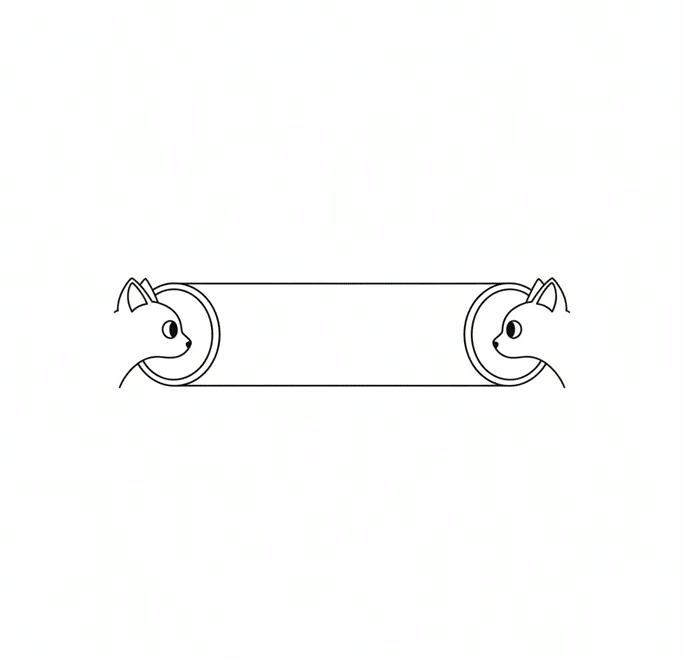
Two cats are looking down opposite ends of a three foot piece of pipe but they cannot see each other. Why not?
For info:
There is nothing wrong with either cat’s eyesight.
There is no blockage in the pipe; it is completely empty.
It is broad daylight.
The pipe is completely straight.
The cats can see the whole length of the pipe.