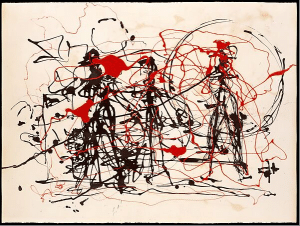
Jackson Pollock, Untitled, The Metropolitan Museum of Art
Hew Do You Do?
This week, my wonderful Year 13 students have been engaging with the question of freedom in Hamlet, a play where conscience wrestles with consequence in a Danish death spiral. As ever, it’s a privilege to be a party to their thoughts. In this case, even more so, as they’ve provided the inspiration and excuse, if not the defence counsel for this week’s reflections, paltry as they are wont to be.
There seems to be something in us that wants to know whether we are merely acted upon by forces beyond our control, or whether we’re the ones that do the acting and if so, how freely. Your humble Director knows very little about the modern world, but from my quiet exile in the land of books and biscuits, I spy a culture saturated with algorithmic nudges, economic determinism, and a rather increasingly shouty obsession with personal liberty. It seems to these feeble eyes that getting the business of freedom right seems at least as important as it ever was.
In such waters, dear reader, we are navigating literary questions as well as human ones. Not of course that there is any real borderline between those domains as we have already discussed in columns past. As you know, Hamlet’s Denmark is haunted, not just by the ghost of a dead king but by a deeper uncertainty about whether our choices matter, or whether we are only ever acting out the parts written for us by nature, nurture, Nemesis, or in Hamlet’s case, Shakespeare. Towards the end of the play, the great Puer Aeternus does seem to come to an understanding that much in life is beyond any attempts at control. We hear him muse to his pal, Horatio, There’s a divinity that shapes our ends, rough-hew them how we will. He goes on to add, in essence, that if something is not going to happen, it’s not going to happen and if something is going to happen then it’s going to happen. In the face of such uncertain certainty, the only thing we can do is be ready for it when it does (or doesn’t) happen. So, the ends may be shaped, but the hewing is ours. How’s your hewing arm, dear reader? He finishes these musings at this point near the end of the play with the words, Let be which forms an interesting counterpoint to his earlier famous question, To be or not to be…?
Hamlet spends much of the play trying to play a hand he wishes he hadn’t been dealt. I guess the question then arises whether Hamlet’s freedom is diminished by, to introduce another metaphor, being asked to play a role he never auditioned for. But maybe we are getting ahead of ourselves. Perhaps we should attempt to come to some kind of agreement as to what exactly this thing called freedom is. What do we really mean by freedom?
Freedom is often spoken about in a kind of ‘language of release’. In other words, freedom from stuff: from constraint, from obligation, from restraint. It is this conception that animates much of social media discourse (so I’m told), where freedom is assumed to mean maximal choice with minimal interference. But there is another sense of freedom; the older, and I think a more fulfilling one, in which freedom is defined not by the absence of limits, but by the presence of purpose. In other words, freedom for something. A freedom misunderstood as mere license, or as the right to do what I want, when I want, because I want, is not only unsustainable but self-defeating. Misunderstood freedom in this way turns out to be its own worst enemy. The moment of unbound choice feels like liberty; but the long-term consequence is often chaos, addiction, and despair. An excess of freedom always leads to tyranny.
This is hardly a new insight. The Apostle Paul, the Stoics, and our old friend, Aristotle all argued that true freedom is found not in the indulgence of impulse but in the mastery of it, in the formation of character towards the good. Thanks to Freud, we tend to see impulse-control as repression. Freud, of course, never had to teach my Year 9s. He might have had something to say about the efficacies of impulse control if he had, but I digress… The alternative model in which moral life emerges through spontaneous play, social equilibrium, and meaningful responsibility is not only more optimistic, it’s also actually more human. An authentic freedom, as thinkers from Epictetus to Viktor Frankl, have reminded us, is not merely about external options. It is an interior discipline; the ability to say yes or no in accordance with the truth we discern, however dimly. This of course requires a certain defiance, a refusal to surrender the responsibility for one’s own life to the pressures of circumstance.
Freedom then, is not the suspension of rules, but the discovery of the right ones. If we were to take a trip to analogy town…the pianist, for example, is not free because the keyboard has no constraints, but because she has internalised its logic so fully that her hands can play what her soul hears. The rugby player is free on the field of play not in spite of the discipline, but because of it. In every area of human excellence, discipline is the price of meaningful freedom. In this model, freedom does not mean the avoidance of burdens, it means choosing the right ones and growing strong enough to bear them. It means orienting oneself to the archetypal patterns; those deep structures of human experience that give shape to a life that is, let’s face it, not just chosen, but worthwhile.
If your Director might be indulged to opine a little at this point, I think here lies the answer to the reported anxiety of so many today. What actually seems to be craved is not just the right to choose, but the wisdom to choose well. I think most of us sense rightly that a life governed by changeable whims is no life at all.
Perhaps the matter has grown more complex in recent times. In the twentieth century, as we have discussed, quantum physics unsettled the tidy clockwork of classical determinism, revealing a universe built partly on uncertainty. Chaos theory, too, showed how minute variations could ripple outward into profound and unpredictable consequences, a scientific echo, perhaps, of the tragic turns of Greek drama. Our scientist friends teach us that even within systems governed by rules, emergent patterns arise that cannot be wholly predicted or controlled. The human person, we might say, is such a system shaped by history, biology, and society, yet still capable of surprise.
The arts have long captured this layered experience of freedom and constraint. Beethoven’s late quartets wrestle with themes of structure and improvisation, each movement a struggle between formal order and expressive impulse. Jackson Pollock’s drip paintings, often misunderstood as random, are in fact meticulous dialogues between chance and control. Honestly they are. In literature, Dostoevsky’s characters are most free not when they escape suffering, but when they accept it as meaningful.
In our own time, we’re all aware of the pressures that threaten to reduce freedom to a shallow simulation. Algorithms anticipate our desires before we are even conscious of them. We are all aware, for example, of how social media can entice us into echo chambers where the illusion of choice often does a good job of masking the manipulation of attention. AI systems, trained on human preferences, now shape the very landscapes of decision-making. The question is no longer simply whether we are free, but whether we even notice the slow erosion of freedom beneath the smooth surfaces of convenience. Perhaps the most chilling possibility is that freedom, in its modern usage, becomes a kind of skeuomorph where the outward appearance of agency is retained for comfort, even as its underlying function slips away.
Perhaps, then, Hamlet’s reflection offers a model for us. We may rough-hew our lives; our choices imperfect, our knowledge partial, but the shaping remains ours to attempt. To live freely is not to control every outcome, but to act in good faith amidst the uncertainty, to accept that meaning is fashioned not by power but by commitment. In a world increasingly designed to manage and predict, the quiet assertion of genuine freedom; the freedom to think, to love, to hope becomes not merely a personal achievement, but a radical act of being human.
It’s one of the many reasons why Shakespeare still matters. Hamlet, for all his hesitation, senses that he must act in accordance with something higher than himself. He does not claim to be free of fate. But he seeks to be free within it, not tossed about by circumstance, but brought, finally, to a kind of inward alignment. If it be now, ’tis not to come; if it be not to come, it will be now is not fatalism, but freedom within finitude; not liberty as escape, but liberty as vocation.
And that is perhaps the deepest kind of freedom we can know.
Until next time, Happy Reading/Freeing
Today’s well-known English saying which appears in another language is; the pot calling the kettle black, which turns up in German as; ein Esel schimpft den anderen Langhor, meaning, a donkey gets cross with a rabbit. I like that.