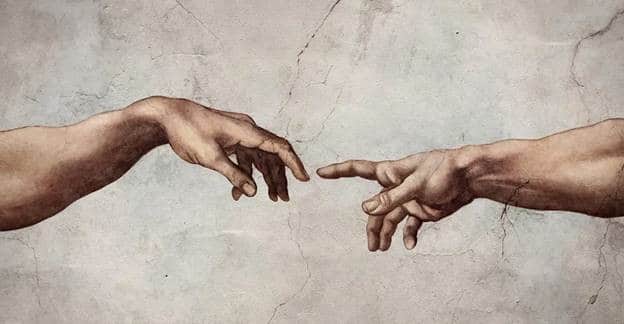
Detail from Michelangelo’s Creation of Adam (c.1508 – 1512)
From Goo to You. Maybe.
In last week’s column we discussed the probability of there being life anywhere other than here. As far as we know (which is never as far as we think), human beings are the only bits of the universe that talk about the universe. Therefore it feels appropriate in today’s column that this particular human being ought to share a few paltry words on the whole business of the origin of life itself.
If I may nail my colours to the mast as we begin this week’s voyage, I don’t think anybody knows how life began. There are, of course, many clever people working in the field but the Director’s meagre reading on the subject discovers no real consensus. My reader may be interested in the fact that there is a $10 million prize on offer (The Evolution 2.0 Prize) for anybody able to solve “the #1 Question in all of Science”. Those behind the prize summarise the problem thusly: Code is essential for replication and for life. Code is needed for cells to have instructions to build themselves; for reproduction. Code that has the ability to rewrite itself is essential for any kind of evolution to occur. No one knows where the first code came from. If you think you know, there may be some cash in it. But, as I say, I don’t believe anyone does.
My reader will have noticed my preference for questions that don’t have ready-made answers. I think those who say they have the answers to imponderables are either lying or trying to sell us something. Or indeed both. Nevertheless, it is always fun and sometimes illuminating, to have a look at what people think on these subjects.
Before we get to the science of which the Director knows nothing, there are, of course, many literary texts that explore the theme of the origin of life. And I might at least know next to nothing about these. I find that literature and art more generally ‘get there first’ in most areas and are instrumental in framing the way we think about the important questions but maybe that’s for another column. Anyhoo, off the top of my head, here are some texts that in some way, shape or form explore the business of the origin of life and might be worth a read should you be so inclined:
Frankenstein (1818) Mary Shelley
Shelley’s novel deals with themes of creation, life, and human ambition, centring on Victor Frankenstein’s attempt to create life through scientific means. It raises questions about the responsibilities of a creator as well as the consequences of “playing God” (always a bad idea unless you happen to be God and even then it’s not always plane sailing).
Paradise Lost (1667) John Milton
Milton uses the biblical story of creation, humanity’s fall, and the relationship between God, Satan, and humankind to reflect on the origins of life and the complexities of divine and mortal existence.
Metamorphoses (8 AD) Ovid
In the opening of this Roman epic, Ovid describes the creation of the world and the origin of humanity. The story explores themes of transformation, creation, and the interconnectedness of life.
For those with perhaps a more modern bent:
Never Let Me Go (2005) Kazuo Ishiguro
This dystopian novel reflects on the ethics of cloning and what it means to create life artificially; exploring the emotional and moral implications of treating humans as a means to an end.
Oryx and Crake (2003) Margaret Atwood
The first book in the MaddAddam trilogy, this novel examines bioengineering and the creation of life through scientific experimentation. It critiques the ethical boundaries of human intervention in life’s origins.
And then there’s poetry. There’s always poetry. Thank goodness:
Songs of Innocence and Experience (1789/1794) William Blake
Poems such as “The Lamb” and “The Tyger” reflect on creation, divinity, and the duality of innocence and experience in the natural world.
In Memoriam A.H.H. (1850) Alfred Lord Tennyson
This lengthy elegy includes meditations on evolution and the origins of life, influenced by early theories of natural selection.
The sci-fi genre is of course awash with stories exploring this theme. For example:
The Island of Doctor Moreau (1896) H.G. Wells
In this novel Wells explores themes of biological experimentation and the ethical implications of creating new forms of life, blending horror and science fiction.
2001: A Space Odyssey (1968) Arthur C. Clarke
This classic contemplates the origin of intelligent life and humanity’s potential future, guided by enigmatic extraterrestrial forces.
I am reminded by my esteemed colleague Ms Harris, that special mention must be made here to Doctor Who’s 1979 adventure City of Death where life on earth is started four hundred million years ago by an accident which also, unfortunately for them, destroys the Jagaroth. But I digress.
Now to the science. But before we get started, and I promise we will soon, I think it’s worth underlining to those Darwinians in our midst that the origin of life cannot be explained in Darwinian terms. Even our friend Richard Dawkins would agree that natural selection explains an awful lot of stuff once life gets started but the process of natural selection itself can’t actually start until we have the appearance of genetics.
If you were to ask several clever people for their ideas about how life started, the chances are you would get several different answers, so a whistle-stop tour then, of current prevailing ideas when it comes to abiogenesis (the origin of life from non living matter). There are more ideas but hey, I am a Director of small brain so I have compiled a ‘Top 3’ of those that seem at least a little bit comprehensible to me.
- Chemical Evolution and Prebiotic Chemistry
Life is thought to have arisen from non-living chemical processes on early Earth, around 3.5 to 4 billion years ago. This is the Primordial Soup Hypothesis which I remember was the explanation a young Director was given in school. It posits that organic molecules (the building blocks of life, such as amino acids) formed in Earth’s oceans, possibly energised by lightning, ultraviolet light, or some kind of geothermal activity. I remember also being taught about the Miller-Urey experiment (1953), which apparently demonstrated that amino acids could form under simulated early Earth conditions. Personally I have my doubts that 1950s chemistry is directly comparable to the chemistry going on billions of years ago. I reckon to construct any convincing theory of abiogenesis you’d have to take into account the condition of the earth back then… I mean, there weren’t any test tubes for a start. But as I frequently say; what do I know?
- The “RNA World” Hypothesis
RNA (ribonucleic acid) may have been the first self-replicating molecule, as it can both store genetic information and catalyse chemical reactions. This hypothesis suggests
RNA molecules could have served as precursors to DNA and proteins.
- Environmental Influences and Variability
Life’s origin was likely influenced by early Earth’s fairly angry environment, which included
loads of asteroid impacts, volcanic activity, and a reducing (low-oxygen) atmosphere.
These factors then created a dynamic setting for experimentation by natural processes. And these experiments eventually and randomly produced life.
The current most fashionable idea as far as I can tell, is Number 2: The “RNA World” Hypothesis which kind of addresses the chicken and egg nature of the abiogenesis problem, namely you need information which is stored these days in a DNA molecule to produce proteins but the problem is, you need proteins to process and express the information in the DNA.
In the 1980s it was thought that maybe the RNA could help solve this chicken and egg problem because RNA stores information but it also catalyses at least a few of the reactions that some protein molecules will catalyse, so maybe RNA would be the the ‘Holy Grail’ – the information storage molecule – and also some kind of a catalyst that would be analogous to what proteins do in modern cells. The idea was that if scientists could build RNA today then we’d be off to the evolutionary races. Some scientists have claimed that they can build RNA in 4 billion year old conditions but this claim is hotly disputed by other scientists. Those scientists, eh?
So essentially this hypothesis invites us to imagine that in the world before there was life, there were molecules bumbling around and that self-replicating molecules – that made copies of themselves – came into existence by some kind of stroke of sheer luck. And it’s RNA because the original genetic molecule was RNA or something like RNA, as DNA would have been too complicated for reasons to do with one being a good catalyst and the other not. Or something like that.
Moving swiftly along…
As we saw last week, the sheer number of planets where life might have occurred or might at least have had opportunities to occur, kind of staggers the imagination. The idea that life only happened here is a similarly staggering idea – probability wise. This has quite a strange consequence which is, when scientists look for evidence for a theory like the RNA World Theory, they’re not looking for a plausible theory at all, they’re looking for a highly implausible theory because if it were plausible that life could originate then the universe would be crawling with life, and as far as we know (which isn’t very far, as I may have mentioned) (and really not very far at all in the Director’s case), it ain’t.
The only person I’ve come across who’s pretty confident that he does know where life comes from and is therefore a shoe-in for the $10 million Evolution 2.0 Prize, is Leroy “Lee” Cronin, the Regius Chair of Chemistry in the School of Chemistry at the University of Glasgow. Cronin believes that it’s a matter of simplicity to explain how non living matter became life; how we got from rocks to dinosaurs, for example.
Cronin’s answer takes the form of ‘Assembly Theory’ where complexity at scale is used to piece together all the components that in turn work together to create adaptable life. Assembly Theory argues that life is copying and existence.
It also challenges the notion that life is vastly impossible, because Assembly Theory explains how rocks, by grinding together, undergo selection, and produce complexity, step by step, by step, by step, by step etc. And so, the environment on Earth at the origin of life, created the chemistry and then the cooking started. Chemistry therefore gives birth to biology.
Cronin’s point in a nutshell is that there is only one thing that is the key to the origin of life and that is: existence. His point being that for an object to exist, it has to survive for a longer time than its natural life. And it’s in this process of copying and existence to defy the law of being erased where life starts to emerge. It is the battle to emerge from the chaos of randomness and then persist in that existence. And this idea is what leads Cronin to conclude that life is copying and existence. Life, in other words, is extremely fragile chemistry that has found a way to copy itself to continue to exist.
Hmmm…
It would seem that all such questions as to whether there is life elsewhere and how life started all depend on what we mean by ‘life’. Perhaps we have hit upon the subject of next week’s column.
Until next time, Happy Reading/Copying and existing!
This week’s Director’s tip has been sent in by a Mr J Nussbaum. Thank you Mr Nussbaum and keep them coming!
Office workers, are you worried about spending money on expensive name plaques for your desk? Simply change your name to Toblerone.