“I Think We’re Alone Now”
Ritchie Cordell for Tommy James & The Shondells
If you’re anything like me, and Lord knows I sympathise if you are, your TikTok feed in December was full of ‘news’ regarding the appearance of mysterious coach sized drones in the sky, mostly over New Jersey. The number of sightings declined during the holiday period (wonder why) but authorities apparently continue to investigate the source and purpose of these UAPs (the new sanitised acronym/initialism/abbreviation for UFOs). Much airtime has been given to those who are convinced that these craft are of extraterrestrial origin and therefore proof, if proof be need be, that we are not the only ‘intelligent’ life in the universe. Now, whether we are an intelligent form of life is perhaps a fitting subject for another column, but today’s paltry words are some musings on the whole business of whether we’re alone out here.
The Little Book of Aliens written by astrophysicist, Adam Frank, examines the possibility of there being life elsewhere in the universe and I certainly wouldn’t argue with this extract from Google Book’s review: “With wit and brio, Frank separates current nonsense about aliens from the serious and fascinating search for extraterrestrial life.”
If you’re anything like me, and Lord knows I sympathise if you are, you’ve often looked up at the night sky and wondered how many civilisations are out there. Well, Adam Frank reminds us that there’s an equation for that. It’s called the Drake equation, and it looks like this:
N =R∗×fp×ne×fl×fi×fc×L.
Allow me to explain. I’ll probably get bits of this wrong, so forgive me, but I think we’ll arrive together at the gist .
In 1961 Drake pointed a radio telescope at a couple of stars and listened for signals, thereby carrying out arguably the first ever astrobiological experiment. Unexpectedly shortly after he began this adventure he got a phone call from the US government asking him to be part of a meeting on interstellar communications and was also asked to provide an agenda for this first meeting. Always a tricky ask, as far as I’m concerned. But he solved it brilliantly by coming up with his now famous equation in which he breaks down the issue of extraterrestrial life into seven sub-problems which when multiplied all together, give you the number of civilisations out there that we would be able to communicate with. The various bits and bobs of the equation are made up of the following:
N = number of civilisations with which humans could communicate
R∗ =the rate at which stars form
fp = the fraction of those stars that have planets
ne = number of planets that could support life per star with planets (i.e. the number of planets in the habitable zone)
fl = fraction of life-supporting planets where an abiogenesis event occurs (i.e. life forms)
fi = fraction of planets with life where life develops intelligence
fc = fraction of those where that intelligence goes on to create a civilisation
L = the length of time that those civilisations can communicate
Frank points out that what Drake did by breaking the problem up into these seven sub-problems was essentially to quantify our ignorance. As well of course, as giving astronomers something to do. So the star people could figure out how many stars were forming per year. The people who were interested in planets could go out and find techniques to discover planets and so on and so forth.
So, 60 odd years later,how far have we got using this equation to work out how many places there might be where this weird thing called life has occurred?
Well, apparently we now know the ‘fp’ bit of the equation. The Director looking up at the stars can now confidently know that every one of them hosts a family of worlds. And they might be like terrestrial worlds. Which means that even if there’s not life, there still might be snow falling, and oceans washing up on shorelines. Imagine how many places and stories there are out there.
After the fp bit of the equation, the next term is how many planets on average are in the habitable zone. By habitable zone, I think what is meant is the band of orbits around a star where there could be liquid water on the surface of a planet. I mean, where water wouldn’t freeze immediately because the planet is too far out or boil away immediately because it’s too far in. I don’t want to sidetrack us here but whilst Bob Frost’s 1934 poem Neither Out Far Nor In Deep is almost certainly not about planets in the habitable zone, it certainly is a meditation on the notion of being in space and time. I recommend it.
Anyway, ‘ne’ turns out to be around 1 in 5, or for those more decimally minded around 0.2. Which means that next time you’re out there looking up, if you just count five stars, one of them will have something habitable orbiting it. Given that current estimates suggest that there are around 100 billion to 400 billion stars in our own Milky Way and around 200 billion trillion in the whole universe, one in five is a pretty big number.
In which case, shall we agree that it’s not an unreasonable scientific claim to suggest there should be alien civilisations all over the place? Which begs the question why haven’t more of us seen them. Ah, well this, dear reader, leads us to the Fermi Paradox.
Let me picture you the scene….
It’s 1950 and Enrico Fermi is walking with his physicist chums to the canteen at Los Alamos nuclear weapons lab. They are laughing at a recent New Yorker cartoon drawn by Alan Dunn which humorously depicts aliens in flying saucers collecting ‘trash cans’, playing on the current UFO craze as well as recent mysterious disappearances of ‘trash cans’ in New York. The cartoon is reproduced below for illustrative purposes.
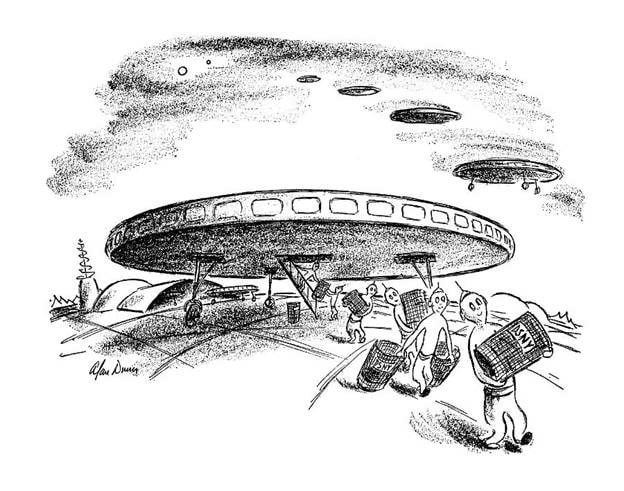
Now, even though the Director has been around and about a fair bit, I wasn’t there, but I have it on reasonably good authority that being physicists, their laughter turned to discussion of interstellar travel. You know what physicists are like. And that conversation went on for a bit until they started tucking in to their tea and sandwiches, or whatever was being served up in the canteen at Los Alamos nuclear weapons lab. Until at a certain point Fermi blurts out, “Well, where is everybody?” Chewing on his sandwich, he’d done the calculations and he suddenly realised that, if intelligence is common in the universe, that even traveling at sublight speeds, a civilisation could hop from one star system to another and spread it out across the entire galaxy in a few hundred thousand years. Hence the question of ‘why aren’t they here now’? Hence the beginning of the Fermi paradox. It’s not something we need to know but it might come in handy at some point to know that Fermi’s idea actually got picked up as a formal thing in a 1975 paper by Hart where he crunched the numbers and concluded that since there’s nobody except us here now, there’s nobody anywhere else.
But Hart’s conclusion is wrong.
Bear with me dear reader and I shall explain. And I shall try to be brief for I know our time together is limited.
There’s a book, which I haven’t read with the catchy title: If the Universe Is Teeming with Aliens … WHERE IS EVERYBODY?: Seventy-Five Solutions to the Fermi Paradox and the Problem of Extraterrestrial Life by Stephen Webb. But I reckon you only really need two ideas to show that Hart’s conclusion is wrong. I suppose it wouldn’t be a very long book but I’ll lay my two thoughts out for you here and you can tell me what you think next time we meet.
So firstly, Hart suggests that we’ve looked for aliens but not found any evidence of there being any. But that’s not quite right. It turns out that the area of the universe we’ve actually looked at for signs of alien life is vanishingly small. Adam Frank uses the comparison of the water in a bath to the water in an ocean. If you don’t find any fish in a bath’s worth of ocean, it would seem a tad far fetched to conclude that therefore the ocean is fishless.
The second point relates to the question: “if there are so many aliens out there then why haven’t they visited us?” Well, we all know that civilisations don’t last forever. If for example there was a lovely alien civilisation that lasted, say between 10,000 and 100,000 years, that would mean there would be big holes in regions of space where there wouldn’t be anyone at all for millions of years. And so if we’re living in one of those regions now, then maybe we were visited, but maybe 100 million years ago. And if that were the case, there would be no way to tell; there’d be no record left. No matter how really really really antediluvian your records are. Maybe you could look at the isotopic strata to see if there was anything reminiscent of an industrial civilisation. I mean what do I know? I’m only a Director of Literacy and Oracy. But I’m going out on a limb here and saying that if we were visited 100 million years ago there would be absolutely no way of knowing. And actually my reading tells me that I have company on this limb. There’s something called The Silurian Hypothesis which my reader might like to look up. Although anyone who knows their Doctor Who won’t need to.
Cutting to the chase, according to the maths, there have been 10 billion trillion habitable zone planets in the universe. And that means there are 10 billion trillion ‘let’s make life’ experiments that have been run. And the only way that we’re the only time the experiment was successful would be if every one of those experiments had failed except here. In other words, if the probability per habitable zone planet is less than 1 in 10 billion trillion, then we’re alone. If it’s anywhere larger than that, then we’re not the first; it’s happened somewhere else. So unless nature really has some bias against civilisations, we’re not the first time this has happened. It’s very very likely it’s happened elsewhere over the course of cosmic history.
The only question which remains is just how hard is it for life to originate? Or to put it another way, how hard is it to be rather than not be. Well now at last we might be reaching the point of the Director’s paltry words. As Hamlet remarked, being or not being does seem to be the question. And solving that question in Philip Larkin’s words, brings the priest and the doctor in their long coats running over the fields.
With your permission, next week’s paltry words will consider the question: ‘where did life come from in the first place. If indeed there was a first place?’ (I’ll try and get a better question by next week).
Until then, Happy Reading/Being an intelligent life form!