Get the Resolve, Mary.
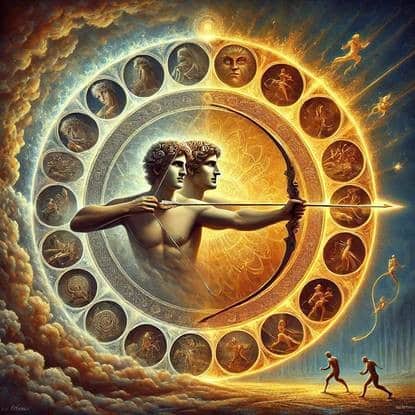
As we approach the end of the year, many people’s thoughts will be turning to their New Year’s Resolutions. Indeed, it is a truth universally acknowledged that a person in possession of a new calendar must be in want of a resolution. The month of January is named for the Roman god Janus. Now, Janus, as you know, is represented as having not one face, but two, one of which looks to the past, the other the future. At the Christmas table he could have had his eyes on the starters and the pudding at the same time, which would have brought its own problems. But I digress. Being able to look ahead and simultaneously behind, also makes Janus a perfect contender for being the god in charge of doors, gates and thresholds – or in short, the bits in between. I guess January is aptly named. It does feel like the most liminal of months; one which is neither here nor there. Perhaps that’s why the month after Christmas has come to be known as the season for self-delusion, otherwise known as The Resolution.
But what is it about the turning of the year that makes us believe we are capable of becoming entirely new people simply because the earth (pace flerfers) has run another lap around the sun? According to the Journal of Really Pointless Futility (a publication I may have just invented), 86.76% of New Year resolutions fail by February, making them statistically less reliable than one of the Director’s soufflés.
A Brief History of (Failed) Aspirations
The ancient Babylonians are often credited with the invention of New Year resolutions, though their version was a little less “lose ten pounds” and a little more “return the plough I borrowed from Nebuchadnezzar.” They made vows to their gods to cultivate favour for the coming year – a reminder that even in 2000 BCE, humans were adept at overpromising. The Romans then took things further by dedicating resolutions to Janus, although their resolutions may have been more bacchanal than betterment.
By the time we reach Victorian England, resolutions were resolutely moralistic. Victorian magazines encouraged people to resolve to be kinder, more diligent, and to embody the virtues of their age. Anyone who’s read Dr Jekyll and Mr Hyde will know all about the tricky nature of embodying Victorian ideas of moral virtue. They probably meant well, but so did Dr Jekyll. Nevertheless these moral imperatives have morphed in the modern age into resolutions to meditate more, exercise daily, eat kale for breakfast and finally finish that novel (both reading and writing it).
The Psychology of Self-Delusion
Why do we persist in making resolutions despite their near-certain failure rate? The answer lies, perhaps, in our unshakable optimism and the peculiar human ability to imagine our future selves as entirely different people. Some psychologists call this phenomenon the “fresh start effect” where temporal landmarks like New Year’s Day make us feel like we’re stepping into a new chapter of life, unsullied by past failures. The problem, of course, is that we bring the same flawed author to write the chapter.
“But what’s all this got to do with evolutionary biology?” I hear you ask. Well who knows? I mean, it must have something to do with it. Everything does, after all. Maybe from an evolutionary biology perspective, our penchant for setting ambitious goals has something to do with survival instincts. In a world where adaptability often meant the difference between life and death, envisioning a better version of ourselves may have once provided a competitive edge. Those who dreamed of greater feats were perhaps more motivated to seek out resources, secure mates, or forge alliances, enhancing their chances of survival. It’s a thought. However, in the modern world, where comfort and convenience often shield us from the harsh realities of life, this same drive manifests in resolving to eat kale and do marathons rather than foraging for food or running down prey.
I am also told by my younger colleagues that resolutions, like blind dates, often suffer from unrealistic expectations. We resolve to “get fit” without defining what that means, or to “be kinder” without considering that it might involve not throttling the next person who uses “literally” incorrectly. Tough one.
A Word About a Word
The word “resolution” conjures images of determination and unwavering resolve, but perhaps we should consider its deeper implications. The Latin root “solvere” means “to loosen or dissolve.” Ironically, as we attempt to tighten our grip on our goals, we often find ourselves loosening our resolve. The resolution, like the Director’s soufflé, is often destined to deflate, leaving us with nothing but the taste of failure and the faint scent of ambition.
What if, instead of rigid resolutions, we embraced a more fluid approach to change?
Karma might have something to say on the matter. Some believe that when one seeks liberation, the first obstacle to be overcome is past karma. Karma, which literally means “action” in Sanskrit, is often misconstrued in popular culture as some kind of moral law of retribution. However, in its truest sense, karma represents the consequences of our actions, shaping our experiences in ways we may not fully comprehend. As we embark on the journey of self-improvement, we must acknowledge that our past choices may loom large, presenting themselves like creditors demanding payment. For those of us attempting to change a long-standing habit, consider the wisdom of a famous adage: “If you plan to turn over a new leaf, don’t let the devil know.” This might more readily lead to embracing a practice of living in the moment, reminiscent of nishkama karma, or acting without attachment to the results of our actions. Which leads us to…
Zen and the Art of Resolutions
There’s a story in Zen in the Art of Archery (Zen in der Kunst des Bogenschiessens) by Prof. Eugene Herrigel published in 1948 about his experience studying kyðdõ, a form of Japanese archery which might be useful at this point in the column. As a story it’s had many iterations but the bare bones of it are something like the following…
So there’s Eugene having a lesson from the arrowmaster, Awa. Eugene can’t loose the arrow skillfully no matter how many times he tries. He asks Awa for help, and the following dialogue ensues:
Eugene: How can the shot be loosed if ‘I’ do not do it?
Awa: It shoots
Eugene: And who or what is this ‘It’?
Awa: Once you have understood that you will have no further need of me. And if I tried to give you a clue at the cost of your own experience, I would be the worst of teachers. So let’s stop talking about it and go on practising. (I must admit that the Director can often be found channelling his inner Awa during many a poetry lesson).
The point here is mastery comes not through effort but spontaneous action. The archer is taught to release the bowstring not when their mind commands it but when the action arises naturally, almost unconsciously. It is a lesson in surrendering control; letting go of overthinking and trusting in a deeper instinctual rhythm.
There’s a similar story of the Zen master and his disciple watching an archery competition. One of the archers is extremely skilled but is shooting poorly. The disciple asks his master why the accomplished archer isn’t doing well. The Zen master replies that the archer’s desire to win deprives him of his power.
So true. But try telling that to Year 8s.
Similarly, in life, success often lies in fluidity; the ability to act without the paralysing interference of doubt or overplanning. Here, the act of releasing the bowstring without hesitation becomes a metaphor for embracing the present moment fully, without the clutter of self-imposed expectations.
This approach, while deceptively simple, requires practice. It asks us to cultivate a state of awareness that is both deliberate and detached, to trust our instincts without clinging to outcomes. And in doing so, we may find not only success but a sense of liberation from the relentless wheel of striving and self-critique.
A Resolution to Question Resolutions
So, dear reader, as we march bravely into another year armed with gym memberships, gratitude journals, and dubious self-improvement apps, let us remember that the best resolutions are perhaps the ones we never write down. Let us, dear reader, embrace the absurdity of our intentions, and recognise that change is rarely linear and often fraught with challenges. But at least we can return Nebuchadnezzar’s plough.
If, by February, our goals are languishing alongside last year’s unread (and unwritten) novels and unlearned hobbies, we mustn’t despair but simply resolve to begin again – or not. And all the while, navigating the waters of self-improvement with a light heart.
Until 2025 Happy Reading/ Sailing the Good Ship Resolve!
PS: I would like to take this opportunity to thank everyone who has supported the Director in 2024, whether through kind words, suggestions and prayers or indeed any feedback at all. It is all very much appreciated.
And so here, the last Director’s Tip of the Year…
Too frightened to say boo to a goose? Why not start with a pigeon and see how you get on.