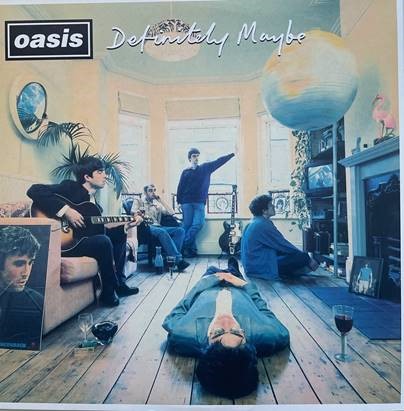
Definitely Maybe
And now, the end is near
And so I face the final curtain
My friend, I’ll say it clear
I’ll state my case, of which I’m certain
“My Way” English lyrics by Paul Anka
“What is the proof that I know something? Most certainly not my saying I know it.”
Ludwig Wittgenstein, On Certainty
“Doubt is an uncomfortable condition, but certainty is a ridiculous one.”
Voltaire
I wish there was such a thing as certainty.
Year 11 Tiffin student (27/11/24)
Earlier on today, typing these paltry words, I glanced up at my bookshelf and noticed my well-thumbed and not very well understood copy of Wittgenstein’s On Certainty. So we can put the subject of today’s thoughts down to whichever of the Muses it is who rearranges books on bookshelves.
If you were to try to picture certainty, what might it look like? A clock striking the hour? A mathematical theorem? There never being enough time? Leeds United conceding a 95th minute equaliser due to a goalkeeping howler? These might all be useful ways to picture the idea, but does that get us any nearer to what the thing actually is? Probably not. I’m not even sure that using the metaphor of getting ‘nearer’ to certainty is all that helpful. Although it might be. I’ll get back to that later. If there’s enough time.
First off though let’s have a look at what some of our philosopher friends had to say on the matter. Surely they’ll get us somewhere? Well yes and no…
Descartes famously tried to establish certainty by doubting everything he thought he could until he reached something he thought it was impossible to doubt. What he concluded was that he could doubt pretty much everything except that when he was having a doubt, he could be certain that he was having a doubt. Hence his famously erroneous and unhelpful claim: Cogito, ergo sum (I think, therefore I am). A bold declaration no doubt, but even René had to hedge his bets. His certainty hinged on the existence of a benevolent God who wouldn’t deceive him. Without divine intervention his certainty wasn’t certain.
Compare this with David Hume, who came along to cheerfully pull the rug out from under certainty altogether. As an empiricist, Hume argued that human knowledge is based on habits of thought not any kind of rational certainty. For example, our belief in cause and effect is not certain but is based on repeated experience, making certainty about the external world or future events impossible.
One more?
Bertrand Russell. The main thrust of his thoughts on the business was that you could achieve a limited certainty through logical analysis. He believed that logic and mathematics provided some level of certainty and was sceptical of metaphysical claims to absolute certainty. He was more of a one for probabilistic knowledge instead. I’ve always had a soft spot for Bertrand.
Okay, so philosophy has several takes on this thing called certainty. Surely science can help us out here? Well, yes and no…
Science, too, is something of a double agent in the story of certainty. On one hand, as a discipline it might be seen as being built on the quest for reliable truths: laws, formulas, principles that stand the test of time (or at least until a better theory comes along). Newton’s laws gave us the clockwork certainty of the universe but then Einstein showed us that time itself could bend and stretch. Or something like that.
If science teaches us anything (and I’m sure it does), it’s that certainty often has a ‘Best Before’ date. As Karl Popper explained, a crucial way in which science advances is not by proving things true but by proving them false. Every certainty is provisional, awaiting the next paradigm shift. Certainty, then, is less about what we know than how we know it, and how willing we are to let go of it when the evidence demands.
So much for the certainty of science.
What about ourselves? Surely we’ll find some kind of psychological certainty in the human mind, if only in our own perceptions and beliefs. Well, yes and no…
The brain, as we know, is a trickster; a machine of biases and blind spots. Psychologists like Daniel Kahneman have shown us how we mistake confidence for correctness. Indeed, the more certain we feel, the more likely we are to be wrong. Try explaining that to a Tiffinian!
Certainty of course can be comforting, acting as an anchor in turbulent seas but it can also blind us. You only have to have a cursory knowledge of history to note the certainties that have fueled history’s greatest follies: the “certainty” of moral superiority, the “certainty” of scientific dogmas later debunked or the “certainty” of one’s right to impose their will on others.
So where does that leave us, and does the Director have anything useful to say on the matter? This I shall of course leave to you to decide but I don’t mean to keep you long either way.
I suppose the main thing is why this desire for certainty in the first place? My reader will know, I have held forth on these matters in previous columns but it’s always good to revisit old friends.
As a teacher for many years and as a human being for probably even longer, one thing I’ve noticed is that people prefer what is already familiar. Fair enough, but this can lead to getting stuck on ‘repeat’ in terms of approach and ways of understanding when perhaps a kind of ‘yes but’, Devil’s advocate approach might yield better results. And the internet, which is no doubt, a wonderful thing hasn’t helped in this because it’s possible for people to get trapped in bubbles where they reinforce the things they believe without really hearing other points of view.
If we start being too certain about anything it means we’ve missed something else. I often invite my more strident students who are absolutely adamant that something is definitely the case, to build as strong a case as they can for the opposite point of view. I learn that this is called the ‘steel man’ approach (as opposed to the straw man). I often think the world would be an awfully better place if people got into the habit of inverting everything they believed and saw the value in the opposite views. This brings us to a very important metaphysical point which is that rather than opposite things/ideas being simply as far apart as they can be, in fact opposites are very much connected. There is a dark side to every good for example. My psychiatrist friends tell me this is a crucially important facet of psychiatry. So much so that it’s almost a truism to say that a lot of the work psychiatrists do is helping people to see that there is a good side to what it is that they fear and dislike in themselves but there is also a dark side to the bits that they pride themselves on. As Ged found out in Ursula K. Le Guin’s marvellous Wizard of Earthsea, you cannot get rid of the dark side. But you can accept it and work with moving it towards something creative. You certainly can’t create a better society by trying to legislate away everything that you are certain is not good. Dr Jekyll tried that and only created Mr Hyde.
Returning to the metaphor of ‘getting closer’ to certainty, I think it’s more the case that whatever means we choose to try to attain ‘certainty’ we will only ever approach it asymptotically. We’ll never get there because we are a pilgrimage people. As Chaucer pointed out. Or something like that. I’m not too certain.
Until next time, Happy Reading/Ploughing an asymptomatic furrough
Again, there were no tips from readers in the Director’s mailbox this week so here are some things about which we can never know for certain.
Things which are not certain #1
Where pens go
How socks disappear but Tupperware lids multiply
How many holes it takes to fill the Albert Hall