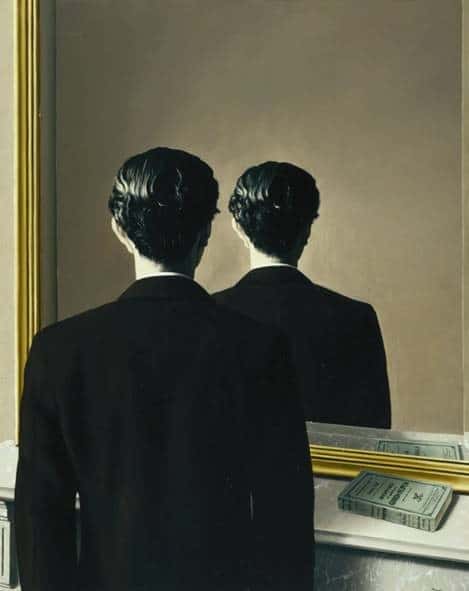
René Magritte – “Not to Be Reproduced” (1937)
1888 words – read time: 14.5 minutes
Mind the Gap: Logic’s Leap into Paradox
I recall as a very young Director, startling my Year 2 English teacher during a writing task by asking her how to spell ‘illogical’. After enunciating each letter in that kindly voice of hers that I can still hear to this day, she said she was looking forward to seeing what use I was going to make of it in my writing. I often feel a twinge of sadness at the disappointment she must have felt when she found out I was writing about Star Trek and needed to know how to spell Mr Spock’s favourite word.
Many years later, at university I found myself taking a course on philosophical logic. I have long been fascinated by how people have attempted to pin down the nuances of meaning in language using quasi mathematical symbolic notation. I recall one particular seminar where a visiting Canadian Professor was illustrating to us how to parse the sentence , ‘All the nice girls love a sailor.’ into symbolic logical notation. If memory serves, it goes something like this:
∀x(G(x)→∃y(S(y)∧L(x,y)))
Which can be read as “For all x, if x is a nice girl, then there exists some y such that y is a sailor and x loves y.”
Did I mention that the Director is an absolute hoot at parties?
But logic is a funny thing. Allow me to explain.
There are often said to be three traditional laws of logic and I guess most people these days would accept them as being blindingly obviously ‘true’:
- The Law of Identity;
- The Law of Non-contradiction;
- The Law of Exclusion or of Excluded Middle
In other words;
- Everything is what it is; whatever a thing is, it is always equivalent to itself.
- Nothing can both be and not be in the same exact manner. Something cannot be both true and false at the same time in the same way. I cannot be both typing these paltry words and at the same time not typing these paltry words.
- Either something is or it is not. It cannot be both. For any given statement, it must be either true or false—there’s no third option.
Obvious, right? Well, maybe…
Shall we stop a moment to ask where these laws of logic come from?
Some people argue that we get the laws of logic from observations. For example, we don’t see it raining and not raining at the same time, so we have the law of non-contradiction. These selfsame people suggest that the laws of logic would be different if the world wasn’t as we observe it to be. Along similar lines others argue that the laws of logic work because they are designed to fit the world and that we have designed them to fit the world.
But, as I’m sure you will agree, dear reader, these explanations are deeply unsatisfactory. They don’t come close to explaining why the world corresponds with the laws of logic. Why is the world not chaos and darkness and lots of other scary unpredictable things that make logicians nervous?
We don’t have time here to look at all the arguments about why the rules are the rules, whether, as a theist might argue, it’s because God made them that way (which of course implies God could have made them another way, but that’s for another time). Or whether as some kind of Platonist might argue that the laws of logic exist in the immaterial plane and are instantiated in the material plane. In that way, the law of noncontradiction is out there in the platonic realm and in this world it’s in how there are no contradictory properties. But as I say we must leave these arguments for another time.
On the topic of arguments, hands up who thinks the following is a valid argument:
The sky is green
The sky is not green
I am the King of Mars
Well done! Yes, it is indeed a valid argument because there’s no way that the premises can both be true and the conclusion be false. There’s no way that both the premises can be true because they contradict each other. So it’s a valid argument in that it follows from the sky is green and the sky is not green, in logic, to me being the king of Mars.
A valid argument is not defined as an argument where if the premises are true then the conclusion is true. The definition of valid argument is there’s no interpretation in which both of the premises can be true and yet the conclusion be false.
This weird logical trick is called the Principle of Explosion (or ex falso quodlibet) and states that from a contradiction, any conclusion can be derived. For those of you still here, in logical notation, it looks like this:
P∧¬P⇒Q
⇒Q: is the bit telling us that if a contradiction exists, then any statement Q can be concluded.
Now that just seems silly and certainly not the way we go about our business. But most of the time the rules of logic work perfectly well to get us where we need to be on a daily basis, whether that’s down to the shops or from off the pointy horns of a dilemma. Of course it’s also true that we actually want certain things to work ‘logically’ – like if A implies B and you’ve got yourself A, then you’ve got B too. Otherwise, as I said, where would we all be?
At the same time, it is the case, as Captain Kirk was often pointing out to Mr Spock as they wended their merry way through the universe, that the rules of logic can lead us into some weird places. Places where logic seems to be being used to undermine itself. Let’s put the USS Enterprise in orbit around planet Paradox and see what’s to be seen there.
Let’s remind ourselves of a couple of the paradoxes that have been knocking around for thousands of years. Thorny problems, yes but also tremendous icebreakers at many a social gathering. Did I mention that the Director is an absolute hoot at parties?
Zeno’s Paradox of Achilles and the Tortoise
As you know, this is the one where a tortoise challenges the famously speedy Achilles to a race claiming that Achilles will never be able to catch him. Achilles being the type of guy that he is, gives the tortoise a head start and lo and behold, Achilles can’t ever reach where the tortoise is and so loses the race. Now, according to the logic of the Paradox, the reason speedy Achilles can never actually pass the tortoise is because the first thing Achilles has to do is to get to where the tortoise is, but by the time he’s got there the tortoise has moved on. So Achilles’ next task is to get to where the tortoise has moved to, but, you’ve guessed it, by the time he gets there the tortoise has moved on. According to the rules of logic, Achilles will never actually pass the tortoise, as there are infinitely many points he must reach. Logic concludes that it must be an infinite series and logic also tells us that an infinite series cannot be resolved in a finite time
Now we all know that Achilles, in what I like to call the real world, is going to overtake the tortoise but logic tells us he can’t so there’s something wrong here. What is it?
In my humble opinion, the paradox arises from trying to construct reality as if it is made up of discrete fragments. As if the world is put together by a process of addition. And of course we all know one of the things about infinity is that Infinity is not the end of a series. Infinity is not a really really big number. We could imagine carrying on numbers for however long but we would never actually reach infinity. A line a millionth of an inch long is as far from Infinity as one that is thousands of millions of light years long. It’s got no nearer Infinity by being prolonged. So Infinity is not achieved by addition in the way a purely logical approach tries to achieve. What’s needed is some kind of leap. And I think that’s good because all the best things require some kind of leap to begin to understand them
Here’s another:
The Ship of Theseus
This is the one where Theseus retires from his life of heroic exploits and the Greeks decide to preserve his ship in honour of the heroic exploiting he did on it. After a while some of the timbers start to rot and are replaced. This process continues until eventually all the parts of the ship have been replaced. The question which therefore arises from this neat little paradox is whether this is still the ship of Theseus. And if the answer is ‘no’, then at what point did it cease to be the ship of Theseus and become not the ship of Theseus?
Unlike being in foot races with tortoises, this paradox does have the benefit of having something to do with situations that we find ourselves in. Bits of our bodies are being replaced all the time. I seem to recall something about there being no cell in your body today that was there seven years ago. And yet we seem to be the same person continuously. How are we to reconcile this apparent paradox?
Once again, the problem arises from a point of view which sees the whole as being a sum of its parts. As in so many things, the Germans have a word for it which isn’t readily translatable into English: Gestalt. It’s a word which has several layers of meaning and application but for our purposes today, it means the sense that the meaning of any thing cannot be understood by breaking it down into its component parts. It is an idea, incidentally, which the Director is often unsuccessful in pointing out to Tiffinians when it comes to looking at what a poem is.
The Gestalt of me and of the ship of Theseus is present and is continuous even though things come and go within them both. A logical approach will only ever perceive a fragmented, time-sliced entity, whereas the more veridical approach is one which sees the importance of the Gestalt, the importance of the persistence of something and the wholeness of something.
After all, as I think I may have mentioned before, every single ‘part’ is also a whole in its own right when looked at closely. Logic tells us that wholes are made up of parts. The truth, as ever, is far more interesting.
Paradoxes are examples of misunderstanding the nature of reality and therefore coming to absurd conclusions. And, dare I say it, you will always be dogged by paradox and absurdity if you think the world is made out of logic. Some of it is, but the best bits aren’t.
Until next time, Happy Reading / ∀x(B(x)→I(x))!
Reader’s Logical Tip #6
Worried about wear and tear?
Roll up all your carpets and keep them in the shed or garage. Saves on the vacuuming too!