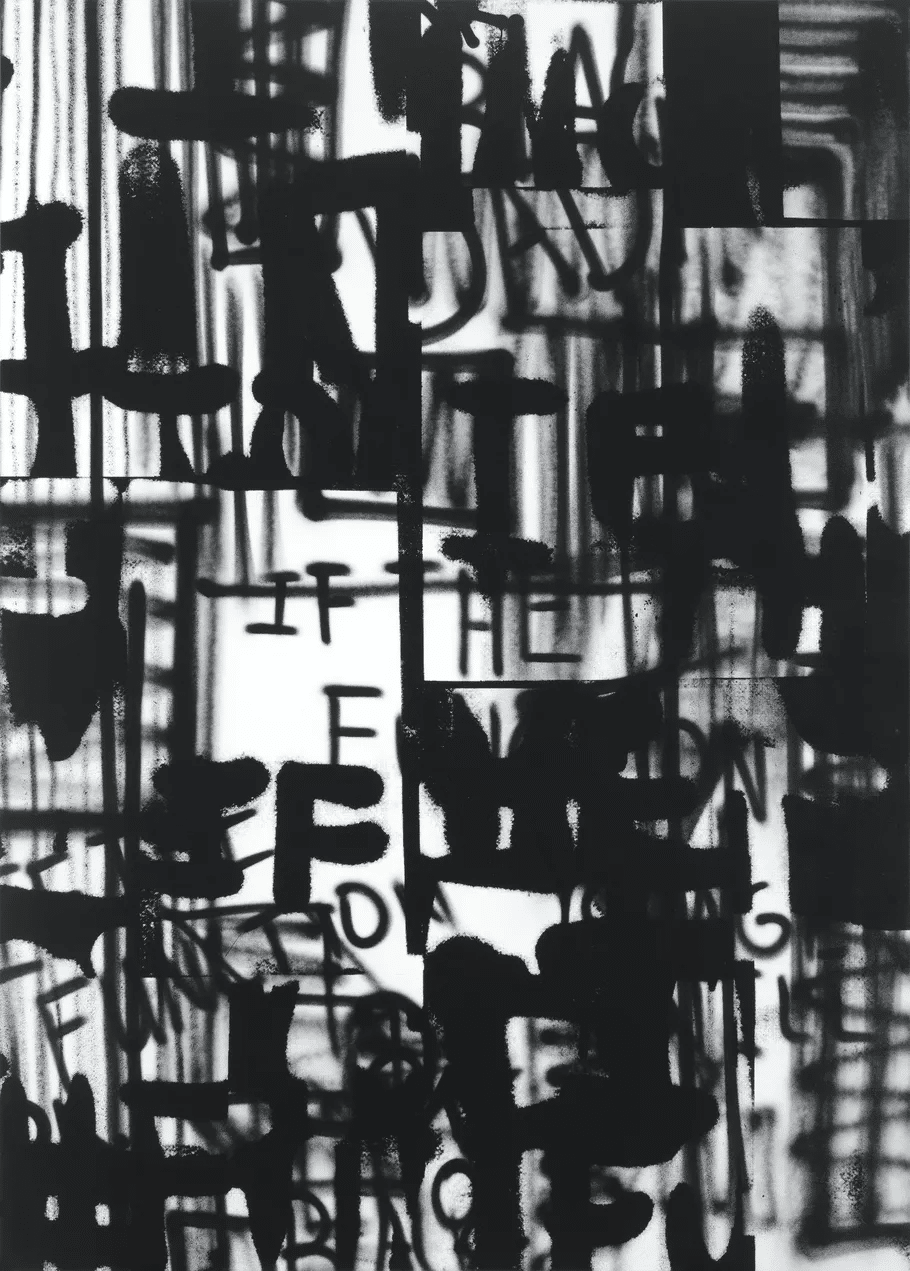
If the function of dada by Adam Pendleton, 2017
Reasons To Be Cheerful, Pt 1
As Cole Porter reminds us, ‘Birds do it, bees do it, even educated fleas do it’. I don’t think Mr Porter wasn’t referring to them doing language, but he could have been. These days we all know that animals have language. What seems distinctive about the human animal, is not therefore, the capacity for language, but how they have put language into writing. However, the movement from an oral culture to literacy is not a straightforward business and continues to change the very essence of what it means to be human.
Writing shapes our world in ways that we perhaps don’t readily notice because it is now so embedded in our lives. But it wasn’t always so.
Radio 4 is currently running a series of programmes consisting of essays delivered by novelist Naomi Alderman, entitled The Third Information Crisis. Alderman draws comparisons between the crises which followed the invention of writing, and then printing, and now the ‘Third Information Crisis’. She explores how we are not really coping very well with the ‘enormous wave of information’ coming at us from the internet and social media, pointing out how this technology “changes us psychologically, socially and emotionally in profound ways that simply cannot be reversed”.
I thought I might use these few paltry Director’s words to reflect a little on such things, as well as perhaps seeing how I’m coping.
Let’s look at how writing came about. Just the highlights. It’s an enormous subject.
Anthony Burgess in his lovely book A Mouthful of Air reflects on the ‘miracle’ of the invention of writing. He refers to it as the conversion of the temporal into the spatial, pointing out that speech works in time, but letters stand in space. Which, as well as being a nice way of putting it, also points to the fundamental reason why the written word in its various forms is an awful and artificial contrivance.
I am minded here to point to the no doubt apocryphal story of Christopher Wren showing his completed St. Paul’s Cathedral to the King who responded that the building was both ‘awful’ and ‘artificial’. Wren was delighted by this, as in the 1700s, ‘awful’ meant ‘awe-inspiring’ and ‘artificial’ meant ‘full of great artistry’
I’m using the terms in their 18th and 21st century sense when it comes to the written word.
W. F. Mavor wrote that “writing is universally allowed to be the noblest invention that can possibly be conceived.” Now, who am I to suggest otherwise? But it might be worth pointing out that he was probably referring to alphabetic/phonetic writing which arrives fairly late on in the business of converting the temporal into the spatial. It is doubtful that the alphabet is much more than 3000 years old.
Before the alphabet, there were ways of granting permanence to words but these had nothing to do with words becoming temporal events. The Egyptians, the Mexicans, and the indigenous peoples of America drew pictures that stood for words – recording what the word stood for. Picture writing is our oldest form of setting down signs for the referents of language i.e. the things in the outside world that language refers to. So the earliest forms of writing preserved many links with the natural world. The pictographs of Sumer for example, can be seen as metaphors of realities. With the evolution of phonetic writing those links were severed. Professor John Gray argues this severing meant that writing no longer pointed outwards to a world humans shared with other animals. Henceforth its signs pointed backwards to the human mouth, which soon became the source of all sense. Here then are the beginnings of what Alderman refers to as the first of the three great crises. But I’m getting a little ahead of myself.
Walter Ong (Orality and Literacy), the anthropologist Jack Goody, and, most recently, Eric Havelock (Preface to Plato), have written about the changes in human consciousness after the invention of phonetic script. By ‘phonetic script’ I mean writing where the words can be sounded out by seeing them written down. And phonetic script was accessible to almost anybody unlike the earlier cuneiform which was the preserve of the elites.
Now, I don’t know if you’ve heard of the Axial Age? The term was invented by Karl Jaspers in his 1949 book Vom Ursprung und Ziel der Geschichte. To cut a long phonetically written story short, the Axial Age (roughly between 800 BCE to 200 BCE) is a period of time which saw an explosion of thought and ideas, and a resulting profound change in humanity. During the Axial Age, the intellectual, philosophical, and religious systems that came to shape subsequent human society and culture emerged. For example, from Greece we got Socrates, Archimedes, Hippocrates, Plato, and Aristotle. In the Middle East, Jewish prophets like Isiah and Ezekiel, as well as Zoroaster in Persia. In India, the Buddha and the writing of the Hindu Upanishads. In China, Confucianism and Daoism, as well as Sun Tzu.
German egyptologist Jan Assmann, suggests that this profound change in the Axial age could never have happened without the invention of writing. Anderson points out that modern homo sapiens have been around for roughly 300,000 years and that during that time there were probably loads of interesting people saying loads of interesting things but whatever they said would largely have been forgotten without the invention of writing. Writing gave humans the power to preserve their thoughts and experiences. In oral cultures this was attempted by feats of memory, but with the invention of writing, human experience could be preserved when no memory of it remained. It is therefore no surprise that the invention of writing engenders great leaps forward in knowledge and understanding, hence the Axial Age. But such ushering in of all this information is not without its problems, or accompanying crises.
The new and beautiful ideas of the Axial Age also contained within them new ways of warfare as well as new reasons to go to war. Now people went to war not just over territorial disputes but also, increasingly over different ways of interpreting the written word.
Walter Ong makes some interesting observations about what happens when cultures move from orality to literacy. For example, literacy causes societies to value older people less. Before literacy, elderly people were needed because they, as Alderman points out, were the ones who could remember for example where the safe places to shelter were the last time the river burst its banks. If you can write that information down, you don’t need the old people who remember it. Respect for the elderly severely diminishes and becomes less common. This in turn leads to another societal value change. The figures of the wise old man/woman (repeaters of the past) become downgraded in favour of younger discoverers of something ‘new’. Writing invents the idea that above everything else, culture and society should be seeking out the new. The ‘new’ is more valuable than the ‘old’. The ‘old ways’ come under intense scrutiny. And we all know what happens then.
So writing creates an artificial memory, whereby humans can enlarge their experience beyond the limits of one generation or one way of life. But at the same time writing has allowed them to invent a world of abstract entities. And humans being the animals they are they will very often mistake those abstract entities for reality.
Professor Gray argues that when twentieth-century philosophers such one of my favourites, Wittgenstein, attacked the reverence for words they found in philosophers such as Plato, they were criticising a by-product of phonetic writing. Plato is what historians of philosophy call a realist – he believed that abstract terms designated spiritual or intellectual entities. You can’t imagine a philosophy such as Platonism emerging in an oral culture. How could a world of Forms for example be represented in pictograms? Classical Chinese script is not ideographic, as used to be thought; but because of what A.C. Graham terms its ‘combination of graphic wealth with phonetic poverty’ it did not encourage the kind of abstract thinking that produced Plato’s philosophy. In contrast, throughout its long history, Chinese thought has been nominalist. In other words, it has understood that even the most abstract terms are only labels or names for the diversity of things in the world. As a result, Chinese thinkers have rarely mistaken ideas for facts.
So it turns out that one of the ‘awful’ things about the alphabet is that it has encouraged us to see abstractions as facts. And you don’t need to be an historian of any great note (not that history existed at all before the invention of writing) to notice how many people have suffered and died in the cause of ideas taken to be facts. Wars have been fought, tyrannies established, cultures ravaged and peoples exterminated in the service of abstractions . As Professor Gray puts it, “Europe owes much of its murderous history to errors of thinking engendered by the alphabet”.
And if you think that’s bad, wait until you see what the printing press did for us. Tune in to find out in next week’s instalment: Reasons to Be Cheerful, Pt2
Until then, Happy Reading/Writing!
Director’s Tip #10
Fruit stains on the hands?
Hold the hands over the smoke of burning sulphur until the stains disappear.