To See or Not to See
The story goes that a wealthy businessman commissioned the artist Picasso to paint a portrait of his wife. Picasso, who rarely accepted such commissions, agreed, and set busily to work. In due course came the day of the big reveal. The painting was typical of Picasso at the time, and I’m sure you can imagine it, dear reader: an enormous triangular nose with two eyes looking in different directions on the same side of it, a chin that could have cut glass, and a fruit bowl perched atop a flat head where one might have expected hair. The businessman, upon seeing Picasso’s handiwork, was furious. What’s this rubbish? he shouted. That doesn’t look anything like my wife! And in his rage, he pulled a passport-sized photograph from his wallet and brandished it in the artist’s face, screaming, This is my wife! This is my wife! Picasso, slightly bemused and, I imagine, with a twinkle in his eye, replied, She’s rather small and two-dimensional, isn’t she?
What the businessman failed to see was that he was interpreting the painting, and that the photograph in his hand was not reality itself but the apparatus through which he had decided to read reality. He had not made a mistake of eyesight. He had made a mistake of method, whilst having no idea he was using a method at all.
I thought of him this week when I accompanied some students to see Hamlet Hail to the Thief. As you may have gathered, dear reader, this is a production that fuses Hamlet with Radiohead’s album Hail to the Thief, weaving acting, music and dance into a burst of choreographed energy. Your ex-Director must confess that at times it was difficult to follow, what with all the whizz-banging, but this is a fault located in his own critical apparatus rather than in the production itself. And of course, this is the way of things. Susan Sontag, whose essay Against Interpretation argued that critics did too much decoding and too little experiencing, would probably tell me not to worry. I have some sympathy, but the whizz-banging was the company’s reading of the play, and so it was never going to arrive uninterpreted. Every time a play is staged, somebody has to decide what it means. Is Hamlet a brooding intellectual or a spoiled young man in need of a job? Is Claudius a terrible villain, or a man fatally torn between desire and duty? Is that famous opening line, Who’s there?, a nervous sentry in the cold, or a question aimed at the whole audience, and at the Prince himself? The words on the page stay still, but a production cannot. There is no neutral staging, only staging whose interpretation is declared and staging whose interpretation is hidden. A director who claims to be just doing what Shakespeare wrote is, like our businessman, holding up a photograph and calling it his wife.
The word for all of this is hermeneutics, which is, I accept, a conversation stopper at dinner parties I am never invited to. It comes from an ancient Greek verb meaning to say, to explain and to translate. The Romans turned it into interpretari, which is why interpretation feels like a much friendlier neighbour. They mean the same thing. Hermeneutics is the study of how we come to understand anything at all, and it makes some very interesting claims which your ex-Director will now attempt to put into his paltry words.
The first is that we never perceive the world raw or unfiltered, with the meaning added afterwards like icing on a cake. Every act of seeing already arranges what is in front of us, shaped by our history, our culture and even our profession. The philosopher Hans-Georg Gadamer, who spent a long and distinguished career on this question, argued that we never begin from nowhere. We arrive carrying a language, a tradition and a stock of assumptions, and these are not obstacles to understanding but the very material we understand with. Nietzsche put the same thought more bluntly when he suggested that there are no facts, only interpretations. This is, I think, largely right, as we have discussed many times, and immensely difficult to explain to a student attempting to say something about a poem whilst steadfastly clinging to the lifebelt of their calculator and the safety of sums.
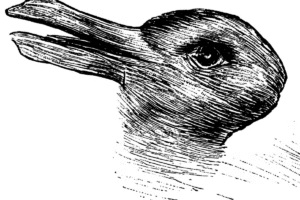
Wittgenstein was on about the same thing when he referred to the drawing which is a duck when we look at it one way and a rabbit when we look at it another. Nothing on the page changes, only the seeing. Science, which likes to think of itself as the great neutral observer, is no exception to the notion that everything is an interpretation. The philosopher Norwood Russell Hanson liked to ask what Tycho Brahe and Johannes Kepler saw when they watched the sun rise together. Tycho, who believed the sun travelled around a fixed Earth, saw the sun climbing into the sky. Kepler, who believed the Earth moved, saw the horizon dropping away from a stationary sun. Same dawn, same eyes, but the theory each man carried had shaped what he saw. Werner Heisenberg, who knew rather a lot about observation, remarked that what we observe is not nature itself but nature exposed to our method of questioning. This does not make science foolish. It makes it human, and it is one reason scientists spend so much time checking each other’s work.
A second claim is that understanding happens when the unfamiliar meets the familiar. Gadamer called this a fusion of horizons. When we really grasp something, whether a poem, an argument or a teenager, we take another viewpoint and join it with our own, and we come out slightly changed and with a wider view. That is also why a good play can be staged a hundred different ways without any one of them being the last word. Each production is a meeting between the horizon of the text, the horizon of the company and the horizon of the audience, and each meeting produces something new.
A third claim has the best name of the lot, which is the hermeneutic circle. It sounds like an unpleasant condition of the inner ear, but it simply means that understanding depends on context. We understand a sentence by understanding its words, and we understand the words by understanding the sentence. We understand a play’s final scene by remembering its first, and the first scene means something different once we know the last. It is not a dog chasing its own tail. It is closer to a spiral, in which each pass round leaves us a little better informed.
Now, at about this point, a sceptical dear reader may be wondering whether I am saying that anything goes, that every reading of Hamlet or every assessment response is as good as every other. I am not, and neither are the hermeneutic thinkers. To say that we interpret everything is not to say that we make the world up. The businessman’s photograph was a perfectly good measure of something but it was not the only measure, and it was certainly not a measure of what Picasso was attempting. The world discloses itself to us, but it does so according to the angle from which we look, and some angles are better than others for the question being asked. The sensible response is therefore not one of despair but care: to know which lens we are holding, and why we picked it up and looked through it in the first place.
The alternative is what we might call the businessman’s condition, the certainty of someone who has forgotten that they are interpreting at all. It is the root of dogmatism, and it is not the property of any one group. Religious people can have it, but so can scientists, atheists and the wholly unreligious, and so can anyone who is sure of their own wife’s likeness. Fundamentalism, in its broadest sense, is simply the inability to recognise that even our deepest convictions come to us through language, tradition and history. One of your ex-Director’s stock phrases, which he wheels out at least once a day, is that anybody who tells you that something is definitely the case is either lying to you or trying to sell you something, and probably both (a claim which, it should be noted, I am making rather definitely). Philosophers have a grander name for this habit of reading for what lies behind the surface: Paul Ricoeur called it the hermeneutics of suspicion, and found it at work in Marx, Nietzsche and Freud. It is a valuable lens, but it remains a lens, and the suspicious reader would do well to ask what it leaves out.
I also thought of these things during part of last week’s Professional Development Day, when our esteemed Director of Belonging reminded us of the value of knowing something of our colleagues’ lives, because we do indeed interpret people exactly as we interpret paintings and plays. The teenager who slams a door, the colleague who sends a curt email, the stranger who says something we find outrageous: each of them we read through our own lens, and we are very quick to decide that our reading is simply what happened. It is part of being human that we have our own passport photograph which we are inclined to wave angrily when something or someone challenges the way we think things are.
Harper Lee understood this well. In To Kill a Mockingbird, Atticus Finch tells his daughter that you never really know a person until you climb into their skin and walk around in it. It is a great description of empathy, and it is hermeneutics in everyday clothes; the fusion of horizons carried out in the corridor, at the kitchen table, or in the car on the way to school. There is also a comedic take on the idea which has raised a smile on my face several times over the years: before you criticise someone, walk a mile in their shoes; then, when you do criticise them, you will be a mile away, plus you will have their shoes. I confess it is this version of empathy I am also most likely to embody. Nevertheless, perhaps there is a serious point hiding inside the footwear. Walking is the hard part, and it is the part that changes us. To step into another person’s way of seeing, even briefly, is to discover that their reading of the world has reasons behind it, and that our own reading has a history we had perhaps stopped noticing. Having done that, we may still disagree, but we will be disagreeing with something far better than a caricature.
Your ex-Director offers no grand advice here, if only because he is as likely as anyone to wave his own passport photo-sized version of reality when provoked. But perhaps it is worth keeping an eye on the lens through which we frame the world, and worth wondering about the spectacles worn by the person across the table. Because before we get too cross about how someone else is reading the world, it is no bad thing to consider that our own picture might be rather small and two-dimensional.
Until next time, Happy reading / Interpreting!