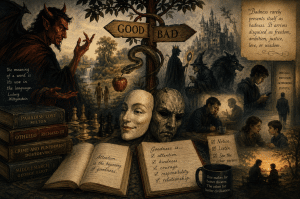
Bad Language
Last week, a generous soul in my familial circle gave me a book to read. I am always both honoured and troubled by such events. Honoured that somebody would deem me worthy enough to share a book with that they have read; troubled in case I do not see in the book what they see, which might be what prompted them to give it to me in the first place. And of course, the chances are, being a Director of such small brain, I probably miss most of what there is to be seen at the best of times.
The book in question was The First Bad Man by Miranda July. While I liked it well enough for its easy way with words and occasional absurdities, I don’t think your Director will be recommending it anytime soon. I certainly will not, for reasons we won’t be discussing here, be passing it on to my mother. There are some literary conversations from which no good can come.
What lingered with me, however, was not so much the novel as its title. The First Bad Man. Not the first awkward man, misguided man, mistaken man, misunderstood man, or traumatised man. The first bad one. It is a phrase that presupposes we know what bad means. And yet…and yet…
We really don’t.
Dear friend of the Column, Ludwig Wittgenstein, was a great one for pointing out that words get their meanings by the way they are used. As he wrote: the meaning of a word is its use in the language. As we have discussed several times, he rightly doubted that words derive their meanings from some hidden definition attached to them once and for all. The word good for example changes its meaning in the sentences, ‘moving your pawn to g4 was a good move’ and ‘she’s a jolly good person’. Contexts are forever changing, and so are what Wittgenstein called, the language-games we play. Unfortunately, recognising that words are slippery does not relieve us of the obligation to use them.
And so what is true for good is equally true for bad. The difficulty is that whilst most of us are content to admit that good can mean many things, we tend to assume we know a bad person when we see one. But the villains are not always as easy to identify as the fairy tales promised.
When we are young, of course, the matter seems perfectly straightforward. Fairy tales are full of bad people. There are wicked queens, evil witches, cruel giants, and wolves with suspiciously expansionist ambitions regarding grandmothers. They are bad because the story tells us they are bad. Their motives are unclear, their psychological development non-existent, and their prospects for rehabilitation somewhat limited. The witch wants to eat children; the giant wants to grind bones into bread; the wolf wants to impersonate elderly relatives. Case closed.
As we grow older, however, something curious happens. The villains begin acquiring backstories.
The wicked queen turns out to have suffered neglect. The monster was ostracised by society. The tyrant experienced childhood trauma. Every antagonist receives an explanatory appendix; every dragon is discovered to have attachment issues. We see this even in our modern mythologies. Where our old friend J.R.R. Tolkien stubbornly refused to make evil merely misunderstood; insisting that Sauron’s malice was a deliberate, catastrophic choice of the will, modern prequels rush to assure us that the dark lord simply had a difficult upbringing. Somewhere along the line, we seem to have become profoundly uncomfortable with the idea that anybody might simply be bad.
This is not entirely a bad thing. Understanding is generally preferable to ignorance; compassion is preferable to condemnation. If somebody behaves cruelly, selfishly, or destructively, it is usually worthwhile asking why. Human beings are complicated creatures, and our failings rarely emerge from nowhere.
Yet explanation and justification are not quite the same thing. To understand why somebody did something is not necessarily to excuse it. A reason is not always a defence.
This strikes me as one of the peculiar tensions of modern life. We are simultaneously more psychologically sophisticated and more morally hesitant than previous generations. Like Hamlet, we are paralysed by a surplus of perspective, pacing our own chilly mental ramparts, wondering if thinking too precisely on the event has stripped us of the ability to call a foul deed a foul deed. We know more than ever about the influences that shape behaviour, yet sometimes seem less willing to make judgements about behaviour itself.
Indeed, your Director occasionally gets the impression that bad has itself become a bad word. We prefer challenging, problematic, complex, troubled, or misunderstood. We are happy to discuss dysfunction, but reluctant to discuss vice. We are comfortable analysing wrongdoing but less comfortable naming it.
Literature, of course, remains stubbornly resistant to this trend. For while we may hesitate to speak of bad people in real life, we remain utterly fascinated by them on the page or stage.
The merest of glances through the literary canon quickly reveals that virtue has a public relations problem. Students reading Othello often find themselves drawn to the character of Iago. Shakespeare’s Richard III continues to delight audiences despite being, by any reasonable measure, appalling.
Indeed, a curious irony often emerges in classrooms studying Paradise Lost: in the grand narrative of the Fall, a traditional, if deeply unfair reading has often laid the blame for the introduction of evil squarely at the feet of Eve. If one follows that particular line of historical interpretation, the ‘first bad man’ was actually a woman. Yet it is not Eve who tends to capture the imagination and certainly not Adam who students regard as a mere simp (don’t ask me). It is Satan.
Milton’s great rebel has been attracting admirers almost since the poem was published. The Romantic poets were particularly susceptible. William Blake famously remarked that Milton was of the Devil’s party without knowing it, suggesting that the poet’s artistic genius could not help but make Satan compelling, courageous and even admirable. More recently, the literary critic Stanley Fish offered a rather different interpretation. Satan is attractive, Fish argues, not because Milton accidentally made him heroic, but because temptation itself must appear attractive if it is to function as temptation at all. If evil looked obviously ridiculous, nobody would choose it.
There is, I suspect, a broader truth lurking here. Badness rarely presents itself as badness. It turns up on the doorstep disguised as freedom, ambition, self-respect, self-expression, loyalty, security, justice or even love. The serpent in Eden does not advertise rebellion, misery and alienation. He offers wisdom. Shakespeare’s villains do not usually announce that they are villains. They offer plausible grievances, seductive arguments and just enough truth to make the lie convincing. Even fairy-tale witches are generally smart enough not to begin negotiations by explaining their plans to eat the children.
Perhaps this is why we remain fascinated by literary villains. They reveal something uncomfortable about ourselves. The most dangerous temptations are not the ones we instantly recognise as wrong. They are the ones that look right. If badness never appeared good, it would be remarkably ineffective. The devil, one suspects, would have a very short career indeed.
Yet the significance of these stories extends beyond literary technique. It is not simply that villains make narratives more interesting, though they undoubtedly do. It is that temptation and bad choices seem woven into the fabric of what it means to be human. The reason Satan must appear attractive is that human beings must be capable of finding him attractive. Without that possibility there can be no temptation; without temptation, no meaningful choice; and without meaningful choice, no freedom worth having.
What all the ancient creation stories of a ‘fall’ really remind us, therefore, is something far more fundamental about our nature. They suggest that the capacity to make bad choices is part of what makes us human in the first place. To be human in these narratives is not to be a perfectly programmed automaton, incapable of straying from the path. It is to possess agency, and with that agency comes the terrifying, beautiful, and occasionally catastrophic freedom to choose poorly. Without the possibility of the wrong choice, the right choice ceases to have any moral significance. We are defined by our missteps as much as by our triumphs.
Perhaps this is also why stories themselves are so often built around wrongdoing. Narrative depends upon the possibility that things might go wrong. Paradise, however desirable as a place to live, has always struggled as a narrative setting. The trouble with perfection is that nothing happens there. The Fall, by contrast, is a story.
Nobody writes a thousand-page novel about a community that functions perfectly, where everybody communicates clearly, fulfils their responsibilities, treats one another kindly, and resolves disagreements with mature emotional intelligence. (Believe me, if such a place existed, I would apply to be its Director tomorrow, if only for the reduction in paperwork.) Such a society would undoubtedly be pleasant to inhabit, but it would make for desperately dull reading. Villains create movement. They introduce tension. They unsettle settled worlds and expose hidden weaknesses. Dramatically speaking, they are indispensable. And anyway, as Sleeping Beauty shows us, you can’t keep Maleficent out of the castle no matter how hard you try.
This perhaps explains why evil so often appears glamorous in fiction. It possesses energy. It attracts attention. It gets the memorable speeches. Goodness, by contrast, is frequently quieter. It builds rather than disrupts, repairs rather than destroys, reconciles rather than divides. One makes for better theatre. The other makes for better civilisation.
And yet, this literary fascination conceals another truth: the badness that populates stories is rarely the badness that populates ordinary life.
Most of us are unlikely to overthrow kingdoms, poison rivals, launch invasions, or become Shakespearean villains. The opportunities simply do not arise in the course of an average working week. The moral failures that shape our lives are usually far smaller. They occur when we fail to listen properly. When we choose convenience over courage. When we speak carelessly, or allow resentment to ferment. When we reduce another human being to an obstacle, a stereotype, or an irritation.
The philosopher and friend of the Column, Hannah Arendt famously coined the phrase the banality of evil while reflecting upon the horrors of the twentieth century. What disturbed her was the frightening possibility that terrible things might arise not from monstrous individuals, but from ordinary people who simply stop thinking, stop paying attention, or stop taking responsibility.
This remains unsettling because it removes the comfortable distance between ourselves and the villains. If evil belongs exclusively to monsters, then most of us can safely exempt ourselves from consideration. If, however, it emerges from ordinary selfishness, then matters become considerably less reassuring.
As Aleksandr Solzhenitsyn famously observed, and as Dostoevsky illustrated throughout the pages of Crime and Punishment, the line dividing good and evil does not cut through states, nor between classes, but right through every human heart. The struggle is internal.
The older I become, the less convinced I am that goodness consists primarily in following rules. Rules matter, of course; schools would become rather chaotic places without them, and the lunch queue alone requires a certain Hobbesian enforcement. But goodness seems increasingly to involve attention.
And now, dear reader, you will have anticipated the inevitable McGilchrist (Bingo!) moment here, but the connection is hard to resist. Moral failures are almost always a symptom of left-hemisphere capture. When we reduce another human being to an obstacle, a statistic, or an irritation, we are allowing the emissary to usurp the master. We are mistaking the bureaucratic map for the living, breathing terrain, substituting a system of cold utility for a soul.
True goodness, by contrast, requires that expansive, relational attention that sees the whole picture. The good person notices. They notice the lonely Director sitting by themselves; they notice the student having a difficult week; they notice the family member who has fallen strangely silent. They see the other person not as an inconvenience to be managed, but as a centre of experience every bit as real as they are.
Badness, by contrast, often begins with a failure of attention. The moment another person becomes merely useful, inconvenient, or irrelevant. The moment relationship gives way to self-absorption. This is perhaps why some of literature’s most compelling villains are characterised by precisely this blindness. George Eliot’s Edward Casaubon from Middlemarch is a masterful example of this on a domestic scale; he is so entirely consumed by his own dead academic monument, his Key to all Mythologies, that he treats his young wife purely as an ornament or an extension of his filing. Such villains may be intelligent, witty, charismatic, or powerful, but they fail to recognise the reality of others. Everything becomes subordinate to the self.
And perhaps that is why goodness so often appears less dramatic. It is fundamentally relational. It consists not in grand gestures but in the continual practice of seeing other people properly.
This does not make it easy, nor does it make it exciting. Villains destroy things spectacularly; good people build things slowly. Villains make headlines; good people make communities. Villains generate plots; good people generate trust. One is considerably more entertaining than the other. And yet it is the latter upon which schools, families, friendships, and societies ultimately depend.
Perhaps that is why the title The First Bad Man stayed with me. Not because it answered any questions, but because it reopened one that many of us assume was settled long ago: What does it actually mean to be bad?
The older I get, the less inclined I am to answer that question confidently. But I suspect it has less to do with wicked queens, Shakespearean villains, and dramatic acts of malice than we often imagine. More often, it begins in the smaller failures that gradually erode our relationships with others.
Which is a somewhat sobering conclusion. Still, it could be worse. At least nobody has yet written The Moderately Decent Man Who Consistently Considered Other People’s Needs. It would undoubtedly contain valuable moral lessons, but I fear it would sell rather poorly.
Until next time, Happy Reading!/ Being…er…well you decide!
Director’s Detritus #25
The Omelette of Evil
In 1926, a notoriously temperamental Parisian chef named Henri Soulé fired his sous-chef on the spot for a ‘morally corrupt’ omelette. The crime? The chef had folded the eggs three times instead of two, creating an unauthorised structural map of a classic French dish. Soulé claimed the extra fold was a deceitful lie to the palate.