Act Natural
Sometime friend of the Column, dear old T. S. Eliot, opens The Waste Land with the memorable words: April is the cruellest month. Fellow poet Longfellow chips in on the month debate by offering May for our consideration in his poem It Is Not Always May. In it he adopts a distinctly carpe diem perspective, reminding readers that May is transient, as indeed are the youth and beauty it symbolises. He writes: Enjoy the fragrance of thy prime, / For oh, it is not always May! Those students currently embarking upon their exam adventures might reasonably baulk at the idea of seizing the carp of May but it is not for me to question the wisdom of the poets, and as Socrates might have said, the unexamined life is unfortunately not an option available on the AQA specification.
Teachers too find themselves swept into the annual examination ritual, particularly, of course, when it comes to marking the blessed things.
Your Director has this week been assessing the Year 10 Literature paper, which asked candidates to explore how poets present the power of nature. Our Year 10s have worked busily a day, writing valiantly about wind and rain and the like, as well as humanity’s battles with nature. All of which means that while marking the responses, your Director’s thoughts have been turning to the nature of nature itself. Hence today’s paltry words.
Asking the question, ‘what is nature?’ rather quickly leads us into the thornier question of what exactly we mean by ‘natural’. This turns out to be rather less straightforward than granola packaging and yoghurt advertisements might suggest. Historian and sometime professional disturber of complacency Yuval Noah Harari makes the point that human beings can never really violate nature because we cannot violate the laws of physics themselves. There is no cosmic police officer waiting behind a hedgerow with a speed camera prepared to issue humanity a fixed penalty notice for the invention of Wi-Fi or oat milk. If something is possible within the fabric of reality, then in one sense it must be natural. Genetic engineering, vaccinations, the internet, mildly unsettling meat substitutes and the existence of Year 10 mock exams are all, technically speaking, perfectly natural phenomena. Hurricanes are natural and so are tax returns. Neither, one suspects, should automatically be taken therefore as evidence of moral goodness.
Harari’s wider point, I think, is a useful corrective to our sometimes sentimental view of nature as a sort of morally approved pastoral backdrop complete with birdsong and photogenic foxes. Nature itself is not especially concerned with human flourishing. Stars explode. Species vanish. Asteroids hurtle silently through space entirely indifferent to parents’ consultations and A-Level revision timetables. The universe is under no obligation to arrange itself for our convenience. Which is perhaps both a sobering and oddly liberating thought.
And yet, even if everything is in some sense ‘natural’, human beings have never stopped arguing about what ought to count as natural in the first place. More intriguingly still, those definitions shift constantly across time. What one age dismisses as deeply unnatural, another eventually accepts as entirely ordinary. The printing press was once feared. Coffee was denounced in some quarters as dangerous. Novels themselves were accused of corrupting young minds long before smartphones inherited the role. One suspects that somewhere in ancient Athens a weary teacher was lamenting that students no longer memorised epic poetry properly because they had become dependent upon these new-fangled written texts.
Ideas about human nature shift too. Practices once regarded as inevitable, proper or simply ‘the natural order of things’ are later seen as cruel absurdities. Equally, behaviours once considered strange or dangerous gradually become woven into the fabric of everyday life. The phrase it’s only natural therefore turns out to conceal rather more philosophy than we might imagine. Often what we mean by ‘natural is simply familiar, or perhaps comfortable to us at this particular moment in history.
One age’s ‘natural’ order, then, has a habit of becoming another age’s curious historical artefact. And few periods illustrate this more dramatically than the world into which William Shakespeare was born.
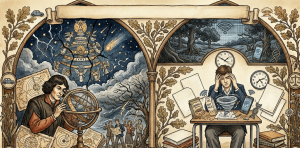
We sometimes forget quite how intellectually disorientating the late sixteenth and early seventeenth centuries must have felt. For almost two thousand years the Earth-centred universe of Aristotle and Claudius Ptolemy had provided not merely a scientific explanation of the cosmos, but also a moral and spiritual map of reality itself. The universe was ordered, hierarchical and meaningful. The heavens were perfect and immutable. Humanity, while certainly fallen, nevertheless occupied a privileged and central place within creation. Kings ruled beneath God; fathers ruled beneath kings; children obeyed fathers; everything had its allotted station in the great cosmic filing cabinet.
And then, rather inconveniently, the universe refused to cooperate.
Nicolaus Copernicus proposed that the Earth was not in fact the centre of things at all. Explorers such as Francis Drake circumnavigated the globe, expanding both maps and imaginations. New stars appeared in the heavens. Comets streaked across supposedly incorruptible skies. The crystalline perfection of the cosmos began to crack. What had seemed fixed, eternal and ‘natural’ suddenly looked rather less secure.
One can imagine the collective cultural vertigo. It is unsettling enough to discover that one has mistaken where one has parked the car at Tesco. Discovering that humanity may have misunderstood the structure of the universe for millennia is a rather larger psychological inconvenience.
Some greeted this opening up of knowledge with exhilaration. Others experienced it as catastrophe. Christopher Marlowe revelled in the sense of expanding horizons and human possibility. But the poet John Donne looked upon this collapsing cosmos with something approaching existential dread. In An Anatomy of the World he laments:
‘Tis all in pieces, all coherence gone…
It is difficult to overstate how radical that sentiment was. Donne is not simply worrying about astronomy. He fears that once old certainties collapse, everything else begins to fracture too: morality, authority, duty, relationship, even the very idea of a shared human order. If the heavens no longer possess a fixed hierarchy, why should earthly society? If nature itself appears unstable, what becomes of ‘human nature’?
Which brings us, in a roundabout sort of way, to King Lear. Few works dramatise the terror and ambiguity surrounding the word ‘nature’ more powerfully. Throughout the play the meaning of the term is fought over relentlessly. Is nature fundamentally ordered or chaotic? Moral or indifferent? Are cruelty and selfishness distortions of nature, or expressions of it? Edmund appeals constantly to ‘Nature’ as a justification for appetite and self-interest, while Lear appeals to nature as though it were a moral force capable of recognising justice and injustice alike.
The famous storm on the heath stages this confusion magnificently. At first the storm appears almost to mirror Lear’s inner turmoil, as though the external world itself were participating in human suffering. But gradually the play raises a darker possibility: perhaps the storm is not about Lear at all. Perhaps nature is simply doing what nature does, magnificently indifferent to human dignity. Lear begins by raging against the elements, then accusing them of siding with his daughters, then finally confronting the possibility that the true tempest may lie not in the skies but within the human heart itself. Significantly, amid his descent into madness comes his first genuine moment of compassion, as he notices the suffering of poor naked wretches.
Madness, in literature at least, often represents not merely the loss of reason but the collapse of an old way of seeing the world. Lear is forced into the terrifying question beneath the entire play: is evil a corruption of nature, or one of its ordinary products? Are human beings spiritual creatures who sometimes fall beneath their proper selves, or are we simply clever animals explaining our appetites after the fact?
The play, characteristically, refuses easy answers. But perhaps that refusal is itself important. Human beings seem unable to stop asking these questions, however elusive the answers become. What is nature? What is human nature? Is it something discovered, something inherited, or merely something constructed?
As Philip Larkin rather wonderfully writes in Days, attempting to answer these questions tends to bring,
the priest and the doctor
Running over the fields.
Which may feel faintly familiar to anyone currently living in proximity to GCSE or A Level revision.
And perhaps that is partly why arguments about nature have become so fraught in the modern world. We increasingly possess extraordinary powers to analyse, manipulate and redesign aspects of the world around us, while becoming rather less certain about the purposes toward which such powers ought to be directed. We can split the atom, edit genes, communicate instantly across continents and ask AI to produce passable coursework introductions in under four seconds. Yet the old philosophical questions remain stubbornly unimpressed by our technological achievements. What is a human being for? What does flourishing actually look like? What, if anything, do we owe one another?
Friend of the Column, C. S. Lewis worried that once human beings ceased to believe in any objective idea of human nature or human value, we might not become freer so much as increasingly manipulable. In The Abolition of Man he makes the unsettling observation that Man’s conquest of Nature may eventually turn out to be Nature’s conquest of Man. The more we treat the world, and indeed ourselves, merely as material to be engineered, optimised and controlled, the easier it becomes to forget that human beings are not simply problems to be solved but persons to be understood. What dear old Jack would have made of the Manosphere is anybody’s guess.
This perhaps explains why literature continues to matter, despite periodic predictions of its demise from people who think a spreadsheet is a personality. Stories, poems and plays insist upon asking questions that cannot be answered purely by efficiency, data or utility. A poem by William Wordsworth is not especially useful in the same way as a microwave is useful. But usefulness and meaning are not always identical categories. Human beings do not live by data alone. We also live by stories, symbols, relationships, memories, hopes and shared acts of imagination.
Indeed, one of the recurring insights of literature is that human beings flourish not when they place themselves triumphantly at the centre of the universe, but when they recognise their participation within something larger than themselves. That is true whether one finds it in Wordsworth walking above Tintern Abbey, Lear finally recognising the suffering of others on the heath, or simply in the small acts of kindness and fellowship that quietly sustain ordinary life.
Perhaps, then, the important question is not merely whether something is “natural”. Hemlock is natural. So are earthquakes. The more important question may be what kind of world helps human beings become more fully human: more thoughtful, more compassionate, more truthful, more capable of wonder.
Schools, at their best, are really attempts to cultivate precisely those qualities. Education is not simply the transfer of information from one generation to another, rather like intellectual Tupperware. It is also an invitation into questions that human beings have never quite managed to settle. Questions about meaning, goodness, beauty, truth, responsibility and what it might mean to live well within a world we did not create and only partially understand.
Which may be one reason why, despite everything, we still find ourselves teaching poetry in May.
Until next time, Happy reading/Being natural!
Director’s Detritus #10
The word examination comes from the Latin exāmen, referring to the tongue of a balance or scale. Technically, the ‘natural’ root of the word isn’t about testing knowledge, but about the precarious moment of weighing something to see if it holds true.