Jung at Heart
One of these days I might compile a list of questions which English teachers are most frequently asked. With a view to providing, once and for all, the definitive answers to these more or less constant companions. QETFAs, if you like. I’ll work on a better acronym. Or should that be an initialism? But I digress.
Today’s paltry words are prompted by a question I was asked this week. Now, If I had a penny for each time I have been asked the very same question throughout the long years of my career, I would easily be able to afford a sandwich from one of those high-end sandwich shops, although probably not an accompanying hot drink. Let’s not go mad.
The question in question, when it came, was neither original nor unreasonable. It was asked politely, even earnestly, and with the faint air of someone hoping there might be a genuinely satisfying answer this time. Why are we doing this? Or, to quote exactly: Why the hell are we doing this? More on hell later.
It is a question that tends to surface whenever we encounter something that resists immediate usefulness; a poem, a play, a novel written by someone who did not have an email address. And it is usually accompanied by a quiet but persistent suspicion that if something cannot be quickly explained, applied, or assessed, it may be that thing to be dreaded above all others: irrelevant.
I began to answer confidently enough but then realised I was drifting perilously close to saying, because it’s good for you, which, unless you’re trying to get a 3-year-old to eat their vegetables, is never a good answer; and probably not then either. So I stopped. And in that reflective pause, I recognised both the potential subject for a Director’s Column as well as perhaps the underlying question: What is the relevance of this?
That word irrelevant has a habit of cropping up in classrooms. It is the exasperated harumph directed at Shakespeare, Homer, Austen and all those other inconveniently thoughtful dead people. It is also a word that has wandered, rather confidently, into public life. Recently, a protest song was dismissed by an official voice as containing irrelevant opinions.
What is striking here is not the politics of the song, but the instinct behind the response: the suggestion that art which does not align neatly with an immediate political or economic purpose may be safely disregarded. Relevance, it seems, has come to mean usefulness on someone else’s terms.
The trouble here is that relevance has quietly been mistaken for utility. We have come to believe that something matters only if it can be immediately deployed: toward a career, a transaction, a measurable outcome. If it cannot be turned into a skill, a credential, or a talking point, it is filed away under potentially interesting, but more or less unnecessary.
The danger here is not that we become incapable, but that we become narrowly capable: quick with spreadsheets, slower with fear, envy or grief, particularly our own. We get very good at being efficient. Whether that always makes us wise is altogether another question.
When students say that a nineteenth-century novel feels irrelevant, what they often mean is that it looks unfamiliar. The clothes are strange; the pace is slower; the manners appear excessively polite or dramatically repressed. They are judging the book by its packaging. But the experience inside is anything but antique. Love, resentment, ambition, loneliness never go out of fashion. Elizabeth Bennet’s irritation at being misjudged, Pip’s shame at his own social ambition, Nora Helmer’s dawning recognition that her life has never been her own are all moments which land with force precisely because they are not tethered to a single era.
Take for example, Odysseus, washed up yet again on a hostile shore, lying creatively in order to survive and get home; clever, homesick, exhausted by the length of the journey. Or Macbeth, mistaking ambition for destiny and discovering too late that power does not quiet the mind, only amplifies its noise. Or Antigone, who refuses to stop caring even when the law tells her to, insisting that obedience without conscience is a form of violence. Or Lear, learning the cost of love only after he has surrendered authority, shelter, and dignity on a heath that strips him down to what he truly is. These characters are not museum pieces. They are recognisable people wearing unfamiliar clothes.
Friend of the Column, Carl Jung had a name for this persistence. He spoke of archetypes: recurring patterns of human experience that surface and resurface across cultures, centuries and civilisations. The seeker, the ruler, the caregiver, the trickster, the rebel, all figures who refuse to stay put in any single period or genre. We meet them everywhere: in Dante losing his way in a dark wood, in Milton’s Satan mistaking freedom for self-assertion, in Austen’s heroines negotiating the uneasy terrain between pride and perception, in Orwell’s characters discovering just how easily language bends when power leans on it, and in the quick-witted mouse of The Gruffalo, inventing a monster in order to survive. These figures endure precisely because they are not tethered to fashions, platforms or technologies. They map something more permanent: the architecture of the human interior.
One way of seeing this persistence more clearly is to notice how often stories return to the same journey. (Here’s the hell bit). Again and again, across cultures and centuries, we tell stories about descent: about going down, going under, crossing a threshold into danger, darkness, or loss. The underworld, hell, the cave, the dragon’s lair. Odysseus descends into Hades. Orpheus follows Eurydice into the dark. Dante begins not in heaven, but lost and disoriented. Bilbo leaves his comfortable hobbit-hole and finds himself facing Smaug in the depths of the mountain. Lucy Pevensie steps through a wardrobe and discovers that adventure, fear, and moral choice lie on the other side of familiarity.
Modern readers sometimes imagine the underworld as a piece of fantasy geography, safely distant from ordinary life. But we all know exactly where it is. We go there whenever the fragile order of our lives collapses: when illness arrives, when grief intrudes, when something we thought was solid turns out not to be. It is the territory explored in The Road, where a father and son move through a world stripped to essentials, and in Lord of the Flies, where the veneer of civilisation proves alarmingly thin.
This is why the image of the snake is a recurring theme throughout art and literature. No matter how carefully we construct our own small, habitable worlds, there is always something we did not account for. The story of Adam and Eve begins in a garden precisely because a garden is neither wilderness nor fortress, but an uneasy mixture of order and vulnerability. It is a place of warmth, sustenance, and belonging, and also the place where something can appear, uninvited, and change everything. Sleeping Beauty tells the same truth. The king and queen do not summon Maleficent; they attempt to exclude her. The curse enters not because the world is careless, but because it believes it can be sealed.
And if we are honest, the snake is not merely something that happens to us. It is something we are drawn to. Tell a human being not to touch, not to ask, not to go there, and curiosity will do the rest. This is as true of Pandora lifting the lid or Eve reaching for the fruit, as it is of children pulling back the curtain in The Secret Garden or Edmund stepping into the sleigh with the White Witch. These stories suggest that the problem is not that danger exists, but that we imagine vigilance alone will save us. What is required instead is the harder task: recognition, courage, and the willingness to deal with what cannot be kept out.
Stories like these endure not because they record events, but because they distill patterns of experience that repeat endlessly, with variation. They describe structures of reality that cannot be photographed or measured, but which nevertheless shape our lives. They are imagined, yes but profoundly real. A good work of fiction often feels more real than the circumstances that inspired it, not because it happened once, but because it keeps happening.
Anthony de Mello once observed that the shortest distance between a human being and the truth is not an explanation, but a story. Explanations tell us about reality; stories allow us to inhabit it. They bypass our defences, slip past our certainties, and invite recognition rather than agreement. We do not argue with a story in the way we argue with an assertion. We see ourselves in it, sometimes to our comfort, sometimes to our unease, and in doing so move a little closer to what is actually the case.
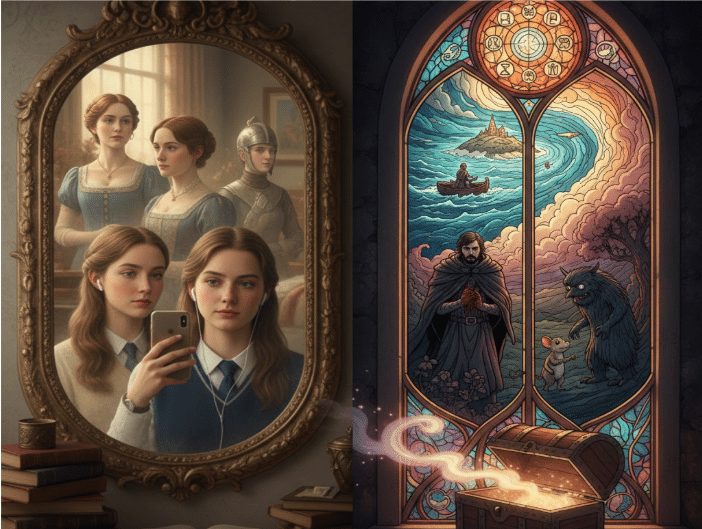
There is a familiar idea in education that literature functions as both mirror and window. As a mirror, it reflects back experiences we recognise. A student encountering heartbreak, frustration, or the pressure of expectation may find those feelings articulated with unsettling precision by a writer long dead and feel, perhaps for the first time, less alone. As a window, literature does something even more important. It allows us to inhabit lives not our own. Different eras, values, assumptions. It forces empathy to stretch.
If we restrict ourselves only to what feels immediately relevant we end up in a room of mirrors, seeing only versions of ourselves reflected back. Stories insist that we look outward. They introduce us to strangers and then quietly remind us that the stranger is not so strange after all.
This is why the study of so-called irrelevant subjects is, in fact, a masterclass in discernment. Literature rehearses moral perception. It asks us to weigh competing claims, to sit with ambiguity, to recognise when a persuasive voice, whether it belongs to Iago, the narrator of The Tell-Tale Heart, or a modern demagogue, is attempting to lead us somewhere dark while insisting it is doing us a favour. Students who have watched tragic heroes rise and fall are better equipped to recognise hubris in the modern world. Dare I say it, but students who have encountered the shadow in Shakespeare, in Greek drama, in dystopian fiction are less easily persuaded by rhetoric that seeks to divide the world into heroes and villains with suspicious neatness.
We are surrounded by information. It arrives constantly and demands instant reaction. Wisdom, by contrast, moves slowly. It accumulates. It asks us to compare the present moment with patterns we have seen before. Poems, plays, novels, songs are not distractions from reality. They are training grounds for understanding it.
So when a lesson feels irrelevant, I would encourage students to look again, and to listen for what I think of as the human echo. Who is afraid here? Who wants control? Who feels unseen? Who is refusing to look away? Because somewhere in that story will be a version of ourselves or of someone we will one day meet.
Stories remind us that we are part of a much longer narrative, one that did not begin with us and will not end when we receive our last ever notification buzz.
We read what came before us not out of nostalgia, but out of necessity. As T. S. Eliot observed, the present is shaped by its relationship with the past; each new work subtly alters the pattern that came before it. To cut ourselves off from that conversation is not to be modern, but to be momentary. We study the past so that the present becomes legible. There is no best-before date on truth, or on the human capacity to recognise it when it appears.
If relevance means anything at all, it is this: the power to recognise ourselves and others clearly. That is why stories endure. Not because they describe our world, but because they describe who and what we are. And so, your Director’s search for a moderately priced panini continues.
Until next time, Happy Reading/Being relevant!
The Director’s Detritus #2
Did you know…? Research in epigenetics suggests that some memories or fears can actually be passed down through our DNA. Next they’ll be telling us that Jung’s idea of a collective unconscious is spot on and we’re all born carrying the echoes of our ancestors’ stories. You never know…