To Choose or Not to Choose: It’s not actually that deep
These paltry words are the fruits of discussions with my students this week during our reading of Paradise Lost Book 9; a poem that has been grappling with the problem of human freedom for nearly four centuries. Milton’s lovely epic is not, however, a tired relic of seventeenth-century theology; instead, it acts as a mirror to the students’ own emerging sense of agency. At the bit we read where Eve sallies forth on her journey, which we all know ends with her eating the forbidden fruit, the questions started to come thick and fast; the kind of questions that cut through the veneer of literary analysis to the very essence of human existence. If God is omniscient, our students asked, then he knows what is going to happen way before the first sunrise in Eden. He knows that Eve will reach for the fruit, and he knows the consequences of that choice before it is ever made. Why, then, does he allow it? What real choice did Eve have if the outcome was already written in the divine mind? A lot of questions to deal with there before the bell for morning playtime.
Of course, these are not just academic puzzles; they are the questions that, in a mechanical or deterministic context, might be used to annihilate the concept of free will completely.
The late great polemicist, Christopher Hitchens once asked himself whether we truly have free will, and answered with characteristic, curmudgeonly economy: Yes, I think we do… we have no choice. Haha. T’is a joke that has done rather well for itself and it works precisely because it captures the fundamental human paradox that our students were wrestling with. It suggests that even when free will is slippery, elusive, or apparently impossible to prove via test tubes, formulae or pie charts, we persist in acting as though it exists. Like Adam and Eve, we choose, we judge, we blame, and sometimes we repent. It is, in a sense, all a performance, but as Milton suggests, it is a performance in which the acting itself creates the reality of our moral lives.
In Milton’s hands, the architecture of the universe is designed not to stifle choice, but to provide the stage for its dramatic enactment. Milton himself seems remarkably untroubled by the objections of the determinists, as does his Adam. In Book 3 of Paradise Lost, God defends the structure of creation in words that have long challenged interpreters: he says that he made humans sufficient to have stood, though free to fall. This phrase is the hinge upon which the entire poem turns. It suggests that freedom is not a static possession, like a certificate of ownership or a soul-shaped appendix somewhere within our anatomy. Instead, it is a condition carefully maintained and therefore a dynamic state that can be exercised, neglected, compromised, or reinforced. Crucially, Miltonic freedom only makes sense in relation to something resisted. Obedience without the possibility of prohibition is merely automatic, because freedom without a challenge is meaningless and empty.
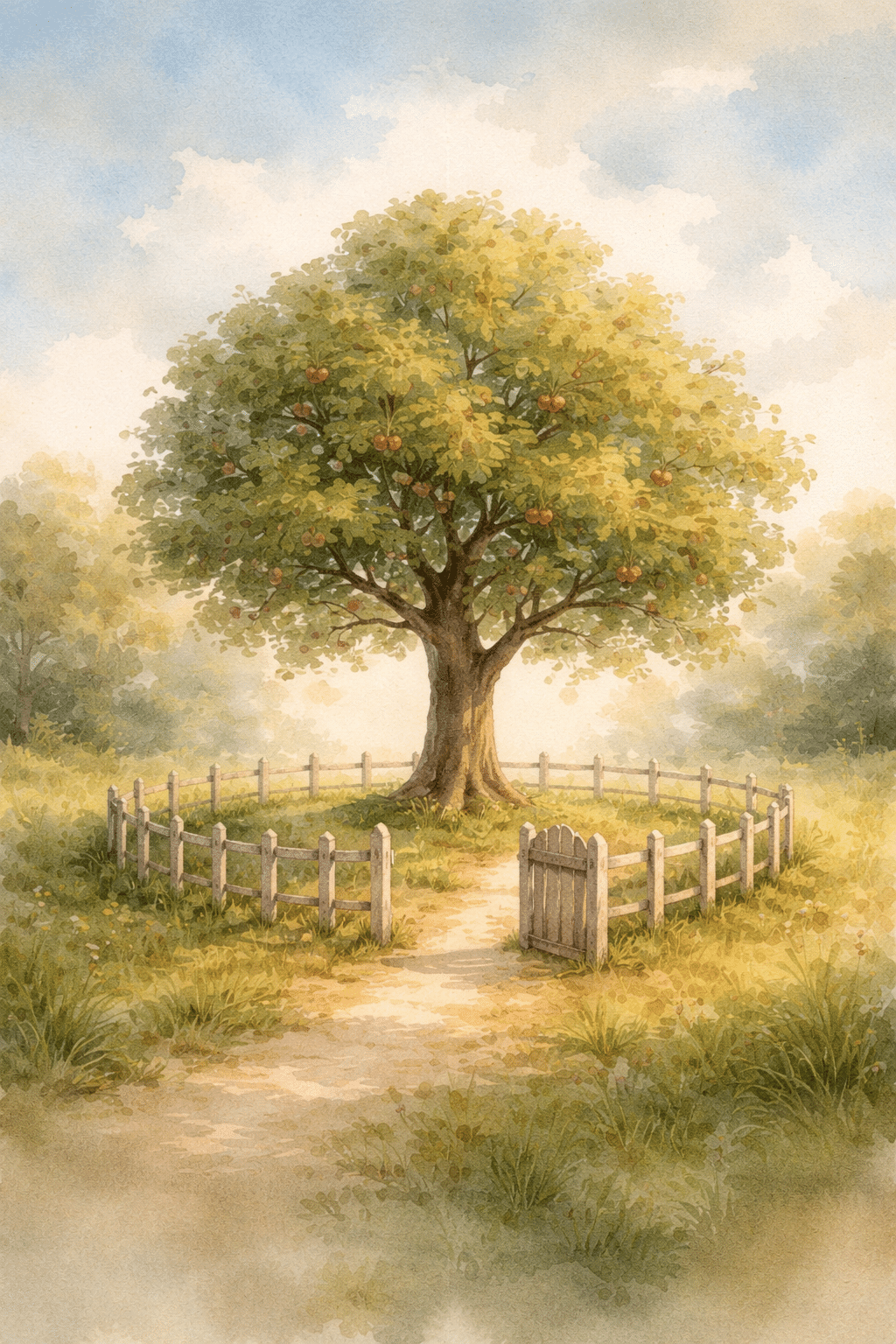
This brings us (at least figuratively) to the good old Tree of Knowledge, which is perhaps, in your Director’s humble opinion, the most misunderstood symbol in Western literature. In the classroom, students often initially view the Tree as a divine trap, an arbitrary whim, or a piece of unnecessary cruelty. They see it as a gotcha moment planted by a manipulative deity. And this is usually the point at which God begins to sound suspiciously like an annoying secondary school teacher. But within the rigorous logic of the poem, the Tree is the very condition that makes moral life possible. If it wasn’t there Adam and Eve might still be biologically human i.e. sentient, capable of survival, and full of sensation but they wouldn’t be capable of virtue. They would be capable only of compliance. This is the central pillar of Milton’s prose masterpiece against censorship, Areopagitica, where he famously refuses to praise a fugitive and cloistered virtue, unexercised and unbreathed, that never sallies out and sees her adversary. To Milton, goodness untested by temptation is mere habit, or what he calls blank virtue. Freedom then is inseparable from risk; a world without forbidden fruit may be safer, but it is also thinner, poorer, and none of us could ever even begin to start to flourish there.
Much of our modern difficulty with this idea stems from the way we describe the competing agents of our lives. When we speak of God, or Nature, we instinctively reach for labels (my students certainly do) like omniscient, omnipotent, or if we’re of the more Dickie Dawkins persuasion, genetically determined. We start treating these grand ideas, whether it’s God’s plan or our own genetic code as if they were just massive, immovable pieces of furniture in the room of our lives, leaving us no choice but to bump into them all the time. In this way, free will spends most of its time walking around bruised and apologising. But in the intellectual tradition Milton inherited, God is not a thing among things. St. Augustine reminds us that evil is not a substance but a privatio boni, in other words a privation or a ‘thinning out’ of the good and that the fallen will is incurvatus in se, or ‘curved inward’ upon itself. Freedom is distorted by this inward curve, but it is never wholly absent. Thomas Aquinas reinforces this by showing that divine causation operates at a level entirely different from human agency. God does not compete with our choices any more than the laws of physics compete with a bird in flight.
Once we stop treating the ‘divine’ (whatever that is) or the ‘biological’ (whatever that is) as competing agents, the familiar paradoxes of foreknowledge begin to dissolve. To know what will happen is not the same as causing it, just as an astronomer’s prediction of an eclipse does not pull the moon into the earth’s shadow. Eve remains free because she deliberates; she debates, persuades herself, and reasons. Her fall is not inevitable in a mechanical sense; it unfolds argumentatively, morally, and relationally.
You will not be surprised, dear reader, to learn that old friend of the Column, Iain McGilchrist, illuminates this very idea. Indeed, before we proceed, my regular reader may wish to tick him off their Director’s Column bingo card…
In McGilchrist’s writings on the divided brain, he stresses that free will is not the absence of causation, but the presence of responsiveness. He distinguishes between two modes of attention: one that abstracts, fixes, and predicts (the domain of the left hemisphere) and one that perceives relationships, context, and meaning (the domain of the right). Our freedom is threatened not by prior causes or neural firings, but by a worldview that flattens and detaches the self from its context. When we view the world through a purely ‘left-brain’ lens, we see a machine made of parts, and in such a machine, there is no room for the ghost of choice. But as McGilchrist argues, to believe ourselves to be mere machines is perhaps the most effective way of ensuring that we eventually behave as if we are. Like Adam and Eve, we must act attentively and relationally, or we risk getting rid of the very freedom we claim to prize.
Freedom, in both Milton’s theology and McGilchrist’s neurology, is therefore a fragile and enacted thing. It is expanded or contracted according to our habits of attention and desire. And it is no surprise that we see this play out across the landscape of great literature, where the ‘performance’ of freedom is shown to be a slow, incremental labour rather than a single explosive moment of choice. George Eliot, in the closing pages of Middlemarch, beautifully reminds us that the growing good of the world is partly dependent on unhistoric acts and on those who lived faithfully a hidden life. Freedom isn’t just about the big, dramatic decisions; it’s more like a slow, steady growth. It’s the result of the thousand tiny ways we choose to pay attention to the people around us every day. As George Eliot famously suggested, if we look closely enough at the ‘ordinary’ lives of others, we develop a sort of moral sixth sense; an attention so sharp we can almost hear the grass grow. For Eliot, we become free by attending to the reality of others, moving away from the ‘moral stupidity’ of taking our own egos as the centre of the world. Our choices are the result of the thousands of tiny attentions we have paid to the world around us long before the moment of so-called ‘decision’ arrives.
This idea is shared by the philosopher and author, Iris Murdoch, who argued that freedom is not a sudden leap of the will in a vacuum, but the ability to see rightly. For Murdoch, if we attend to the world with enough justice and love, the ‘right’ action often becomes clear, appearing not as a choice between two equal options, but as a necessity of the truth we have perceived. Conversely, Fyodor Dostoevsky, in the Grand Inquisitor chapter of The Brothers Karamazov, dramatises the human terror of this very burden. He suggests that humanity is often eager to trade its freedom for bread, miracle, and authority. We find the weight of real choice so heavy that we look for any system; political, religious, or deterministic, that will take the responsibility off our shoulders. Dostoevsky shows us that while freedom is our greatest dignity, it is also our greatest suffering. It is the ‘burden’ that makes us human, and yet it is the one thing we are most tempted to cast aside for the comfort of certainty. (Your Director hesitates to make a political point about the current state of the world, so he won’t. But do feel free to take a look around you).
Anyway, all of these voices; the poet, the saint, the scientist, and the novelist, get together around the campfire of a conclusion that free will is not the capacity to act uncaused; it is the capacity to act meaningfully within influence, temptation, and limitation. Milton’s Eden is not a padded cell designed to keep its inhabitants safe from error; it is a moral theatre in which the actors are aware of the stage, the script, the audience, and, most importantly, each other. The Fall is tragic not because it was inevitable, but because it was argued into existence. Modern determinism, whether it comes from the language of psychology or the hard data of neurology, does not erase our responsibility; it only sets the stage on which our choices are enacted. It provides the ‘given’ conditions of our life, but it does not dictate the ‘response’ we make to those conditions.
This has profound implications for how we view the life of a school. Schools are, by their nature, full of ‘forbidden trees’. Rules, boundaries, deadlines, and social expectations are often viewed by students as constraints; fences designed to limit their horizons and dampen their spirits. Your Director has for example, on numerous occasions witnessed the non-uniform hoodie suddenly become a matter of existential injustice. But if we take the Miltonic view, these limits are exactly what make freedom possible. A world without any ‘no’ does not produce freer people; it produces people who have never learned the art of choosing. If there is no standard to meet, there is no achievement in meeting it. If there is no rule to navigate, there is no development of the moral muscles required to act within a framework. Students must confront limits, wrestle with consequence, and argue with themselves. This friction is not an obstacle to their growth; it is the very engine of it.
When we hold a student to a standard, or when they struggle with the temptation to take the easy path over the right one, they are participating in the same moral theatre that Milton described in the seventeenth century. They are learning that freedom is something to be practised and fragile. It is something that grows when we attend to our relationships and our duties, and something that withers when we retreat into the cloistered safety of self-delusion or the easy excuses of I couldn’t help it. Schools are in the business of teaching students that their attention is their agency. How they look at a problem, how they listen to a peer, and how they respond to a setback are the moments where their freedom is either expanded or contracted.
Hitchens was right, though not in the way he intended. We may never prove, with the finality of a mathematical theorem, that free will exists in an absolute sense. We may never perfectly reconcile the ‘spectator’ view of foreknowledge with the ‘actor’ view of the present moment. And yet, like Adam and Eve, and like every moral agent across time, we act. We deliberate, stumble, recover, and we try again. We perform our freedom in the face of our limitations, and in that performance, we find our humanity. In our school, as in Milton’s Eden, the borders are there not to bar our way, but to remind us that we have the power to choose which way we turn. Perhaps that is enough, or at least, as Milton might suggest, it is the very thing for which we were created.
Until next time; Happy Reading/Being free
This week’s fun answer to last week’s fun question:
Q: A new play by Shakespeare is discovered. How did the literary experts prove it was authentic?
They checked with him; Tom Shakespeare from Peckham.
This week’s fun question to answer:
What makes this number unique: 8,549,176,320?