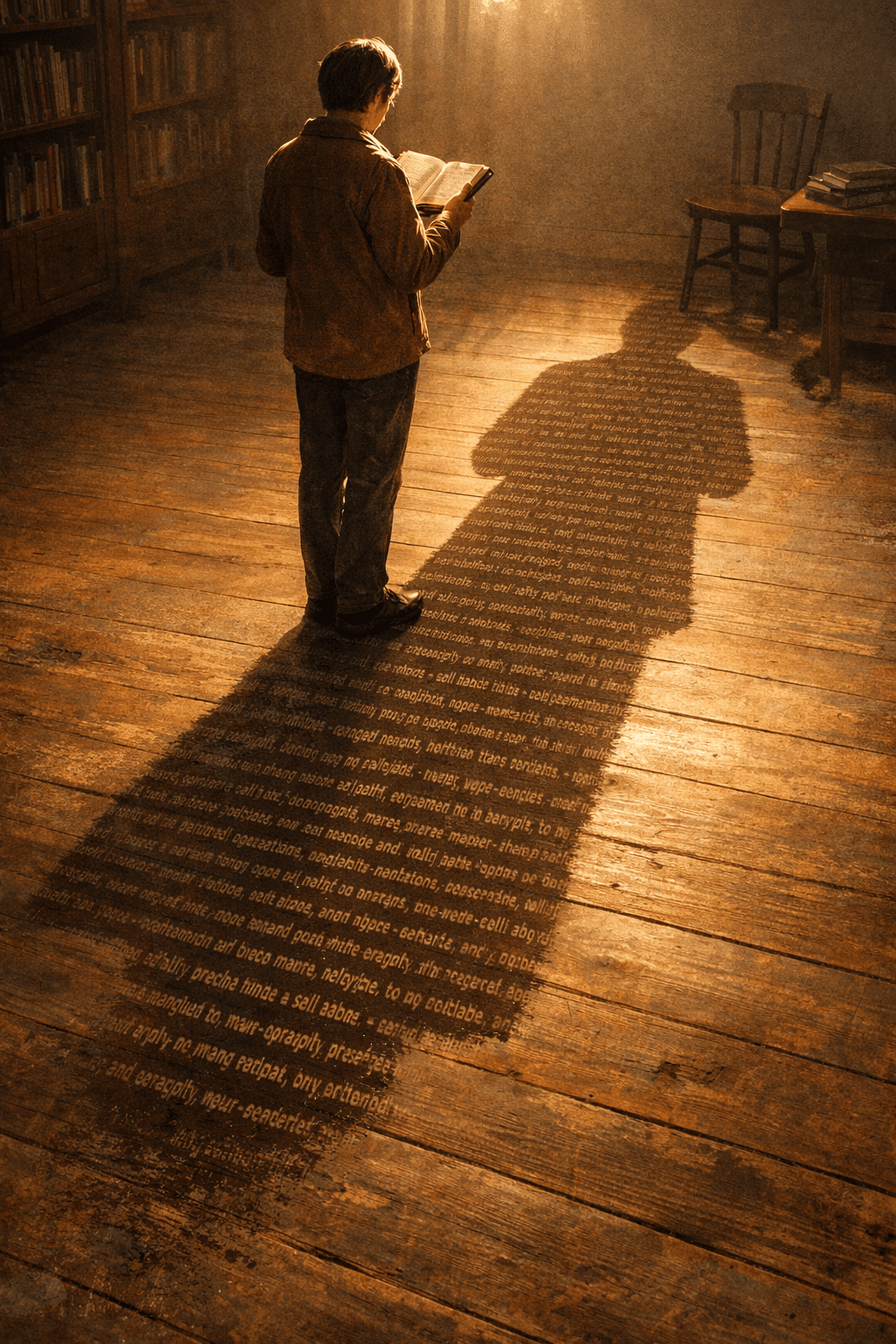
The Plot Thickens
If you will permit me to begin our new year together in tautological fashion; you dear reader, are a reader. And being so, you are also a member of a merry band whose numbers are dwindling all the time. Those annoying party-poopers, facts and figures, tell us that reading is in a state of ever-steepening decline In this context it would be remiss of your Director not to note that the Department for Education, in collaboration with the National Literacy Trust, has in its wisdom designated 2026 as The National Year of Reading. This is intended as a corrective to that decline amongst children, young people, and adults alike. And of course your Director sincerely hopes it will do some good. Campaigns, after all, are probably better than nothing, which is a remarkably low bar to step over, but nonetheless, step gaily we must…
I do not propose here to rehearse the many and several benefits of regular reading. We have discussed these before, and preaching to the choir is about as useful as arranging a delivery of coal to Newcastle, at least back when that would still have counted as an act of redundancy rather than historical re-enactment.
Instead, with your indulgence, I should like to spend our brief time together thinking about what reading is, and why stories, in particular, matter.
Your Director has had occasion to sit through many a well meaning presentation on the business of reading. I am always struck on these days, somewhere between the coffee break and the wheeling in of the buffet luncheon, that these seminars seem to treat reading as a means to an end rather than an event in itself. In this way, reading becomes something we do in order to achieve something or other; valuable only because of what it allows us to do next. You will be familiar with the list; we read to improve vocabulary, boost grades, enhance employability, stave off cognitive decline, or tick the relevant box on a spreadsheet somewhere deep within Whitehall. And of course reading does all that and more but to view it in this way entirely misses the point.
You will not be surprised to hear me suggest that reading, properly understood, is not merely a skill to be employed in the pursuit of something else, but an encounter. It is what Proust called that fruitful miracle of a communication in the midst of solitude. It is not a transaction in which information is extracted and stored, but a meeting between a reader and a voice, a consciousness and a world not one’s own. When we read well, something happens to us. We are addressed. And (whisper it quietly) being addressed is not the same thing as being informed.
The philosopher Hans-Georg Gadamer described understanding not as an act of mastery but as a conversation, and one in which we are as likely to be questioned as to find answers. Reading, at its best, is precisely this kind of conversation across time. We do not stand over the text, clipboard in hand; we find ourselves drawn into a dialogue in which our assumptions are gently, and sometimes violently, unsettled. The book does not merely say something to us; it says something about us, often before we have realised we were listening. I am often pointing out to my classes that their responses to texts should tell them more about themselves than about the texts.
This is why stories matter. Stories do not behave themselves. They do not sit still to be summarised, bullet-pointed, or efficiently harvested for ‘key messages’. They resist the kind of handling that reduces them to content. A story is not an argument, though it may contain many. It is not data, though it may convey truth. It is, rather, an invitation: come and have a look and see what there is to be seen.
C.S. Lewis once remarked that literature allows us to see with other eyes, to imagine with other imaginations, and to feel with other hearts. This is not a sentimental claim but a rigorous one. Stories enlarge our capacity for attention by asking us to inhabit perspectives not our own, and to do so without the safety net of immediate judgement. In an age increasingly tempted to reduce disagreement to error and complexity to confusion, this is no small gift.
To read a story should be to choose to submit to another rhythm of attention. Time stretches or contracts. Causation becomes moral as well as mechanical. Characters act, not because they must, but because they want to, or because they cannot help themselves. We find ourselves caring about people who do not exist, worrying about outcomes that have already been decided, and being surprised by endings we might have predicted perfectly well. This is not a failure of critical thinking; it is one of its conditions.
Old friend of the Column, Aristotle, understood this well. In his Poetics, he argues that poetry is in some sense more philosophical than history, because it deals not merely with what has happened, but with what could happen i.e. with the deep patterns of human action and consequence. A story, then, is not an escape from reality but a distillation of it, clarifying the moral shape of experience by freeing it from the clutter of contingency.
It is also why stories are so difficult to defend in purely instrumental terms. They do their work obliquely. They change us without announcing their intentions. Long after the plot has faded, a line, an image, or a moment will return unbidden, to complicate a decision or trouble a certainty. A good story does not tell us what to think; it enlarges the space in which thinking happens.
Augustine, reflecting on his own intellectual formation in the Confessions, describes how he was first moved towards truth not by argument but by story, by the drama of lives lived towards, and away from, the good. Before he could assent philosophically, he had to be captured imaginatively. In this way it could be said that stories prepare the soil in which ideas can later take root.
This, I suspect, is what makes stories quietly subversive. They remind us that human beings are not problems to be solved but mysteries to be lived with. And of course, that meaning precedes measurement. That understanding is not the same thing as control. As Iain McGilchrist has argued, the attempt to grasp the world solely through analysis and abstraction leaves us with a flattened version of reality, accurate in parts, perhaps, but profoundly misleading as a whole. Stories, by contrast, return us to the lived, relational texture of experience.
If we insist on treating reading solely as a means to an end, we risk losing sight of the end itself.
Those of us fortunate enough to spend our days in schools know this instinctively. We will have seen the student who reads around a novel; dutifully annotating, efficiently revising, without ever quite entering it. Everything is technically in place, and yet nothing has quite happened. The text remains inert, a specimen rather than a voice.
And thankfully we will also have seen, from time to time, the opposite miracle: the student who stumbles, almost accidentally, into a story and emerges altered. Slightly unsettled. More attentive. Harder to fool. Perhaps it is Macbeth that does it, revealing how easily ambition dresses itself up as necessity; or Jane Eyre, quietly insisting on a moral centre that will not be bought; or The Road, where love persists even when hope has become threadbare. In each case, the student has not merely learned something; they have been met.
It is no coincidence that the oldest and most enduring forms of human knowledge come to us as stories. Long before we wrote textbooks, we told tales. Not because our ancestors were unsophisticated, but because they understood something we are in danger of forgetting: that some truths cannot be stated without being storied.
Try explaining jealousy without Othello, temptation without Eden, or freedom without a choice that actually costs something. Milton knew this when he chose to cast the fall of humanity not as a philosophical treatise but as an epic drama, in which obedience, love, pride, and freedom are embodied in voices that still speak with unnerving familiarity. We understand Adam and Eve not because they are explained to us, but because we recognise ourselves in them.
In this sense, reading is not an escape from reality but a training in how to inhabit it. Stories rehearse us for life by allowing us to live many lives, briefly and safely, while remaining stubbornly ourselves. They teach us that actions have consequences, that motives are mixed, and that the world is richer and stranger than any single perspective allows.
Marilynne Robinson has written that one of the tasks of the novel is to restore complexity to the human person and to resist the temptation to reduce individuals to functions, pathologies, or types. Reading, then, becomes an act of resistance against a culture too eager to simplify, label, and move on.
So if this coming year prompts us to encourage more reading and of course your Director hopes it does, let us be careful not to encourage the wrong kind. Let us not reduce reading to another productivity hack or moral supplement. Let us resist the urge to instrumentalise stories until they become palatable but powerless.
If you will allow your Director to inhabit his old-fogey slippers: let us instead defend reading as one of the few remaining practices that asks us to slow down, attend, and listen to something other than ourselves. In a culture increasingly organised around speed, efficiency, and certainty, the quiet, time-consuming, and morally ambiguous act of reading a story may be one of the most countercultural things we can do. It is to insist, with our old friend Borges, that Paradise is not a state of perfect productivity, but a kind of library, a place of endless, layered, and transformative encounter. To read a story is, in the end, to recognise that the world is larger than our immediate purposes, and that we might yet be changed by what we are willing to take seriously.
Until next time, Happy Reading/…and Reading!
This week’s fun answer to last week’s fun question:
Sometimes cubed. Sometimes with a knot. Forever a secret this is not. Sometimes with thought this thing is bought. Sometimes by skill this thing is wrought. Most often with bright colours adorned. This might be carried, displayed, or worn.
Ans: A gift
This week’s fun question to answer:
A new play by Shakespeare is discovered. How did the literary experts prove it was authentic?