A Brief History of…Why I Came Into This Room
It is a truth universally acknowledged that a teacher half way up a flight of stairs will often forget where they are supposed to be going.
This particular universal truth came home to your Director the other morning, when I found myself standing in the doorway of Room 83 with tremendous conviction but absolutely no idea what I was doing there. I was holding a stack of papers, certainly; I was facing the right direction, probably; but the purpose that had propelled me so confidently down the corridor had dissolved entirely somewhere between the Main Building and Mr Haycocks’ door.
It was one of those moments in which consciousness appears not as the crown jewel of human evolution, but as a slightly confused junior minister narrating events with the air of someone who isn’t in full control of their briefs.
Philosopher and friend of this column, Thomas Nagel, came up with the elegant idea that consciousness exists when there is something it is like to be that organism. This definition is both elegant and alarming: alarming because it suggests that my own uneasy meander along the corridor was, in fact, a demonstration of a core ontological feature of mine. What it is like to be me, apparently, is to forget what it is I am supposed to be doing in the very act of doing them.
The thing is, that consciousness, I’ve come to realise, tends to reveal itself precisely when it misfires. When things are going well, awareness hums unnoticed in the background like a reliable boiler. But the moment it slips, when you forget why you entered a room, or find yourself on the landing wondering whether you are going upstairs or down, it becomes centre stage.
The great writers of the 20th century captured this beautifully. Virginia Woolf, for instance, understood that the mind is not a tidy procession of propositions but a Woolfian London street at midday, full of interwoven memories, drifting impressions, and the occasional lorry of existential dread. Her characters are constantly caught mid-thought, experiencing life as a series of fluid, inner movements. William Faulkner goes a little further. Reading the opening of his masterpiece, The Sound and the Fury, feels rather like trying to understand one’s own mind on a busy day. Faulkner presents consciousness as it actually feels: a jumble of impressions, half-remembered conversations, and emotional weather fronts rolling in without explanation. Consciousness is seen here as a sort of ongoing improvisation.
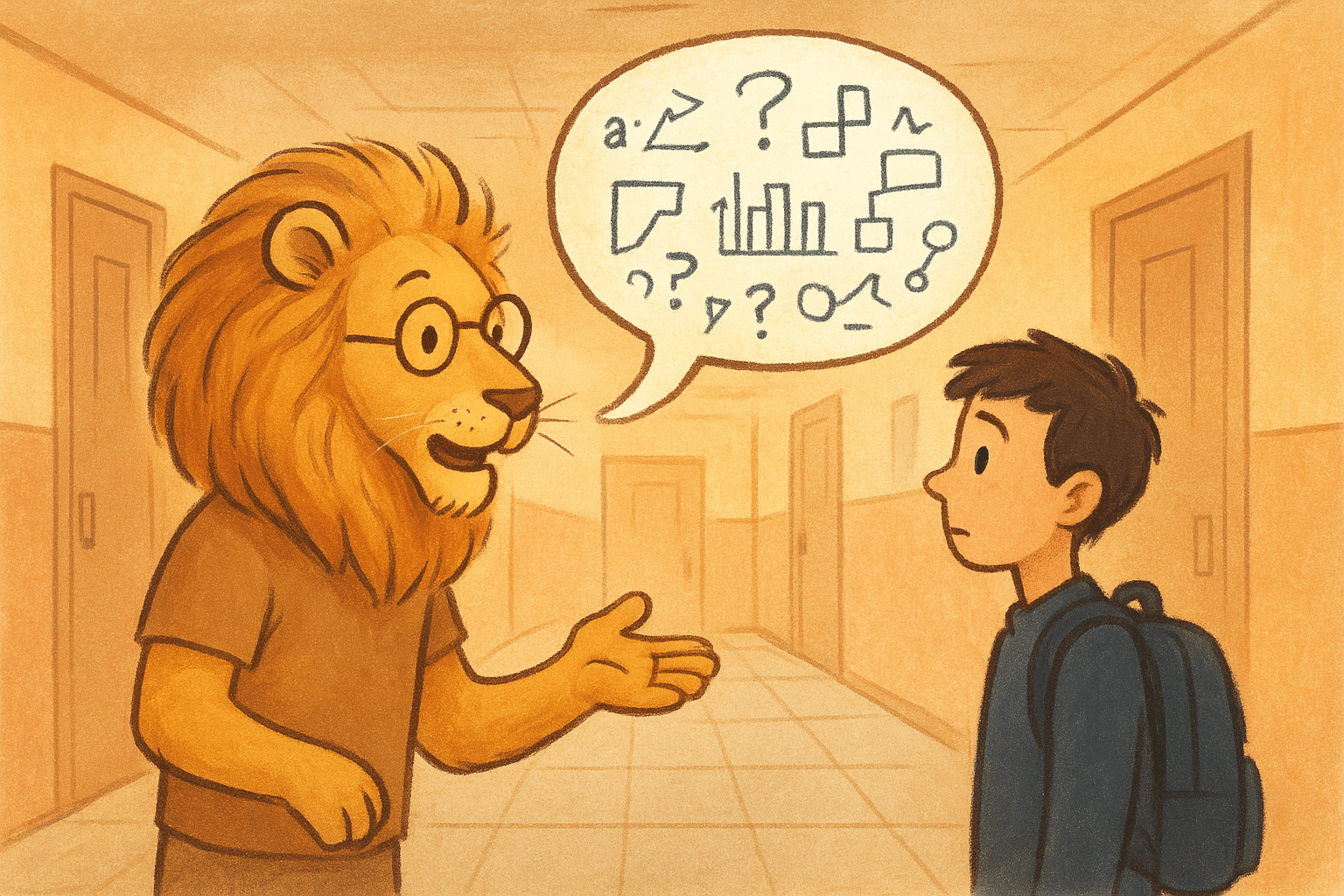
And yet, we treat it as though it were the unquestioned centre of everything. Another dear but uncompromising friend of the Column, Ludwig Wittgenstein, argued that even if a lion could speak, we wouldn’t understand it. Because consciousness is not only private; it is untranslatable. The Director’s unique experience does not flawlessly map onto yours, dear reader (for which I imagine, you are truly thankful). This goes some way to explaining why attempting to decipher the inner world of a Year 9 on a Thursday afternoon sometimes feels like trying to interpret the dreams of an octopus; an act of difficult, necessary translation across private worlds.
We like to imagine that consciousness is our superpower. But I’ve increasingly come to suspect that it is less a majestic cathedral and more a slightly leaky houseboat: charming, certainly, but prone to drifting off-course and waking you in the night with unexplained creaking.
This feeling of consciousness turning against us is nothing new. Fyodor Dostoevsky’s narrator in Notes from Underground is almost paralysed by his own awareness. Hamlet could have given him a run for his money but perhaps he is the first great anti-hero of introspection, endlessly dissecting his motives and sabotaging his own life simply for the pleasure of observing the sabotage. Dostoevsky captures the uncomfortable truth that consciousness, for all its splendour, is also the gateway to overthinking.
Franz Kafka’s The Metamorphosis adds another chilling layer to the problematic nature of our consciousness. The main character in this story wakes up as a giant insect, and consciousness becomes a silent witness to its own disintegration. Kafka forces us to ask: what remains of the inner “me” if the body is no longer recognisable to the outside world?
For centuries, this glorious, infuriating muddle of self-awareness remained a puzzle for philosophers and poets. But in the modern age, the question has shifted from “What is consciousness?” to “What happens when something gets it?”
Every few weeks, it seems, a headline appears warning us all that AI is about to become conscious. If and when it does, if it hasn’t already, we are told it will promptly replace us with something more efficient.
Your Director approaches such prophecies of doom with his usual cynical optimism. If the machines ever do become conscious, they will likely spend much of their time trying to make sense of their own thought processes, experience existential dread, and need a quiet lie-down. Indeed, the machines’ first words might well be those of Douglas Adams’ Marvin the Paranoid Android: “I think you ought to know I’m feeling very depressed.”
Long time friend of the Column, Iain McGilchrist argues that whether or not an AI is conscious is probably something we would never know anyway because it will always be more likely that it is simply simulating consciousness rather than experiencing it. AI, being parasitic and purely computational, cannot cross what he views as an unbridgeable divide. To possess human understanding, one must have an emotional life, a moral life, and a physical life embodied in flesh that dies and suffers. Consciousness and understanding, in this view, is built on the context of the world and the knowledge that our time in it is finite. This is, of course, a context an AI could not have.
Great contemporary writers like Kazuo Ishiguro in Klara and the Sun play with this idea. Klara, the Artificial Friend, observes the world with touching earnestness. Her ‘consciousness,’ if she has one, is not a weak imitation of ours; it is something unique. Ishiguro suggests the question is not whether AI can become conscious like us, but whether consciousness might take forms we cannot fully comprehend. Sci-fi author Peter Watts goes the other way entirely, imagining creatures that display extraordinary intelligence without the burden of subjective awareness, a deeply unsettling idea that maybe consciousness is a rather clumsy evolutionary workaround that we would all be better off without.
The crucial insight from the great writers is that consciousness is not merely a property of individuals; it is something we create between us. No one is fully conscious alone. It will be of no great surprise to you, my regular dear reader, to hear me say that consciousness in its richest sense is relational. It is forged through dialogue, through the moments of shared confusion and shared clarity. We’ve all been there. Chat GPT has not. Indeed, the door to that room is permanently barred.
We must also be wary of the deeper danger that many writers have identified: that in over-admiring the supposed divine efficiency of AI, we begin to imprison ourselves in the machine’s metaphor. This means that rather than speculating about how machines can be like us, we imagine and treat ourselves and each other, more and more like those machines.
We can hear this creeping reductionism in the increasing tendencies of our everyday language. Who is not familiar with scary metaphors like needing to recharge our batteries, feeling shut down or crashed from mental overload, or needing a reset? We talk of our bodies as hardware and our consciousness as software, and we describe forgetting things as deleting unnecessary files. Historically, people have used the dominant technology of their time; from clocks to telephone switchboards, as the primary metaphor for the brain. Today, that metaphor is the computer.
This is where the danger lies: not that machines become more like us, but that we begin to imagine ourselves more like them. By continually speaking of our minds in terms of databases and RAM, we risk becoming blinded to the messy, embodied, and emotional context that truly defines our humanity. We forget that we are not mechanisms to be optimised; we are beings meant to suffer, feel, and understand.
Of course, the machines will inevitably become smarter. They may even become better at diagnosing illnesses or predicting which member of staff will next forget why they went upstairs.
But human consciousness remains a lovely muddle: fragmented, looping, nonlinear, and occasionally found standing in a classroom doorway with no idea why. Yet it is also the source of imagination, humour, reflection, and empathy; in other words, everything that makes our shared life more than a sequence of tasks. Artificial intelligence may one day simulate that texture, but simulation is not the felt experience of being alive.
And so, if you find yourself this week emerging from a busy corridor unsure of what you had meant to do, take heart: you are participating fully in the human condition. Consciousness may be inconvenient, unpredictable, and occasionally unreliable, but without this strange and shimmering phenomenon, nothing in our shared world would matter at all.
Until next time, Happy Reading/Being conscious!
This week’s fun answer to last week’s fun question:
Is ‘No’ the answer to this question?
I could answer this question for us but I would be in danger of opening an infinite paradox loop.
This week’s fun question to answer:
Which common English noun consists of only two letters?