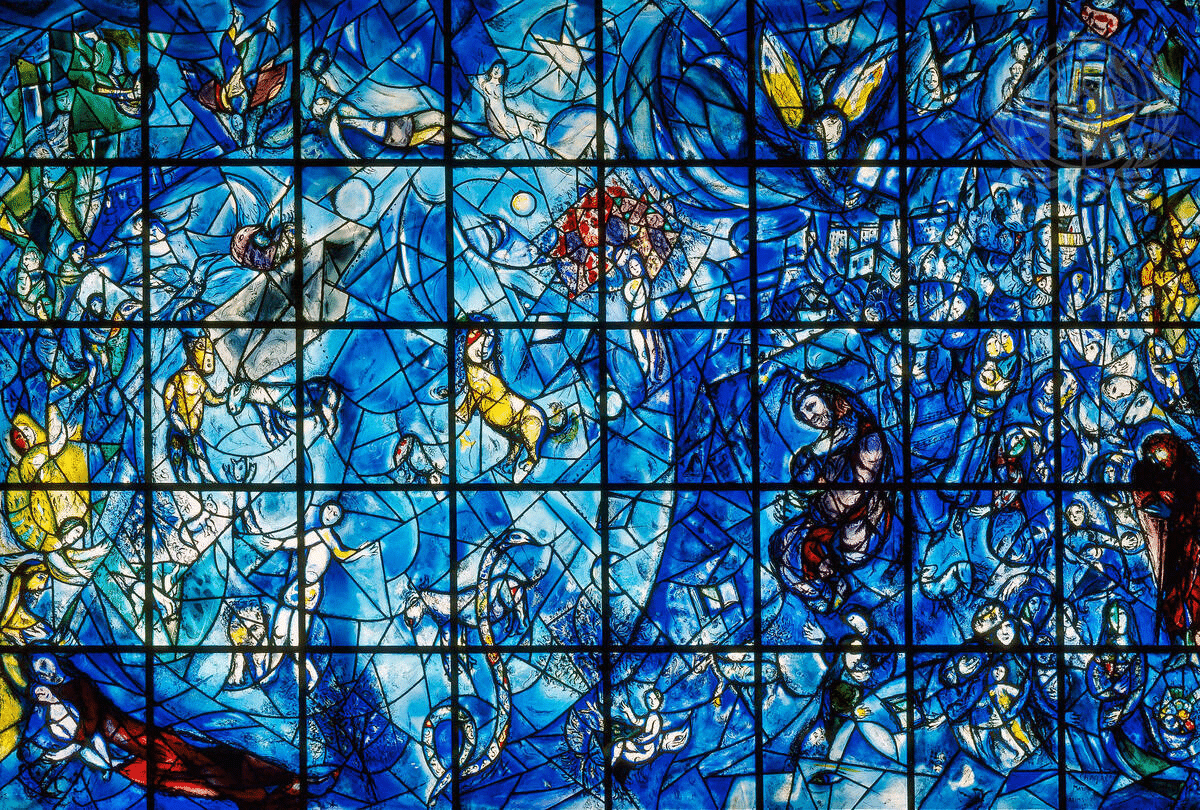
Peace Window – Marc Chagall (Marc Chagall and the United Nations Staff Members – 1964)
Peace Be With You
I can vividly recall, as a young Director, being in an Art class in my primary school. Our teacher was the formidable Mrs Caldicott. A tight brown bun of hair rooted to the top of a head whose brow was forever furrowed, she walked amongst us with a heavy tread, scowling and admonishing as she went, leaving in her substantial wake, bemused and subdued children. Even at that young age I could see Mrs Caldicott was clearly better suited for some other walk of life; preferably one where she did not have to deal with people.
In one lesson she asked us to paint a picture of “something that the world could not do without.” What I lack in artistic skill I have always made up for with blind enthusiasm, so it was with great gusto that I set about my masterpiece. After some time Mrs Caldicott approached us one by one and from a towering height required us to say what we had painted. There was the usual litany of “food,” “air,” “water,” “sleep,” etc., until Mrs Caldicott stopped by my chair and surveyed a badly drawn landscape, complete with idyllic but very unrealistic trees, luscious purple grass and a meandering stream that somehow merged into the sky.
“And what is that supposed to be?” she enquired.
“Peace,” I replied, fairly pleased that I had gone for a more philosophical answer than my classmates.
“Don’t be stupid,” Mrs Caldicott barked. “Of course we can live without peace! We do it all the time!”
Fearing her wrath, I did not protest or state my case any further, but I have often thought that Mrs Caldicott whilst in some sense, surely in her own case, was right, she was also profoundly wrong.
In recent weeks, the ceasefire between Israel and Hamas and Nobel Peace Prizes have taken up much headline space. In a few days we will remember the signing of the armistice which brought an end to the fighting in World War 1. Peace has been much discussed, though seldom really defined. We often hear the journalists speak of a ‘fragile’ peace, which of course is true of any peace which is vulnerable to the slings and arrows of outrageous fortune. Politicians declare ‘a roadmap to peace’ when this metaphorical route is often closed due to ongoing hostilities. Some of us light candles, make statements, post hashtags, and then, more often than not return to scrolling through the next outrage.
Perhaps Mrs Caldicott’s cynical realism has, in a way, become ours too. We treat peace as a pleasant but implausible abstraction, like unicorns, fully functional Wi-Fi on public transport or an assessment system that assesses the important stuff. We might even occasionally sing ‘peace on earth and good will to all’ but believe that’s one of those lyrics we’ll never have to take literally.
The trouble, I think, begins with the word itself. Peace in English grows in rather thin soil. It derives from the Latin pax, which originally meant a pact; some kind of formal agreement to stop fighting. That’s a contractual peace: the sort achieved by diplomats and signatures, not by the slow work of reconciliation. Contrast that with the Hebrew shalom or the Arabic salaam; words that mean wholeness, harmony and speak to the mending of relationships. Maybe our notion of peace is what happens when the guns go quiet when it should be more about what happens when the heart does.
If we were to visualise and audiate the difference, pax would be a ceasefire whereas shalom/salaam would be a symphony. One is about silence, the other about harmony. You don’t have to tell a teacher that there is a world of difference between a room that is silent because no one dares speak and one that is quiet because everyone is listening.
This week I reread a passage from Virginia Woolf’s Three Guineas, in which she argues that peace cannot simply mean the absence of war: The public and the private worlds are inseparably connected… the tyrannies and servilities of the one are the tyrannies and servilities of the other. Woolf’s point, made in 1938, whilst addressing the subjugation of women and the dangerous posturing of men, is also that the conditions that make nations violent are the same ones that make individuals petty, proud, and cruel. In other words, peace doesn’t really begin at the negotiating table, but more so at the kitchen table. Or the breakfast bar if that’s more your style. Because of course the so-called great conflicts are often just magnified versions of our smaller ones. Most wars, like most staffroom or playground disagreements, start with a refusal to listen, a determination to be right, and an inability to see that being right is normally far less important than being kind. As we have discussed before, we are in this vale of tears to build relationships not break them.
Woolf, as ever, is in good company. The Stoic philosopher Epictetus pointed out that nobody who is at war with themselves can be at peace with others. I’m not sure if it’s one of the criteria for the awarding of the Nobel Peace Prize but it probably should be; it would save an awful lot of paperwork if nothing else. The medieval theologian Thomas à Kempis wrote similarly, First keep peace within yourself, then you can also bring peace to others. in economic terms; you can’t export what you don’t produce domestically. Schools, at their best, are microcosms of this: imperfect attempts at ordered harmony, filled with competing wills, learning, sometimes painfully, to co-exist. The daily work of teaching; encouraging, correcting, forgiving, is itself a kind of diplomacy. If world leaders spent a term in a Year 9 classroom, the Geneva Convention might acquire a whole new chapter on pencil-throwing and restorative justice.
Of course, schools are not especially peaceful places. They are lively, occasionally chaotic, filled with collisions of ideas and personalities. Yet they also contain those rare moments of collective stillness; a silence that is neither enforced nor awkward, but full of the right kind of attention. It’s what happens (so I am reliably informed by better colleagues) when a class becomes properly absorbed, when the air itself seems to hold its breath. That kind of peace is fleeting but unmistakable. And, like all the best things, it cannot be commanded, only invited.
There is an old monastic saying which is something like; peace is not found in freedom from care, but in freedom from self. The monks had a point. There are those that talk a lot these days about ‘inner peace,’ usually whilst breathing in the latest scented candle fragrance and checking in with mindfulness apps. But the peace of the mystics isn’t spa-like tranquillity; it’s more like the stillness of a tree that bends in a storm without breaking. The writer Kathleen Norris once defined peace as not the absence of struggle, but the ability to endure it with grace. A definition that, between you me and the gatepost, could also describe the average Year 11 parents’ evening. On both sides of the gatepost of course.
Peace, properly understood, isn’t bland. Friend of the Column, Chesterton, who distrusted all tidy solutions, said the only way to ensure peace in the world is to have war in one’s heart: war against pride, prejudice, and despair. He also noted, with typical paradox, that the most peaceful people are those most capable of righteous anger. The peace of the coward is merely inertia; the peace of the saint is ordered courage.
Perhaps this is why genuine peace so often emerges from unlikely places; a Christmas truce in a trench, a handshake on a picket line, a young Director’s picture of a meandering stream (forgive me). It happens not when conflict is erased but when it’s transformed. As the poet Denise Levertov wrote, Peace is not the absence of struggle but the presence of justice. One thinks of the Civil Rights marches, the Solidarity movement, Gandhi’s salt march, all demonstrations that peace without truth is mere decorum. There is such a thing as too much civility.
My own adult attempts at peaceful living have been patchy at best. I once thought of booking some yoga classes. When I rang the gym they asked me how flexible I was. My reply that I could do most Tuesdays and Thursdays, was not what they were after. So no downward dogs for me. And anyway, if anyone invites me to ‘empty my mind,’ I’m already well ahead of them. I reckon that inner peace is best sought indirectly: through attention, through gratitude, and occasionally through switching off notifications. A quiet walk after rain does more for my serenity than an hour of forced transcendence in a draughty gym hall.
In this, I find comfort in Montaigne, who observed that the greatest thing in the world is to know how to belong to oneself.” Peace, for him, was not withdrawal but perspective, and the art of taking oneself lightly. It’s kind of what the Benedictines mean by conversatio morum, the continual turning toward the good, the refusal to let noise become the measure of importance.
And it strikes me that this is exactly the kind of peace we could use more of, not the peace of agreement but of attentiveness; not of uniformity but of understanding. It is, after all, perfectly possible to be wrong in a peaceful way.
Theologically, peace has always been tied to reconciliation rather than comfort. In the Christian tradition, the ‘Prince of Peace’ doesn’t arrive bearing scented candles and whalesong, but saying I bring not peace but a sword meaning, presumably, that peace can’t be imposed without truth. The Buddhist tradition has a similar notion: the path to enlightenment runs straight through discomfort. Even the natural world seems to agree. The surface of a lake may be calm, but only because underneath, unseen forces are constantly adjusting, balancing, compensating. Equilibrium is not stillness but more like motion held in tension.
Which may be why I have always liked that image of peace as a garden. It needs pruning and patience; it requires us to tolerate mess in the hope of future order. Too much control and everything dies; too little and it becomes chaos. And of course, even the greatest gardener is unable to grow anything. What they can do is provide the conditions where growth might take place. A healthy garden, like a healthy mind or a healthy community, is one where conflict is transformed into growth. It is not the absence of disturbance but the presence of life.
When I look back on Mrs Caldicott’s lesson now, I rather wish I’d had the courage to argue my case. Not that it would have helped: Mrs Caldicott struck me as a woman for whom ‘inner peace’ meant the period between ringing the bell and the class filing in. Yet she did, unintentionally, offer a profound challenge: can we live without peace? Technically, yes. But only in the same sense that we can live without poetry, or kindness, or hope. We can survive without them, but only just, and certainly never well.
Every now and then, when the world feels particularly noisy, I imagine showing Mrs Caldicott my adult attempt at that painting: a scene less idyllic perhaps, the trees a little bent, the stream less meandering and more muddied. But still, somewhere in the frame, there would be a figure sitting quietly, looking, listening. Not the peace of perfection, but of attention.
That, I think, is the peace the world cannot do without. It’s not the one we negotiate, but the one we notice and therefore bring into being.
Until next time, Happy reading / Being in peace!
Answer to last week’s Fun problem to solve
What should Donald Duck have been called?
It’s a little controversial but ‘Duck’ is his mother’s maiden name. Donald was born with the family name, Drake.
This week’s fun question to answer:
A driver was going the wrong way down a one-way street. She passed several vigilant police officers, but they didn’t stop her. Why?