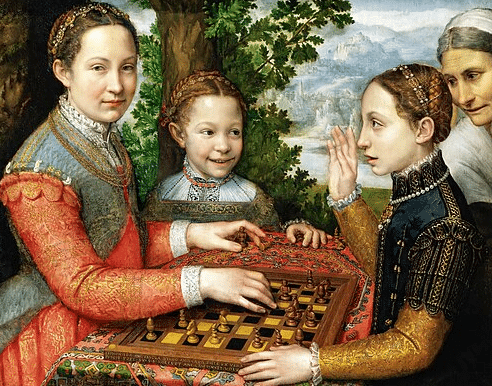
The Game of Chess, Sofonisba Anguissola c. 1555 (A celebration of power).
PowerPoints
I remember many years ago, as a young Director, having a stalling discussion with the school bully as he gripped the lapels of my school blazer. I asked him, hypothetically of course, if we were to have a fight over his claim that two plus two equalled five and he were to prevail, as he surely would have done; you don’t get to be the school bully without some skills in that area. And you don’t get to be an old Director with any skills in those areas. But I digress. So back to the memory. I can still recall the look on Paul’s face (for that was his name and it probably still is) as he looked down at me with that cold sneer of command and pointed out that whatever reason he beat me up over, he would be right and I would clearly be wrong as well as defeated and most likely, on the ground. This was probably my first real encounter with that uniquely postlapsarian idea that ‘might is right’. I like to think it was also the inspiration for Orwell’s haunting image of Winston scrawling 2 + 2 = 5 in the Chestnut Tree Cafe at the end of 1984, signifying the absolute power of the Party, but even your Director is not that old. And certainly not that influential
Today’s paltry words are to be some musings on the notion of Power with a capital P.
I imagine there’s a particular moment in every school leader’s life; somewhere between chasing a pigeon out of the hall and apologising for a broken boiler, when the word ‘power’ starts to feel a little…well, theoretical.
Take me for example. Or take my title. Yes, I’m named the Director, and on occasion people have been known to look meaningfully at me when it’s time to make a decision about something. And once I wielded the mighty rubber stamp of Policy. But in practice, I have no power, and between you, me and the gatepost, dear reader, that’s the way it should be.
Nevertheless, ‘power’ is an idea which comes up a lot. What it is, who wields it, and how it can be obtained, are questions which arise in all sorts of discourses. All conflicts from wars between nations to the school playground for example can be traced to attempts at gaining some kind of power over others. And of course power is also a word which is whispered up and down the lengths of the hallowed corridors of educational establishments. Only yesterday I watched a teaching ‘masterclass’ video which talked about how we should be in the business of “empowering” students, as though we’re supposed to be handing out the AA batteries at the school gates.
It strikes me, not as Paul would have liked to have done no doubt, that we often conflate power with authority, and the two are not the same. Power can be understood as the ability to make people do things, through fear, charisma, legal structure, or sheer weariness. Authority, by contrast, is bestowed rather than imposed. It arises from trust, respect, consistency, which are qualities harder to measure and far easier to lose. You can give someone a title, but you can’t make them worth following. Look no further than the typer of these paltry words.
The sociologist Max Weber famously outlined different kinds of authority: traditional, charismatic, and legal-rational. Most school leaders, I assume, are meant to fall into the third category. Though I suspect many long for a dash of the second, the kind of spellbinding presence that hushes an assembly with a single raised eyebrow. But the truth is that in most institutions, authority is quietly in decline, as Hannah Arendt noted decades ago. Institutions multiply rules when relationships falter. And yet rules alone can’t sustain meaning, as we have discussed. Wouldn’t you know it, but authority too is relational. It lives in tone, not tone of voice.
There is something deeply comic, and faintly tragic, in the desire to control. And nowhere does this desire manifest more vividly than in leadership. I once worked in a school where the Senior Leaders spent an entire year crafting a behaviour strategy so elaborate it required colour-coding, laminated flowcharts, a glossary and a trolley to move it around. It was to be unveiled to the whole school on a particular Monday with the gravitas of Hammurabi’s Code. That morning, a seagull flew into the canteen and chaos reigned. The glossy behaviour framework ended up strewn across the floor, as children screamed, crisp packets scattered, and the Year 7s treated the incident as a kind of apocalyptic prophecy. I realised, not for the first time, that control is mostly an illusion, particularly when wildlife is involved.
This illusion isn’t new. Our old friend Prospero there on his island, marooned with his books and his magic, spends nearly the entire play pulling strings controlling spirits, conjuring storms, orchestrating vengeance. And yet by the end, he chooses to relinquish his power, declaring, This rough magic I here abjure. The moment he lets go is the moment he becomes fully human again. The play doesn’t end with domination, but with forgiveness. Perhaps real influence begins precisely where control ends.
It’s tempting to believe that if we just had more power, we could fix everything. We chase budgets, strategic plans, and the ability to dictate outcomes. But what if we’re chasing the wrong thing entirely? What if the true currency of effective leadership isn’t power, but wisdom? Power is about doing; wisdom is about knowing; knowing yourself, knowing your community, and knowing when not to act. It’s the discernment to understand the root of a problem, not just its symptoms, and the humility to recognise that the best solutions often emerge from collective insight, not individual decree. We often seek power to impose a vision, but perhaps we should seek wisdom to understand what vision is truly needed.
That’s not to say all power is false or coercive. Some of the most transformative kinds of power are invisible, and we’ve all experienced them; a look from a teacher that calms a room; a well-timed word that redirects a life, a quiet gesture of kindness that ripples further than the one who offered it will ever know. The world can associate power with noise; megaphones, manifestos, and main characters. But there is power in silence too, in restraint, in the kind of presence that changes things simply by being there.
Literature, of course, is full of such figures. In Jane Austen’s novels, it is often the character who watches, listens, and reads the room, quite literally, who ultimately shapes its outcome. Power isn’t always about pushing to the front of a group of world leaders; sometimes it’s about seeing the whole pattern. In Emma, Mr Knightley’s influence comes not from domineering, but from a steadiness that gives others space to grow. Austen understood that power exercised wisely is not felt as pressure but as possibility.
It’s no accident that this kind of power often aligns with responsibility. With great power comes great responsibility, says Spider-Man’s Uncle Ben (or Voltaire, depending on your cultural leanings). The point remains: power is only as good as its direction. The philosopher Simone Weil went further. She argued that attention; the act of focused, generous, self-effacing attention, was the truest form of love, and therefore the deepest form of ethical power. Not the power to compel, but the power to regard another person in their full humanity, without distraction, without agenda. This is where wisdom manifests most beautifully: in the ability to truly see.
If schools are anything, they are theatres of attention. And not only in the performative sense. They are places where being properly seen can be redemptive. A student remembered because of their kindness rather than their lateness for example, or one known for more than the headline data. This kind of recognition is a kind of power too that is often underestimated. And it’s also a hallmark of wisdom.
Language itself carries power, though we rarely notice it. Orwell knew this well. In 1984, he imagined a regime that controlled not just behaviour but thought, by narrowing the scope of language until dissent became literally unthinkable. But we don’t need dystopias to see how words shape the world. Our institutional speech is full of euphemisms: “robust interventions,” “behaviour pathways,” “learner journeys” to name but three of the ones I’ve heard today. Sometimes I think we use them not to clarify but to shield ourselves from the real weight of what we’re doing. As our friend Wittgenstein understood, the language that we use shapes the world we experience, as he puts it: the limits of my language mean the limits of my world. So perhaps it’s worth asking: what kind of world are we speaking into existence? And whether our use of language reflects a pursuit of power, or a deeper understanding born of wisdom?
Of course, it’s tempting to think that if we could just wield power correctly, i.e. wisely, benevolently, enlightenedly (is that a word?), we could finally fix everything. But power doesn’t just exert itself outward. I’m reliably informed that it acts upon the one who holds it. It tempts and it reveals. Power tends to corrupt, wrote Lord Acton, and absolute power corrupts absolutely. But I’ve never been sure about that. Perhaps power doesn’t actually corrupt, more that it uncovers or brings into the light what was already there. In much the same way we could argue over whether the witches planted the seeds of regicide in Macbeth, or they uncovered a maniacal ambition that he already possessed. The danger lies therefore not so much in the power itself, but in our failure to look clearly at what it shows us, and to respond with wisdom rather than mere might.
And yet like everything else, when it works, it works. When it’s shared, harmonised, directed toward the good, power can become something altogether more beautiful. Not domination, but composition. Not a hierarchy of command, but a harmony of purpose, as we spoke about last week. A jazz quartet, rather than a marching band, if you will. Each part is distinct but responsive, in a good band, you will notice listening as much as playing. There’s no loss of structure in the process of making music, but the structure is in service of relationship. In the words attributed to friend of the Column, Heraclitus, Opposition brings concord. Out of discord comes the fairest harmony.
So yes, I have a job title, and yes, there are times I must make decisions, talk about policies, or, heaven help me speak at Leavers ceremonies. But the longer I do this, the more I suspect that real influence lies elsewhere: not in the exercise of power for its own sake, but in the wisdom to know when to lead, when to follow, when to listen, and when to let go. It’s in the way we shape each other; in the tone we set without knowing; in the moments we listen instead of lecture, and the times we relinquish control so that someone else might step forward.
And maybe that’s the paradox: that the strongest kind of power might just be the power to let go, guided by the wisdom to know when and how.
So dear Paul, wherever you are, you can let go now.
Until next time, Happy Reading/Being Powerful!
TPQ #5 Does real power come from being obeyed, or being understood? (Do we want to be in charge, or do we want to be in relationship? And can those ever be the same thing?)
(Thorniness level out of 10? 7.8)