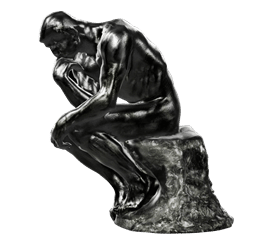
Le Penseur, by Auguste Rodin, 1904
I know that I am intelligent, because I know that I know nothing.
Socrates
Knowing Me, Knowing IQ (Aha!)
It may well be a sign of intelligence that there is no accepted definition of intelligence. This hasn’t stopped us from trying to measure it, compare it, graph it, correlate it to other things we don’t really understand, or even reduce it to a single number, which may well be a sign of something else entirely. Perhaps one of the more reliable indicators of intelligence might be the desire not to quantify it too quickly. Your Director couldn’t possibly comment. Or maybe he could…
Intelligence is a word which floats with all the confidence of the best charlatans, through exam reports and university applications, into parents’ consultations and out of the mouths of those blessed with high-functioning self-regard. But try to hold it down, and it slips away like a slippery well-read eel.
Let us see if a few paltry words might illuminate the eel, even as it slithers out of reach.
Most people would be happy I think, to say that intelligence has something to do with solving new problems and something to do with abstract thought. The former demands creativity, flexibility, and the transfer of knowledge; the latter rests on the ability to manipulate concepts, spot patterns, and reason logically. In short, it’s not just what you know, but what you can do with what you know, how far you can stretch it, reshape it, or, and perhaps most especially, abandon it when a better idea comes along.
This is why intelligence can never be entirely reduced to a static measure, and why knowledge and intelligence, though often mistaken for one another, are not the same. A useful illustration of this, as we have discussed before, is John Searle’s “Chinese Room” thought experiment. For those new to these Columns, imagine someone in a locked room, receiving written Chinese characters through a slot. They have no understanding of Chinese, but they do have a vast instruction manual for replying with other Chinese characters based on the input. To an observer outside, it appears the person in the room understands Chinese. But they don’t, they’re simply following instructions. Searle was using this particular scenario against the claims of strong AI, but the point, whether or not one accepts Searle’s conclusions about AI, is that there’s a difference between knowing what and knowing how. The person in the room has access to knowledge, but no capacity for abstraction, creativity, or application. The room is therefore knowledgeable but it is not intelligent.
Defining what intelligence is and measuring how much of it there is, have always seemed to be activities functioning in a parasitically symbiotic relationship. Both activities feed off the other to the benefit of neither. Nevertheless, it might behove us to have a look at how this relationship has developed over the years. A little history never hurt anybody.
Francis Galton, that Victorian polymath and eugenicist (two roles which should perhaps not so frequently cohabit), attempted to measure intelligence through sensory tasks like reaction time and visual acuity. Even if the tasks conflated cognitive with physical abilities, it was, as they say, a start.
Charles Spearman followed with the infamous g-factor, a measure for what he called ‘general intelligence’ expressing the idea that there’s a core cognitive strength underlying all various specific cognitive skills. Dear old Charles believed that everybody was a genius in some area but it takes suitable tests to figure out just what that area is. He obviously never met your Director.
Shortly after, in 1905 responding to an assignment by the French government to identify children who needed special support, Binet and Théodore Simon developed their aptly named Binet-Simon test. The test included questions of comprehension, for example about the content of short stories, the meaning of words, counting backwards, memorising images and stuff along those now well-worn lines. From their work came the first IQ test. A noble aim, at least in theory, though it quickly evolved into something altogether more rigid and reductive.
The most commonly used IQ test might be the Wechsler Intelligence Scale which attempts to measure intellectual ability with several subtests that assess verbal comprehension, perceptual reasoning, working memory, mathematical ability, and processing speed. You know, you go, ‘person, woman, man, camera, TV.’ They say, ‘That’s amazing. How did you do that? Or something like that, apparently. Only joking. If only…
One big disadvantage of this kind of test is that verbal comprehension strongly depends on what language you’ve grown up with and what education you’ve gone through. In most cases, it’s a good proxy for a kind of general intelligence, but some people fall through the cracks because of their social and cultural background.
A popular alternative is therefore Raven’s Progressive Matrices, a non-verbal test for abstract reasoning skills that works by completing patterns. There’s also the Cattell Cultural Fair Test, which also relies on abstract patterns and was specifically designed to minimise cultural bias. The scores for these tests are calculated by recruiting a sample group, setting their average score of one hundred points, and one standard deviation of fifteen points.
And there I shall have to leave that. Talk of standard deviations gives your Director the heebie-jeebies.
Suffice it to say with all these tests around, I still can’t help but wonder what, precisely, is being tested. It might, after all, be like weighing someone’s potential to dance by asking them to complete a crossword. Or, in Doctor Johnson’s famously imagined words, like fitting wheels to a tomato, time-consuming and completely unnecessary.
The biologist Edwin Boring once said, with commendable candour, “Intelligence is what the tests test.” It’s the psychologist’s version of “shut up and calculate.” And fair enough, if what we’re after is a proxy for predicting academic performance. But intelligence, in the fuller sense, resists distillation. It includes not just logic, but imagination; not just speed, but depth; and not just problem-solving but problem-finding.
It is often useful, whilst investigating matters such as these, to go back to our roots. My scanty research tells me the word comes from intelligence “to understand, comprehend, come to know.” And this is from the assimilated form of inter “between” and legere “choose, pick out, read”. So it’s not simply about knowing, but knowing how to relate. Real intelligence, in this older, deeper sense, isn’t about recalling information or calculating faster than your peers. It’s about perceiving significance, knowing what matters and why. It’s not a race to the right answer, but an openness to the right question. And that, it seems to me, is something we rarely teach, not because we don’t value it, but because it’s difficult to quantify.
Of course, schools are caught in a kind of trap. They have to assess, and rightly so. They have to track, to measure, to sort. But the assessments we rely on, essays, multiple-choice papers, verbal reasoning, vocabulary inference and so on, tend to reward certain forms of intelligence more than others.
This isn’t a criticism of the system, so much as a quiet caution. We should remember what we are not measuring. Empathy, insight, moral courage, and grace under pressure are surely forms of intelligence too even if (or perhaps precisely because) they resist easy measurement.
Intelligence is not only a property of the brain but a posture of the self. It involves not just cognition, but character. The ability to notice what others miss. The humility to change your mind as well as the discernment to know when not to speak. I recall some pithy saying along the lines of how fools are known by their speech and the wise by their silence. Pythagoras maybe.
I have known students for example, who could write prize-winning essays about Plato but could not work out they needed to apologise to a friend. And others who struggled to structure a sentence, but possessed an extraordinary sensitivity to the feelings of those around them. It is humbling and often moving to realise just how many ways there are to be intelligent.
Writers and thinkers have long wrestled with this idea. The psychologist Robert Sternberg proposed a triarchic theory of intelligence, encompassing analytical, creative, and practical domains. Howard Gardner added “multiple intelligences”: linguistic, musical, spatial, interpersonal, and so on. But even these pluralised models risk being co-opted into a kind of typology; some kind of horrific new taxonomy of brain shapes. And that wouldn’t be very intelligent at all.
Fellow travellers will know what question I’m about to ask: what if intelligence is not an ingredient, or even a set of ingredients, but a kind of way of being?
Iain McGilchrist, whose The Matter with Things is equal parts neuroscience and metaphysics, argues that the left hemisphere of the brain responsible for analysis, categorisation, and control, has come to dominate our culture, at the expense of the right hemisphere’s capacity for metaphor, meaning, and relational understanding. In a left-brained world, intelligence becomes mistaken for technical mastery, and we forget that knowing how to do something is not the same as knowing why we should or shouldn’t be doing it in the first place.
In a culture enamoured with what can be measured and managed, it’s perhaps no surprise that we now speak of ‘artificial intelligence’ with barely a flicker of irony. Indeed Artificial intelligence makes this confusion explicit. A machine can beat the world champion at chess, compose plausible symphonies, and even pass a bar exam and yet it has no awareness, no experience, no intentionality. It cannot suffer, imagine, hesitate, or care. If we call that “intelligence,” we have surely hollowed out the word. We have redefined intelligence as performance which is rather like redefining music as speed or sculpture as symmetry.
And then there’s literature. We’re used to assuming that the clever characters are the ones who speak in extended metaphors and have a quotation for every occasion. But how intelligent, really, is Hamlet, for all his antic brilliance? His mind is so teeming with thought that he paralyses himself in the act. Until of course, he stops thinking about it. Iago, too, is a master manipulator and yet his intelligence is snake-like, coiled inwards, devoid of compassion and only brings ruin. Nora in A Doll’s House undergoes perhaps the most intelligent act of all: recognising the limits of her role and stepping beyond it. She chooses not to be clever, but to be free, and in doing so, she becomes wise.
Wisdom. There’s a word we rarely hear in schools anymore. Perhaps because it sounds unfashionably spiritual, or too slow for modern syllabuses. But I wonder whether what we want for our students and ourselves is not intelligence, but wisdom. The kind of intelligence that has passed through fire. The kind that sees beyond success. The kind that listens.
When I think of the most intelligent people I’ve known, they weren’t necessarily the best read or the most articulate. They were curious, humble and quick to laugh at themselves. Also willing to change their minds and live with ambiguity. And always, they made those around them feel seen and heard. That, surely, is intelligence worth aspiring to.
So yes, by all means, let’s celebrate academic achievement, debate performance, and the glint of a brilliant insight in a classroom. But let’s also notice the intelligence of patience, of emotional nuance, of genuine understanding. The kind that doesn’t always raise its hand, but which lifts others without needing to be seen.
All of which brings me, with something approaching inevitability, to our friend, dear old Richard Dawkins. The great reductionist of our age, Dawkins, as we have discussed, tends to treat intelligence as a genetic adaptation: a survival tool engineered by selfish genes to enhance reproductive success. In his view, intelligence is just another cunning trait, like feathers or fangs; a means of winning the evolutionary game. Now, of course, there is something undeniably compelling in evolutionary explanations. From a purely mechanistic viewpoint, it’s easy to see how enhanced cognitive function might lead to better foraging strategies, more effective defence, or even more successful mate selection. But Dawkins’s account of intelligence leaves out precisely what makes it intelligent. It is rather like describing Shakespeare’s King Lear as a well-optimised communication tool. It misses the confusion, the heartbreak, the irony, the terrible grace. A bird’s wing may be explained in aerodynamic terms, but a mind that doubts its own existence, falls in love with a mathematical proof, or cries at the end of Anne of Green Gables, is doing something more than passing on its genes.
Indeed, I might be tempted to say that intelligence begins where utility ends. It is not the cleverest way to survive; it is the capacity to question the value of survival itself. That’s why a machine can calculate better than we can, but still feel unintelligent. It doesn’t care; it doesn’t wonder. And it doesn’t fall apart and put itself back together, although, in my laptop’s case, that would be nice.
And that’s why the most intelligent people are not always the most consistent, the most obedient, or the most easily measurable. In schools, we should be wary of over-identifying intelligence with attainment, and wise to those quiet children who see through the task, or the ones whose questions cause awkward silences. The most intelligent student might be the one who fails the test because they realised the question was badly written.
In the end, intelligence is not a quantity, but a quality, not a score, but a sensibility. It’s what we mean when we describe someone as “sharp” or “thoughtful” or “original.” It’s what lights up when a pupil makes a connection no one else has seen. You know your Director is bound to conclude that intelligence is relational, not transactional. And it is always, always, but always more than a number.
Until next time, Happy reading/Being all kinds of intelligent!
TPQ #3 If Plato’s Cave had an Ofsted inspection, who would they think was gifted and talented?
(Thorniness level out of 10? 7.265)
The problem, of course, is that the brightest student might be the one trying to leave the cave, not the one giving the slickest answers about the shadows on the wall.