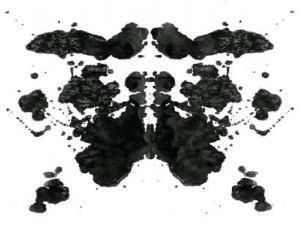
A Rorschach Inkblot of..?
Be patient toward all that is unsolved in your heart and try to love the questions themselves, like locked rooms and like books that are now written in a very foreign tongue…Live the questions now. Perhaps you will then gradually, without noticing it, live along some distant day into the answer – Rainer Maria Rilke
Apopheniacs Anonymous
Many years ago as a young Director, I would often listen to wireless programmes whilst tucked up in bed; a small transistor radio set perched precariously on my pillow, close to a straining ear, lest the sounds of music or canned laughter alerted my parents that I was awake long past my bedtime. Perhaps this is where my insomnia first took root. I can still vividly recall how each night, I would slowly and carefully rotate the dial through the crackling white noise, and the small frisson of joy when, at last, a clear voice or tune would magically emerge.
In some sense, the nightly crackle of that transistor was a kind of rehearsal for what was to come. The digital ether today is, in its own way, much like those wireless sets of my yesteryears. It offers us a bewildering symphony of signals and static. Within this swirling murmur, we, pattern-seeking creatures above all else, are drawn to discern a voice, a melody, a message, or anything that might rescue us from the noise. And as you know, dear reader, it is not merely that we want to make sense of the world; it is that we are actually ‘wired’ to do so. Evolution, I am told, has tuned us finely to detect patterns; faces in the foliage, rhythms in chaos, that sort of thing. And not because those things are always there, but because sometimes they are, and our survival once depended on spotting them. And yet, while the impulse is universal, the results are not: what one person understands as a signal, another dismisses as static. The same cloud might reveal a dragon, a deity, or nothing at all. I guess that’s why beauty is in the eye of the beholder…along with everything else, especially meaning itself.
Psychologists call this phenomenon pareidolia: the tendency to see faces in plug sockets or animals in tea leaves. A charming glitch of the mind no doubt but also only the visible tip of a big iceberg called apophenia; our profound inclination to perceive meaningful connections where there may be none. If pareidolia delights in seeing a dog in a cloud, apophenia insists the dog has a message for us. This impulse to find coherence in chaos lies at the heart of both profound insight and, dare I say, the occasional fanciful delusion. The Director often harbours the thought that many of our conspiracy theorists are, in fact, closet apopheniacs. But you know me, dear reader, I am often to be found wandering the liminal spaces. And so today’s paltry words are broadcast to you from here, between the perceived patterns and their projected meanings. Here is where I spy the unfolding of the delicate dance between faith and apophenia.
Take our friend, Carl Jung’s notion of synchronicity; those moments when events converge in a seemingly meaningful coincidence, thereby pointing to a coherence in the clutter. Think of it as the place where we might say the objective world and the narrative world meet. You will, dear reader, have experienced such synchronous moments. You know, that moment when your Spotify shuffles you exactly the song you didn’t know you needed, just as you’re contemplating a difficult choice. Those moments can feel less like chance and more like a discreet cosmic wink. William Blake talked of it as seeing a World in a Grain of Sand: a sudden expansion of perception that suggests a deeper interconnectedness. Is this a glimpse behind the veil, a fleeting resonance with a larger cosmic harmony? I don’t know. But it does seem to point to something we have discussed in previous columns where the business of meaning arises not from certainty, but from attentive openness to its possibility.
And this is where the business of faith comes to the dance. Not as blind assent to dogma, but as what Kierkegaard called a leap: a courageous decision to trust in meaning even when the evidence is fragmentary. It’s the difference between interpreting Apollo’s murmurs and hearing only wind in the trees. Faith, understood this way, is not certainty, but a stance; a readiness to receive, to intuit, to dwell in ambiguity. It is of course a tricky dance, especially if like your Director you have at least two left feet.
Yet here too lies the danger. The impulse to discern significance in the seemingly random can mislead. The same apophenic drive that births poetry and prayer can also conjure conspiracy. The same longing for connection can harden into delusion. The face in the cloud becomes a sign, the sign becomes a system, and soon we’re tumbling down the rabbit hole. Borges’ Library of Babel springs to mind; an infinity of patterns, all equally plausible and none necessarily true. Without humility, the quest for meaning becomes brittle and wonder can quite easily turn to insistence. People then swap curiosity for confirmation and questions for conclusions. Echo chambers form; doubt is cast out. In this sadly fairly well-travelled road, the pattern-seeking impulse, untethered from doubt and difference, risks turning sacred mystery into secular mania.
Apophenia itself is not necessarily the enemy. Interpreted gently, it can be a tool of the imagination. Consider the Rorschach test, that inkblot dance of psychology, where we are actively invited to project meaning onto randomness. Here, apophenia becomes a playful, even revelatory act, a window into the self’s imaginative landscape. The crucial distinction, perhaps, lies not in the act of seeing connections, but in the tenacity with which we cling to their objective truth, mistaking the whisper of possibility for the shout of certainty. Much of art and literature thrives on uncovering resonances and echoes that defy literal explanations. T.S. Eliot’s Four Quartets famously invokes the still point of the turning world, a place where paradox and unity coexist beyond rational categorisation. George Steiner spoke of language’s transcendent power, words pointing beyond themselves to evoke the ineffable. Perhaps faith, too, can be understood as a kind of creative apophenia, an imaginative act of imposing, and indeed discovering, coherence in an often chaotic world.
Our old friend G.K. Chesterton’s defence of paradox and poetic faith might well be a call to embrace the enigmatic, to find truth not solely in cold logic but in the evocative power of mystery. Chesterton didn’t seek to dissolve paradoxes but to dwell within them, to find joy in the very tension they produced. For him, the world was not a problem to be solved but a riddle to be delighted in. Rainer Maria Rilke, likewise, urged us to love the questions themselves, to inhabit the uncertainty with reverence rather than restlessness. And perhaps that’s where faith finds its truest expression; not as an answer to every riddle, but as a stance of wonder. Not an escape from doubt, but a mode of being that allows doubt and trust to walk hand in hand like two slightly awkward chums trying not to step on each other’s toes in that timeless dance. Think of Enfield and Utterson awkwardly circling the Victorian cobblestones of Jekyll’s London.
In what some are calling the modern world, where traditional faiths falter and fade, new belief systems proliferate. Conspiracy theories, algorithmic determinism, AI messianism; each promising a map through the static. But do these beliefs nourish, or merely soothe? Do they open us to mystery, or close us into control? As my Scotch forebears were wont to say, ‘I hae me doots’. What many of these apophenic cults lack is precisely what older faiths preserved: a humility before the unknown, a practice of shared ritual, a reverence for mystery. Instead, they often amplify fear, feeding certainty rather than wisdom. Kafka might recognise in them a new kind of alienation; humans trapped in systems they can’t understand, seeking meaning in every shifting shadow.
Simone Weil’s distinction between true attention, characterised by patient, open receptivity to reality, and illusion, which is the self-deceptive imposition of preconceptions, rings particularly true here. Are we truly seeing, or merely projecting our fears and desires onto the blank screen of the unknown? Walker Percy’s notion of spiritual homesickness, that deep longing for meaning and belonging that marks the modern malaise, finds distorted echoes in these apophenic conjurations.
Yuval Noah Harari in his bestselling way, has remarked on the power of shared fictions to bind societies, yet when these fictions sever ties to ethical responsibility or historical context, their cohesion always proves brittle. Simone Weil’s call to attention, which is a patient, receptive engagement with reality, stands as a rebuke to the illusory ease of projection. Are we really seeing, or just casting our fears onto the blank screen of the unknown?
Perhaps, then, faith is not about inventing patterns but receiving them. The rituals and practices of older traditions train us in this slower form of attention. A readiness not to impose meaning, but to wait for it. It’s a grounding that might allow the pattern-seeking mind to rest, to simply be in the static, trusting that some truths emerge not from frantic searching, but from patient presence.
The line between faith that enriches and apophenia that ensnares may lie in humility, namely a willingness to question our own interpretations, to remain open to revision. And also curiosity, the desire to engage with the world on its own terms rather than through an often fearful projection. The whispers in the static may indeed carry profound meaning, but discerning their true source and significance demands a delicate balance of imagination and critical discernment.
I recall once standing outside the house, having just put the bins out, one of life’s more grounding rituals, when a sudden gust of wind whipped the lid off the recycling bin and sent a flattened box of Frosties flying across the road. It hit the wall opposite, and danced briefly, before collapsing against the kerb, in a manner that might have resembled an exhausted bird. Was this a message? A metaphor? A nudge from the universe? Of course, I couldn’t say. But in that moment, I did briefly consider whether the cosmos was trying to tell me something about my breakfast choices. Probably not. Nevertheless, I retrieved the cardboard with a certain reverence. Just in case.
Until next time, Happy Reading/Pattern Spotting!
The last in our mini-series of well-known English sayings which appear in another language is; to make a mountain out of a molehill, which turns up in Latin as; arcem e cloaca facere, meaning, to make a stronghold out of a sewer. I like that.