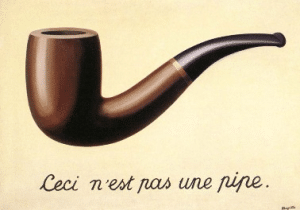
The Treachery of Images, 1929, René Magritte.
Your Director will sometimes be lost in moments of contemplation, more often than not wondering about the meanings of things. And how it comes to pass that anything means anything at all. As the early morning light caterpillars its way over the trees opposite the window beside me, the dawn of an idea is born that this week’s Column should be about meaning. Did I mention that your Director is, amongst other things, an insomniac?
Beware those who would have us believe that the world is made of cold, hard, irrefutable and undeniable facts. You and I, dear reader, know this is at best a mightily impoverished view and at worst, downright dangerous. In reality (we might come back to what that means) the world is full of signs. And signs must be interpreted. That red octagon is not dangerous in itself, but it warns you to stop. A red rose is not love, but it might speak of it, or the Labour Party, or English Rugby. Even the paltry words you are reading now, these squiggles on a screen, are not thoughts but in some way, they point to thoughts. Hopefully.
Meaning is ineluctably tied to the things we call ‘signs’. What a sign is and how it comes to mean, is the business of semiotics. Semiotics shows us that we make sense of the world through symbols, language, and cultural codes. The field may sound ridiculously niche, something only insomniac Directors could ever be bothered by, but semiotics permeates every corner of human life, from street signs to Shakespeare, from emojis to elections.
I feel a brief tour coming on…
Signs are perhaps best understood as those things that stand in for something else. Words are signs because for example, when I write the word ‘elephant’ it allows me to communicate the idea of an elephant to you without me having to go out, find an elephant, bring it to wherever this is being read and point at it. In semiotic terms, the word ‘elephant’ is the signifier which points to the signified, which in this case, is an actual elephant. Ferdinand de Saussure, the granddaddy of linguistics, pointed out something interesting about these kinds of signs, which is that there’s no natural link between any signifier and its signified. In fact, the link is completely arbitrary. The word ‘elephant’ does not have four legs, a trunk and a legendary memory. The word ‘tree’ is not leafy or wooden; it’s a sound attached by cultural agreement to an idea. And that sound depends on the language you’re speaking. In French, it’s arbre, in German, Baum; in Mandarin, 树.
Saussure’s insight is powerful, but also destabilising. If the relationship between words and meanings is arbitrary, then so too are the meanings we build on top of them. In this way we come to see that language does not reflect reality, it actually constructs it. Language is a web of social contracts; words don’t mean because they match reality, but because we agree, more or less, that they do. And when we don’t? Well… increasingly… look around.
Saussure’s contemporary across the Atlantic, Charles Sanders Peirce added his own insights to this thinking. His model added a third term to the signifier and signified relationship: the interpretant, which is the understanding we bring to a sign. And we all know that what we bring to the party of understanding and meaning can vary infinitely. It’s why I point out to students that what they understand from a poem, for example, often says more about them than the poem. It’s also why Literature is constantly showing us what it means to be us.
For the sake of accuracy in this whistle-stop tour, we should mention that dear Charles also gave us a trinity of sign types: icon, index, and symbol. Icons are signs that do resemble what they represent, like particular kinds of portraits or emojis. Indices are signs linked by cause and effect, for example, smoke as a sign of fire or puddles as a sign it’s been raining. Symbols are those signs related to their objects by convention, like a national flag or the Nike swoosh. Most of what we deal with are actually symbols. Take money, which the Tiffinian often equates with success and pinnacles, it is nothing more than a symbol. It works only because we agree it does. This semiotic trinity may be why your Director once shed a tear at a cartoon about a teacup, and why a scribbled note on the kitchen table saying “back soon” felt oddly profound. The sign doesn’t need to be real; it only needs to mean.
French anthropologist Claude Lévi-Strauss took these ideas further still, treating entire cultures as if they were systems of signs. For him, myths weren’t just colourful tales told round fires to pass the time; they were patterned ways of thinking, structured around pairs of opposites: good and evil, male and female, cooked and raw etc.. These binaries, he suggested, aren’t just narrative habits; they’re how our minds process the world. Like language, myth is a machine for making meaning, not necessarily for finding truth, but for putting things in order. We can’t help ourselves. We turn to story not just to amuse, but to domesticate chaos. Myth, like metaphor, makes the world manageable, which is to say, meaningful.
Our old friend Wittgenstein, meanwhile, shifted the whole playing pitch, as was his wont. Early Wittgenstein thought language mapped the world like a mirror. But later Wittgenstein realised language is more like a game. Its meaning lies in its use not in correspondence, but in practice. The word “promise” means something different in a courtroom, a poem, and a playground. So meaning is not a thing at all, but a doing, as I believe we may have already discussed in column’s past. We understand a sign then by how it is played. Language, in this sense, is not a mirror of reality but a toolkit for engaging with it. And sometimes, as in the case of jokes, puns, and political slogans, it’s a toolkit for misdirection.
There’s an old joke about a sign outside a convent that reads: “No trespassing. Violators will be prosecuted to the full extent of the law. Signed, The Sisters of Mercy.” A small moment of linguistic comedy but also a reminder that signs never say only what they say.
If signs mean differently in different games, then perhaps our grip on the world is less firm than we’d like to think. We may not live in a world of facts but in a world of interpretations. If you think about it, that EXIT sign on the wall over there doesn’t actually say EXIT does it? Or rather it does say EXIT. But only if you know what those four letters, in that configuration, signify. To someone who reads only Mandarin, or who has never learned to read at all, it says precisely nothing. Or possibly ‘four squiggly shapes lit up on a wall.’ And that’s the point I’m labouring at: meaning isn’t in the sign itself, it’s in the shared code between sender and receiver. The sign says EXIT, but it means ‘this is the way out’ only within a particular system of understanding. Without that, it might as well say ENTRANCE. A smile might mean kindness, flirtation, mockery, submission, or indigestion, depending on the context. Even silence speaks, but whatever it says depends on the room. Or the classroom.
Take the humble emoji. 😂 Is that face laughing or grieving? It depends; on the sender, your mood, the hour, whether you’ve had lunch, your age etc. etc. As with so many modern symbols, its meaning depends entirely on the context in which it appears. Once, the heart emoji denoted affection; now it might signify sarcasm, irony, or a weary resignation to the state of things. In this way, emojis may be the most transparent expression of our semiotic condition: small, strange glyphs that gesture toward meaning without ever quite landing on it. They are, one might argue, the hieroglyphs of an age both overconnected and under-expressed, open to interpretation, prone to misinterpretation, and inevitably misused by well-meaning parents.
Or consider fashion: what was once a symbol of rebellion becomes, in time, a uniform. As a young Director promenading along the King’s Road, I was meant to be shocked by the safety-pinned, tattooed, Mohican-sporting Punks congregated towards the Sloane Square end of the street. But your Director knew full well that years later, his first suit-wearing corporate manager would be tattooed within an inch of his life, sporting a designer safety pin in his ear. Words undergo similar shifts. Literally now means not literally. ‘Woke’ was once an urgent plea for awareness; now it’s often a term of ridicule. These aren’t failures of language; they’re the life of it. Signs evolve. Meanings migrate. Everything solid melts into air, including the meanings we thought were fixed.
Roland Barthes, the great French semiotician and lover of layered meaning, taught us that even the most banal object, a glass of wine, a strip of fabric, or a wrestling match, could be read like a text. Myth, for Barthes, was the hidden ideology of the every day, the second-order sign that naturalised culture. A baguette isn’t just bread; it’s Frenchness. The American flag isn’t just cloth; it’s freedom. Or nationalism. Or capitalism. Or all three, depending on who’s looking. Myth, in this sense, is ideology pretending to be nature.
In many ways, as well as being the study of signs, semiotics, is also the art of noticing. Once you see it, you can’t unsee it. Advertisements are particularly rich texts: the grinning family around a breakfast table isn’t selling cereal, but domestic bliss. The sports car ad isn’t about transport, it’s about potency. That perfume ad? Not about scent. It’s about seduction, success, selfhood. It’s all signs. Even the self, that central sense of who we think we are, is a sign.
Jean Baudrillard, ever the provocateur, went even further and argued that in postmodern culture, we live not with signs that refer to real things, but with simulations. By this, he meant that we now have signs that refer only to other signs. Famously he gave the example of Disneyland, which he claimed, isn’t an illusion hiding a reality; it’s the real hiding the fact that there is no reality. A T-shirt with the word authentic is already a joke. We’re not faking it anymore; we’re faking the fake.
Social media makes this ever more plain; in both senses of the word. Your holiday is not a holiday unless it’s posted. Your dinner isn’t dinner until it’s shared. The image precedes the event. The sign doesn’t point to the thing, the sign is the thing. This is the age of the sign without the signified. You didn’t just see a sunset. You uploaded it. The sunset is now content.
But perhaps this has always been true. When Jesus says, ‘This is my body,’ while breaking bread, he is offering a sign so rich it spills over with meaning literal, metaphorical, sacramental, communal. The bread becomes more than bread. The sign becomes the substance. And what is poetry, if not a refusal to separate the sign from the signified? A metaphor doesn’t say ‘This is like that’. It says ‘This is that. The line blurs. The language incarnates.
To say that meaning is made doesn’t mean it’s false. It means it’s human. It means we live in a world of interpretation, imagination, association. The danger comes not from signs, but from forgetting that they are signs. To treat a map as the territory, a symbol as the substance, a slogan as the truth, that’s where the danger lies.
We teach students to read between the lines, and Lord knows that’s a tricky business in itself. But perhaps we should also teach them to read the signs around the lines. A novel’s setting, a politician’s photo op, and a celebrity’s outfit at the Met Gala are not just incidentals. They are statements. Though in some cases, the statement might be ‘I got dressed in the dark.’ To be semiotically aware is not to be cynical. It is to be awake. It is to understand that meaning isn’t delivered ready-made, but assembled in context. To learn, in Wittgenstein’s terms, not just how to play the language game, but to ask: whose rules, and why? We need signs. But we also need to remember they point beyond themselves. Like the finger pointing at the moon, as the Zen koan goes; woe to the one who mistakes the finger for the moon.
So the next time you see a sign; on a street corner, a screen, or a face, take a moment and pause. Ask not just what it says, but what it means, and how you know. In a world of signs, reading well is not just literacy. It’s wisdom.
Because in the end, we are all semioticians, whether we know it or not. We are readers of the world, constantly decoding, re-coding, misreading and rewriting. The signposts are everywhere. The meanings shift like shadows. But in the dance between signifier and signified, between what is said and what is meant, lies the whole rich, risky business of being human.
Magritte was right. It isn’t a pipe. It’s a picture of one. The sign is not the thing.
The world is not full of facts. It is full of meanings. And meanings, like people, can be mercurial.
They can wink.
They can lie.
They can mislead.
They can reveal.
They can keep the Director up at night.
But most of all, they remind us that nothing ever quite speaks for itself.
Not even this column.
Until next time, Happy Reading/Being a Sign!
Today’s well-known English saying which appears in another language has a Shakespearean twist; something is rotten in the state of Denmark which turns up in French as; il y a anguille sous roche, meaning, there is an eel under the rock. I like that.