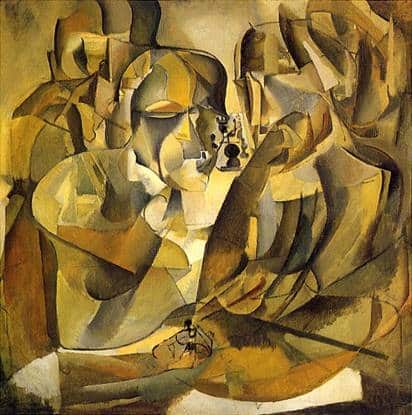
Portrait of Chess Players by Marcel Duchamp (1911)
How to Lose Without Being Defeated
It was suggested to the Director by an esteemed colleague, that this week’s Column might take a look at Game Theory. Always grateful for potential subjects to sink my gums into, I thought, ‘why not?’ And so here we are. Now, I know very little about Game Theory, as will become more and more evident as you, dear reader, progress through these paltry words. Nevertheless I shall plough on regardless. If by the end of it all, nothing has been rendered useful then I am sure we can agree never to speak of these matters again.
I first encountered Game Theory, I think, as a young Director reading about the Prisoner’s Dilemma, a classic thought experiment used to explore strategic decision-making and the tension between cooperation and self-interest. The scenario runs as follows: two suspects are arrested for a crime and held in separate cells, unable to communicate. Each is offered the same deal. If both remain silent, they receive light sentences. If one betrays the other while the other stays silent, the betrayer goes free while the silent party receives a heavy sentence. But if both betray each other, each faces a moderate sentence. The rational move, from a purely self-interested perspective, is to betray, but if both reason this way, they end up worse off than if they had cooperated. The dilemma captures something fundamental about trust, risk, and the costs of suspicion.
If memory serves, this particular scenario sprung from thinking on how the USA should best respond to the discovery in the 50s that the Soviet Union had developed nuclear weapons. And as the world saw, even though both sides would have been better off with a reduction in nuclear weapons, the individual incentive to arm remained strong, leading to a continuous buildup of weapons. So, the prison scenario is designed to help us to think about situations where people should be cooperating; where everybody would be better off if they cooperated but in fact that doesn’t happen.
I should at this point mention that your Director is dimly aware of how Game Theory has been applied to the study of natural selection with something called the Evolutionarily Stable Strategy. As I understand it, Game Theory is centred on the question of exploring what a rational person would do in a contest situation if they can assume that their opponent is rational as well. This doesn’t work for animals. In this case you have to look for an Evolutionary Stable Strategy. This would be a strategy which if every member of the population does it, or almost every member of the population does it, then any mutant doing anything else possible, doesn’t do as well against the members of the population as the members of the population are doing against one another. In other words, any mutant using an alternative strategy would fare worse in that population than those following the dominant one. Or something like that. Maybe a subject for another Column…
Back to the world of the human animal…
Of course, not all games are necessarily adversarial. The Stag Hunt, introduced by Jean-Jacques Rousseau in his Discourse on Inequality (1755), is a game theory scenario that illustrates the dilemma of cooperation versus individual action. It involves two or more individuals who can either cooperate to hunt a stag (a more rewarding but challenging task) or individually hunt a hare (a less rewarding but easier task). The core idea is that while mutual cooperation leads to the greatest overall benefit, the individual risk of not cooperating can be significant. The challenge, again, is trust. Will the other stay in the hunt, or pursue something smaller, safer, and more selfish?
Rational choice, it seems according to these scenarios, leads to mutual loss. And it is therefore no surprise that the best collective outcome depends on trust. But trust, in a single round of any game, is irrational. It is always the more rational choice to betray the other.
But of course, it is a stretch to suggest that human beings behave rationally at the best (or indeed the worst) of times. And life is not a single round. If it’s anything, it’s an iterated game; played again and again, across relationships, communities, generations. And in repeated interactions, in specific kinds of noisy, iterated environments, where recognition and memory are possible, a surprising strategy emerges: Tit for Tat. Begin with cooperation, and thereafter do what your opponent did last time. Be open, but reciprocal. Forgive once. Punish if necessary. This minimal algorithm turns out to be remarkably effective. It is, in its way, the beginning of ethics. But only the beginning.
Game Theory, then, offers insight into the roots of morality, not as a list of commandments, but as a grammar of reciprocity. Morality becomes, as some have put it, “the shadow of the future.” What restrains me today is not fear of punishment, but memory and anticipation: the awareness that today’s action ripples forward. Adam Smith saw this in The Theory of Moral Sentiments (1759), arguing that moral life depends less on abstract rules than on sympathy, on the internalisation of the “impartial spectator.” We thus become moral by imagining ourselves through the eyes of others.
If Game Theory helps explain cooperation, it also helps dramatise its collapse. In Shakespeare’s King Lear, Cordelia is undone because she refuses to play the game of hyperbolic flattery. Her honest speech, measured, restrained, sincere, is misread as disloyalty by a father who has mistaken performance for love. She steps outside Lear’s particular game, and pays the price. But she does so with a moral integrity untouched by calculation.
This type of game appears again in Paradise Lost, where Satan, ever the strategist, sizes up Heaven and Hell as positions on a board. He weighs the risks, calculates the rewards, and arrives at a hellish logic: “Better to reign in Hell than serve in Heaven.” His rebellion is not a moment of romantic defiance; it is a grim exercise in ambition, hierarchy, and power, a textbook example of positional play. Such examples reveal not only the moral limits of strategic thinking, but also its epistemological costs.
It is not for your humble Director to claim that these types of Game Theory calculations do not have their value. They offer clarity, distilling the mess of social life into clean, analysable forms. In doing so, they allow us to simulate behaviour, predict outcomes, and design incentives. But their clarity is also their cost. As friend of the column, Iain McGilchrist might argue, such models reflect a left-hemispheric mode of attention: narrowly focused, compartmentalised, sequential and decontexualised. They thrive on precision and control, but often at the expense of depth and context. Game Theory, in this view, abstracts human behaviour into moves and payoffs, but in doing so, it strips away much of what makes human beings human. It models choices, but not the character that shapes them; strategies, but not the stories we tell ourselves about why we act. It offers a world in which rational agents pursue maximum utility, but says little about love, loyalty, shame, or grace. The world it describes is bounded, rule-governed, and knowable. But the world we inhabit is not. It is ambiguous, evolving, relational, shaped as much by meaning as by mechanism. We may gain something by translating human life into a matrix of incentives and outcomes, but we also lose something in that translation: the messy, living texture of experience.
Even theology has not escaped the seduction of the game. Pascal’s Wager is frequently cited as a proto-Game Theoretic argument. You know how this old chestnut goes: if God exists, then belief secures an infinite reward, i.e. eternal salvation; if He does not, the cost of belief is negligible. Rational choice, says Pascal, therefore favours belief. But what masquerades as prudence here is, in truth, a profound reduction. Belief becomes a calculated risk, devotion a form of strategic hedging. The wager operates within the cold mathematics of outcomes, not the warmth of conviction. Kierkegaard, whose notion of faith involved dread, paradox, and a leap into the absurd, would have been appalled. For him, true faith was not the sum of probabilities but a passionate inwardness; something that begins precisely where calculation ends. The infinite cannot be approached through cost-benefit analysis.
The danger in such reasoning, as Nassim Nicholas Taleb has warned in The Black Swan (2007), lies in what he calls the ludic fallacy, namely mistaking the neatness of formal systems for the messy intricacies of lived experience. Game Theory works best in constrained environments: the rules are clear, the players known, the options finite and everyone makes so-called rational choices. But life is not so obliging. Its rules shift, its players conceal themselves, and its consequences unfold beyond the horizon of predictability. To borrow Donald Rumsfeld’s phrase for a moment, the world is riddled with unknown unknowns. It is asymmetrical, non-linear, and often perverse. In a game, you can measure the stakes; in life, you may not even know you are playing until the consequences arrive. To think otherwise is to seek safety in abstraction which is often a comfort bought at the price of relevance.
Sadly, this confusion now seeps into how we live and learn. Increasingly, education is approached as a series of games to be won rather than a field to be explored. Students are coached to optimise outcomes: target the top band, memorise the mark scheme, decode the examiner’s intention. Intelligence becomes procedural. Creativity is channelled into strategy. Meanwhile, teachers are conscripted into their own game of performance: lesson objectives aligned with assessment frameworks, teaching plans crafted to pass scrutiny, professional development reshaped to suit external metrics. The inner life of learning, the unpredictable, slow, humane business of awakening a mind risks being replaced by what Alfred Korzybski warned against: confusing the map with the terrain. What was once a shared journey of exploration becomes a contest, and what was once a question becomes a rubric.
There is, however, a different kind of intelligence, one not easily captured by matrices or modeled in equations. It resists the logic of advantage and the calculus of gain. It forgives instead of retaliating. It chooses vulnerability over control. It gives without calculating return. This is not naivety, but a deeper form of wisdom, an awareness that life is not best lived through strategies of self-preservation, but through acts of openness and trust. This is the wisdom not of Tit for Tat, but of Cordelia. Not of Satan’s positional logic, but of childlike play. We can see this most clearly in the actual playing of games rather than Game Theory. Games that children play, when unstructured by well-meaning adults, are not zero-sum contests but rituals of belonging. A child does not join a game to win; she joins to be with. The joy is in the playing itself, not in the outcome. Somewhere along the way, us grown ups can lose this and strategy replaces spontaneity. We are taught to play not for presence but for position. We measure our moves, assess our leverage, and forget how to dwell in the game for its own sake.
Game Theory, for all its insights, is ultimately about constraint. It is a study of moves within a given structure, a logic of limited options bounded by the rules of play. But human freedom is not merely the ability to choose among pre-set alternatives. It is the capacity to imagine new ones. The deepest kind of agency lies not in winning the game, but in questioning its premise. Not in outplaying the system, but in outgrowing it. This is what Viktor Frankl gestures toward when he writes that between stimulus and response, there is a space, and in that space lies our power to choose. Game Theory compresses that space into a predictable pattern of incentives and responses. But human beings are not fully predictable. Our most defining acts; love, forgiveness, sacrifice, do not follow from utility, but transcend it. They are not best moves; they are moves beyond. They are not strategic; they are free. To act not as a player, but as a person, that is the possibility that lies outside the logic of the game. The rules may be clear. The rewards may be calculable. But the wisest move, sometimes, is not to win. It is not even to play. It is to see something more.
Until next time, Happy Reading/Playing the game (or not)
Today’s well known English saying which appears in another language is; have your cake and eat, which turns up in German as; auf zwei Hochzeiten tanzen, meaning, to dance at two weddings. I like that.