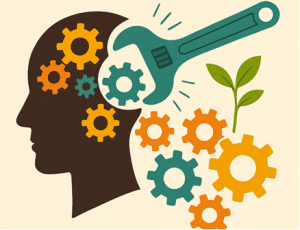
A Spanner in the Works
Over the Easter break I was fortunate enough to read Yevgeny Zamyatin’s novel, We. It’s a chillingly prescient critique of technocracy and the relentless mechanisation of human life. Written in 1923, it inspired Orwell’s Nineteen Eighty-Four and anticipated Huxley’s Brave New World. Zamyatin depicts a society, the One State, obsessed with order, uniformity, and mathematical precision. Its citizens live in glass compartments, their movements constantly visible and scheduled to the minute. The perfect society has arrived: run not by flawed humans, but by mathematics. The highest compliment one can receive is to be “a regular, unerring, and precise mechanism.” That is, to be like a machine. Our protagonist, D-503 is one who thinks in formulae, feels in regulated bursts, and thinks of little beyond being the perfect cog in a perfect system.
Zamyatin’s dystopian vision is not unfamiliar. It is the logical extension of a metaphor that has governed much of modernity: that human beings, and by extension society, are best understood as machines. The Director, in his brief time, has seen a growing tendency to describe ourselves in terms of inputs and outputs, systems and structures, feedback loops and performance metrics. We increasingly speak the language of the factory and the boardroom: efficiency, productivity, streamlining, optimisation. Even education, perhaps once understood as the cultivation of human flourishing, is now routinely framed in the idiom of data points, delivery mechanisms, and measurable outcomes.
Your Director thinks there might be something in us that somehow inclines toward this way of framing the world. It might be understood as a certain desire and drive for mastery, or what the Ancient Greeks called hubris. In other words, we all want to be like the gods, and feel that we can make and do anything. Hubris is, of course, the motor of the Greek tragedies. Typically our hero overreaches and is undone. The overreaching leads to catastrophe, seen as a spectacular downfall (katastrophē ‘overturning, sudden turn’, from kata- ‘down’ + strophē ‘turning’). And so it is too with societies. Societies that believe they can do everything often grow unwieldy, less creative, and increasingly bound by bureaucracy. And as bureaucracy expands, morale declines. People feel their autonomy eroded, their judgement replaced by procedure. This, of course, is the death of everything except mediocrity. To be a cog in a machine therefore is to court catastrophe. And, I don’t know about you but the Director’s courting days are over.
The problem is also not just linguistic or conceptual. I wouldn’t want you to be thinking that the machine metaphor is not merely limited, it is actually patently false. The only things in the universe that work like machines are the machines we have built. Machines are not the archetype of reality; they are the anomaly. Our mistake lies in proximity and pride: because we have made machines, and because we understand them, we begin to think that all else, including ourselves, must work the same way. But that is not the case at all.
It’s a subtle but sweeping error. Mechanical systems can be disassembled, understood, and rebuilt. But living systems do not behave that way. As we’ve discussed in previous columns, life does not emerge by assembling parts. It emerges through relationship and context. A human being, as McGilchrist reminds us and Dr Frankenstein found to his cost, a living organism does not develop like a flatpack wardrobe, starting with isolated components and screwing them together into some kind of a whole. Rather, it unfolds from a single, living unity. The heart in utero for example, doesn’t appear as an isolated piece to be slotted in later; it differentiates out of what is already there. There is no blueprint being followed, no central processor issuing instructions. Instead, form arises through reciprocal interaction, through a dance of constraints and invitations, of environment and inner potential. Development is not an additive process but a continuous unfolding, what our ancient friends might have called entelechy, the inner drive of a thing to realise its form. This is why salt is not hidden inside sodium and chlorine. Combine them, and something entirely new emerges: not a sum of parts, but a transformation. A different order of reality arises, one that cannot be reduced to its constituents without destroying what it now is.
Robert Rosen, the theoretical biologist, puts it like this: complex systems, particularly living ones, cannot be modelled mechanistically without distortion. The more you try to describe life as if it were a machine, the more life escapes the model. And yet we cling to the metaphor. Maybe in some way, it reassures us. And so we find ourselves giving in to the temptation to reframe people in mechanical terms: to call them “units”; to describe thinking as information processing; to measure attention as a finite resource; to believe that, with enough data, all outcomes can be predicted, improved, and delivered on time. But none of this brings us closer to understanding what a person is. On the contrary, it blinds us to what is most essential. Machines are comprehensible, predictable, controllable. But people, as you may have noticed dear reader, are not.
Franz Kafka, writing in the early twentieth century, wrote about where this kind of thinking leads us. In The Trial, a man is arrested and tried without ever being told why. He is not brutalised by cruelty, but by indifference. The system wasn’t out to get him. It just didn’t know he existed. Which is somehow worse. It is not the malice of a tyrant that destroys him, but the cold, impersonal logic of the system. Kafka understood, as Zamyatin did, that when systems become total, they cease to see the individual at all. And cogs don’t get a say in things.
Iain McGilchrist, in The Matter with Things, continues the argument with urgency. He shows that the mechanistic worldview is not only philosophically wrong, but neurologically lopsided. It arises from overreliance on the left hemisphere’s style of thinking which is characterised as analytical, abstracting and isolating. The left hemisphere seeks clarity and control. It excels at manipulating the world but it cannot understand it. The right hemisphere, by contrast, is more holistic, relational, open to ambiguity. It is attuned to the living world: to gesture, metaphor, music, and meaning. It understands that people are not puzzles to be solved but presences to be encountered. Yet the worldview shaped by machines privileges what can be measured and managed, thereby flatpacking lived experience into systems.
McGilchrist writes that we now live in a world made in the image of a machine: a world from which all depth has been drained away… flat, uniform, literal, lifeless. It is a world that forgets how to be astonished. A world that forgets how to care. And of course, this is not a purely philosophical concern. It lands, as it always must, in the very particular. In a school corridor for instance.
Because schools too, feel the pressure to mechanise. Systems are necessary, yes, but increasingly they become ends rather than means. And thereby as helpful as a satnav that insists you’ve arrived when you’re actually crawling round the M25. We are encouraged to measure what can be counted, and to manage what has been measured. But education, properly understood, resists mechanisation. A child is not a data point. A teacher is not a delivery mechanism, though many of us have, at some point, felt like glorified USB sticks. A school is not a factory. The most important things that happen in a school cannot be captured by the dashboard because they happen in moments of trust, of patience, of laughter, of surprise. They are not the product of control. They are the fruit of attention. Unfortunately, “attention” doesn’t graph as well in Excel.
The nervous system is not a machine. It is an embodied responsiveness to a living world. Our brains and by extension our minds, are shaped not to manipulate reality but to participate in it. McGilchrist reminds us that the left hemisphere seeks certainty and control. The right hemisphere attends, relates, integrates. Both are necessary. But when one dominates, everything is reduced to utility. To which in response we must ask “useful for what?”
Education cannot thrive in such a ‘left-brained’ world. It cannot flourish where unpredictability is seen as failure, where complexity is treated as a problem to be solved, where the highest virtue is compliance. Education is not efficient. It is slow, surprising, relational. It is not about controlling outcomes but opening possibilities.
This is not to jettison rigour, nor to spurn evidence. But we must recall the map is not the terrain itself. The data is not the child. The system is not the school.
That wonderful poet, Robert Frost reminded us that all metaphors will inevitably break down at some point and therefore the skill becomes knowing when a metaphor has broken and no longer serves its illuminating purpose. What we need are not better tools, but a willingness to be flexible with our metaphors. Instead of imagining the school as a machine, we might imagine it as a garden: something cultivated, not engineered. Something that grows through care, attention, and time. Something that cannot be hurried or standardised. Something alive, if you like. We are not machines. We are not made to be measured, optimised, or processed. We are made to be known. And the work of education, if it is anything, is to remember this and act accordingly.
Perhaps the deepest clue to why the machine metaphor fails is that this whole life business always resists being broken up into simple binaries. Or rather, it includes them without being reducible to them. “It is the whole mark of a deep truth,” wrote Niels Bohr, “that its negation is also a deep truth.” In the realm of meaning, mind, morality, and time, opposites do not cancel out; they generate tension. And it’s from tension, rather than equilibrium that music arises.
Heraclitus knew this long ago, famously writing: They do not understand how that which differs from itself is in agreement with itself. The strings on a guitar pulled taut in opposite directions is not a mark of inefficient energy use. Without the tension, there is no music. Hegel also cottoned on to this idea, when he argued that “otherness” is prior to sameness; that reconciliation is not a return to stasis, but a generative opposition.
As the old joke goes:
Who was that woman I saw you with last night?
That was no woman, that was my generative opposition.
The deepest forms of life and thought emerge not from sameness but from differentiation: not collapse into a unity of sameness, nor disintegration into multiplicity, but a dance of held opposites, order and disorder, freedom and constraint, competition and cooperation. What survives, in nature and in spirit, is not what conquers, but what collaborates. The most life-giving systems, biological or social, are those that hold together antagonistic forces without obliterating either. What is needed is an attitude of both/and and either/or—not either/or or both/and. If you get me.
And actually, this isn’t only a metaphor. Resistance is not just an obstacle; it is a precondition for form. Michelangelo did not assemble David from discrete limbs. He discovered him in the marble; by listening, by subtracting, by enduring resistance. Friction is not a nuisance; it is what allows us to move. Without resistance, nothing happens but with too much of it, nothing changes. As for ‘Matter’, the very thing the machine metaphor takes for granted, it is not inert. It is a resistance. It limits us, and in so doing, liberates us. To encounter matter is to be delayed, frustrated, shaped. And it is in this shaping that we become.
Whilst we’re on it, our old friend Time, too, defies the mechanistic frame. It is not a sequence of instants, any more than a line is a series of points. A point has no extension; it cannot build. But time flows. It holds. It resists dissection. Like life, it is not a sum of separables but a lived continuum. You can count seconds, just as you can count letters, true, but neither reveals the shape of the sentence or the meaning of the moment.
And so the metaphor shifts. We are not cogs or circuits, but creatures of complementarity. We live not in a closed system of causes, but in an open field of co-creation; of tension, resistance, and invitation. To be is to be in relation as we may have discussed before. And that relation is not a problem to be solved, but a harmony to be played. I think I may have said that before too. Still true, though. And besides, good metaphors deserve a second dance.
Until next time, Happy Reading/Being utterly un-machinelike!
The start of a new term begins a new series of sign-offs. Over the coming columns, we shall look at how well-known sayings in English appear in other languages. Today’s is that old favourite: too many cooks spoil the broth. In Hindi, this becomes zyada jogi math ujaad, which if my translation serves, becomes: too many saints can ruin the monastery. I like that.