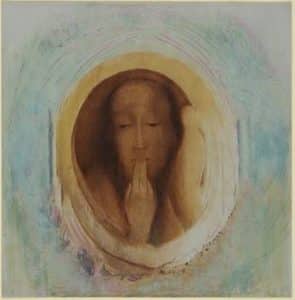
Silence, Odilon Redon c. 1911
The Sound of One Hand Typing
Silence is a true friend who never betrays.
Confucius
If a tree falls in the forest and no one is around to hear it, you need a new joke premise.
Adam Kessler
Somewhere between these two sentiments; the reverence of silence and the compulsion to fill it lies the dilemma of our age.
As a young Director, I was schooled in the virtues of being silent. In those far-off days, children were to be seen and not heard, and preferably not seen either. It may seem at odds with my eminent role as the Director of Literacy and Oracy that I am devoting these paltry words to the business of silence, nevertheless, this is what I shall endeavour to do. In this, as well as many other things, I shall be guided by our friend, the Roman poet Ausonius, who wrote something along the lines of, “If you don’t know how to be silent you won’t know how to speak”. So, dear reader, don your mufflers, turn on stealth mode and accompany your Director into this week’s column.
Shhhhh…
If silence could sue for defamation, it would have an excellent case against the modern world. Where once upon a time silence was the domain of the contemplative, the poetic, and the wise, silence is now more likely viewed as an awkwardness or a glitch in the world of perpetual chitchattery. Sadly education does not escape such shifting in the tectonic plates of societal norms. In schools as much as anywhere else, the expectation is that meaning must be manufactured, produced at all costs; preferably in bullet points and backed by a Google Slide or twenty. And yet, some of the richest traditions of thought, from theology to philosophy to poetry and science, have long suggested that silence is not the absence of meaning, but its absolute precondition.
Allow me to illustrate with a simple tale which came to mind as I sat in silent contemplation of today’s topic. I forget where I first heard it, but it seems to have taken up residence in my memory. It goes something like this…
A great king once visited a spiritual master and, being a busy man, demanded a concise answer: “Tell me how I may be united with God. But give it to me in one sentence.” The master smiled. “I’ll give it to you in one word.” The king, intrigued, leaned in. “And that word is?”
“Silence.”
The king, nonplussed, pressed on. “And how do I attain silence?”
“Meditation.”
“And what is meditation?”
“Silence.”
At this point, the king had likely begun questioning the master’s qualifications. But for those with ears to hear, the message is clear: silence is not just the destination but also the means. It is not an inert void, but a space where something deeper may emerge.
Now, never fear, this is not an argument for the kind of silence that denotes submission; the silence of the suppressed voice or the censored thought. Nor is it the silence of mere vacancy, the dull emptiness I have heard creep into a classroom when a teacher asks an unexpectedly demanding question, or a question about the effect of what a writer is doing. Sorry, that’s the same thing, isn’t it? Anyway, no, this is instead the kind of silence that recognises the impossibility of fully grasping what is real and, in that recognition, becomes an act of humility rather than helplessness. In this, we are invited to embrace the role that silence plays in the way language itself works.
Negative theology, that austere and paradoxical tradition, insists that language about the divine for example must ultimately fail; that every attempt to name God must collapse under its own weight. As Richard Hooker put it, “Our safest eloquence concerning God is our silence.” This is not a mere verbal shrug but more, an acknowledgement that truth does not sit comfortably within the structures we impose upon it. To say anything of God, or of mystery, is to risk making it too small. The same, one might say, applies to all our loftiest concepts: Truth, Beauty, Love, to name but three. Try to pin them down too precisely, and they escape between the cracks of our attempts at definition.
Some years ago, I taught a student who always carried around a dictionary. Whenever he was asked to talk about the meaning of a word he would reach into his pocket, look the said word up and proudly proclaim the answer. His placing of the book back into his blazer pocket, signified that there was nothing more to say on that matter. We could all move on now, safe in the knowledge of being safe in the knowledge. It was, to him, the end of inquiry rather than the beginning. I often wonder what became of him and whether the dictionary is still his constant companion.
It is a strange paradox: the things we most long to define, for example, God, Love, Truth, to name but three again, are the very things that resist definition. This is why mystics, poets, and theologians alike have often resorted to silence. Their silence is not borne out of ignorance, but rather from an understanding that insight is born from silence. They appreciate that some things must be approached asymptotically, in whispers, in silence or in the spaces between words, rather than in the words themselves.
Not all mysteries are grand, of course. Some are small, scurrying, and strangely venomous. Take, for instance, the Hispaniolan solenodon, a creature so baffling to taxonomists that it seems to belong more to prehistory than to the modern world. It is one of the few mammals capable of delivering venom through its teeth; a biological peculiarity that should make it famous, and yet almost no one has heard of it. Scientists, when they do manage to find one, struggle to study it, for it vanishes into the undergrowth as quickly as it appears. In this, it has something in common with our most elusive ideas: the moment we think we have grasped them fully, they slip away.
There is something deeply relevant for those of us involved in the business of education (by which I mean, of course, all of us) about that. The best teachers know that true understanding is not about pinning a concept down like an insect on a card, or a mammal in a forest, but about creating the conditions in which students can pursue meaning for themselves. For knowledge is often best not conveyed in its most digestible, contained form and understanding is not something to be downloaded like a software update. Often, this means resisting the urge to explain too much, to impose too quickly, to over-simplify. True learning has more in common with what St John of the Cross described as “the emptying out” by which I like to think he meant the stripping away of illusions of mastery to make space for something deeper. In teaching, as in theology, the most powerful moment often comes not in the giving of an answer, but in the creation of a silence that forces the mind to stretch beyond its usual habits. It means, therefore, embracing a kind of intellectual solenodonism i.e. allowing for the hidden, the ungraspable, the inarticulable and, let’s face it, the potentially venomous.
Philosophers and theologians alike have wrestled with the idea that meaning is always in pursuit of something it can never quite reach. Language, as Rowan Williams suggests, behaves “as if it were always in the wake of meaning rather than owning and controlling it.“ This is why poetry, music, and liturgy, all of which rely on a kind of structured excess, an interplay of presence and absence if you will, have always been better vehicles for the inexpressible than mere exposition. The best teachers instinctively know this: a great lesson is not an act of transference but of orchestration, arranging ideas and absences so that the student arrives at an understanding that feels both inevitable as well as hard-won.
And yet, in our eagerness to make everything explicit, to test and assess and measure every corner of thought, we risk losing sight of what cannot be tabulated. The silent presence of a great work of literature, the irreducible strangeness of a mathematical proof, the spaces between notes in a piece of music. These are the things that remind us that understanding is not just about knowing, but about being open to what cannot yet be known. The paradox is that we can only cultivate this openness by resisting the urge to control it. As Wittgenstein famously remarked, “Whereof one cannot speak, thereof one must be silent.” The trick, in education as in thought, is knowing when to let silence do the talking.
The great 13th Century mystic, theologian, scholar, poet and all-round genius, Jalāl al-Dīn Muḥammad Rūmī, or as I knew him, Rumi, often evokes the power of silence in his poetry and so it seems fitting to near the end with an extract from one of them:
This is how it always is
when I finish a poem.
A great silence overcomes me,
And I wonder why I ever thought
to use language.
(from ‘A Thirsty Fish‘ )
So the next time silence descends, whether in the office, the kitchen, on the stairs, in the midst of a classroom, on a page, or in your own mind, resist the temptation to fill it. It may not be an absence at all. It may be an invitation. An invitation to what poet Pablo Neruda refers to as, an exotic moment without rush, without engines; (where) we would all be together in a sudden strangeness.
Until next time, Happy Reading/…
And for today, the rest is silence.