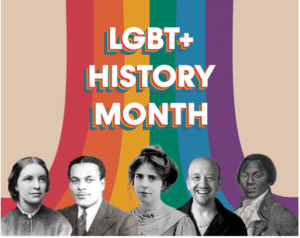
Tiffin School is proud to celebrate the UK’s 20th LGBT+ History Month and this year’s theme: ‘Activism and Social Change.‘ During this week’s assemblies, students learned about five inspiring LGBT+ activists from across the centuries who fought for social change and progress for many minorities: Social Reformer and Founder of the National Trust Octavia Hill (1838-1912); the ‘Gay Father of the Windrush Generation’ Ivor Cummings (1913-1992); Suffragette and Social Feminist Annie Kenney (1879-1953); the First Trans Man to Run for Parliament Charlie Kiss (1965-2022); and Abolitionist and Writer Olaudah Equiano (1745-1797).
We’re also encouraging students across all year groups to participate in a National Poetry Contest run by the LGBT+ History Month organisers, School’s OUT.
We can see through these historical figures that there is significant intersectionality between the fight for LGBT+ rights and the rights of other minorities. There is always, eventually, a crossover between the oppression of one minority and another, which is why it is so important to support each other in the fight for equity and justice, even if you are not directly part of a specific minority group.
Octavia Hill (1838-1912) spent her life working to improve working-class living conditions, especially for the inhabitants of London, first by buying neglected properties in the city and overhauling them for tenants, and second by campaigning to preserve open spaces for the urban poor. She fought to save countless green spaces in London from developers and advocated for creating path networks between protected open spaces in and around the city. She’s also credited for the idea of London’s Green Belt, an area of land surrounding the city protected from development. In 1895, Hill teamed up with Robert Hunter and Hardwicke Rawnsley to found the National Trust, which celebrated its 125th anniversary in 2020!
While Hill’s sexuality is unconfirmed, she is thought to have had romantic relationships with women throughout her life. Hill lived with Dr Sophia Jex-Blake, one of the first women enrolled at university, for a short period, describing their relationship as ‘great companions.’ After this relationship ended, Hill lived the rest of her life alongside Harriot York. The two were engaged as ‘companions’ for 30 years, and their ashes were buried together when they died.
Ivor Cummings (1913-1992) The influence and dedication of Ivor Cummings to the Windrush generation led to him being dubbed its ‘gay father.’ Despite this accolade, Cummings often gets erased from the story of Windrush since he lived his life as an openly gay black man.
After being prevented from pursuing a career in medicine due to poverty, he was then blocked from joining the military due to a law stating all army officers had to be “of pure European descent”. Undeterred, he went on to advocate for African and West Indian seamen and workers during the Second World War, who faced a “colour bar” preventing them from entering air raid shelters. He also rallied against police brutality, after receiving reports that Black people were being “unduly molested” by officers in the 1930s. Cummings became the first Black person to obtain a position in the British Colonial Office in 1941 working with the Colonial Welfare Office, and became the Secretary to the Advisory Committee on the Welfare of Colonial People in the United Kingdom. Cummings continued to advocate for Black Britons through these roles, fighting the colour bar in boxing, and meeting African and Caribbean merchant seamen to discuss the daily barriers they faced. In 1948, he took charge of securing accommodation and resources for those onboard the Empire Windrush, helping them find new jobs in the UK. His decision to use the old air raid shelter beneath Clapham Common as a temporary accommodation led to Brixton becoming the permanent centre for the African Caribbean community in Britain today.
Even though homosexuality was a criminal offence during much of his lifetime, Cummings lived openly and uncensored as a gay man. He socialised in Black queer intellectual circles in the 30s and 40s and was a gay member of ‘the group’ – an assembly of African intellectuals living in London. Cummings also proudly accepted the label of “queer” long before the community reclaimed it in the 1990s.
Annie Kenney (1879-1953) Despite being the only working-class woman to hold a senior position in the Women’s Social and Political Union (WSPU), Ann “Annie” Kenney is often overlooked in the women’s suffrage movement.
Kenney joined the Women’s Social and Political Union in 1905. Her interruption of a Manchester rally, to ask Winston Churchill, the Oldham MP at the time, if he believed women had the right to vote, was seen as a pivotal moment in the suffragette campaign. She and Christabel Pankhurst interrupted the political rally involving Winston Churchill, shouting, “Will the Liberal government give votes to women?” and unfurling a Votes for Women banner. Kenney was jailed for three days for ‘causing an obstruction’ and 12 times throughout her time in WSPU, taking part in hunger strikes while imprisoned. Her actions were a catalyst for the group to move towards more radical and direct protest.
Kenney is known for having ‘several close friendships’ with women in the suffragette movement, including a brief relationship with Christabel Pankhurst. She was also a close family friend of Mary Blathwayt, a fellow suffragette, and a frequent visitor of their Bristol home. It’s thought that the two were lovers, while Blathwayt also kept a diary documenting Kenney’s other relationships with women in the city.
Charlie Kiss (1965–2022) was a campaigner, trade unionist and trans pioneer. By the age of 16, Charlie was living independently and had joined the lesbian feminist community in York regularly joining anti-nuclear protests in London and eventually moving to the women-only anti-nuclear Peace Camps at Greenham Common, where, just after his 17th birthday, he was arrested and charged for the first time. He was the youngest person there and worked at completing his A-levels while living in a tent. He was one of the 44 people who broke through the fence at dawn on New Year’s Day, 1983, dancing on top of the missile silos, captured in a now iconic photograph. His actions led to brief prison sentences–bleak but formative experiences. The Greenham women were seen as political prisoners and Islington council sent them champagne on their release.
Charlie then worked in the printing industry, where he campaigned against the poor conditions for workers and the culture of significant sexism and racism; and later worked for the London Borough of Camden as an administrator, then moved into social housing support from 2006 until his death.
He transitioned in 2002 with the love and support of family and friends and wrote about his gender dysphoria journey from proud lesbian to trans man in his memoir.
In 2015 Charlie became the first trans man to run for Parliament in the UK. Standing for the Green Party in Islington South & Finsbury, he did not get elected but won a record eight per cent of the vote. His work for the party was instrumental in the Green’s adoption of trans-inclusive policies, while he also tirelessly campaigned for better support and NHS funding for trans individuals. In 2019, Charlie was sadly diagnosed with an incurable lung condition and died in 2022, but his legacy of activism continues through a fundraiser set up by his family to support others in the trans+ community.
Olaudah Equiano (1745-1797) Born in what is now southern Nigeria, Equiano was enslaved as a child and sold to a Royal Navy officer. He was sold more than five times before he bought his freedom in 1766 in America and returned to Britain where he quickly became involved in the movement to abolish slavery in Britain, travelling around the country lecturing listeners about the cruelty of British enslavers in Jamaica. Remarkably, while enslaved, he had taught himself to read and write, which was usually forbidden for slaves, and went on to publish his autobiography in 1789 with the support of other abolitionists who were collecting evidence on the sufferings of slaves. Notably, this was the very first published book written in English by an African.
His memoir not only brought attention to the horrors of slavery but was instrumental in the efforts of British abolitionists to abolish slavery in the country. Equiano’s sexuality has been much contested. Many consider the autobiography a window into what life was like as a gay or bisexual African man in the mid-eighteenth century, with abridged versions of the text changing the nature of his relationship with a young white man he met aboard the slave ship.