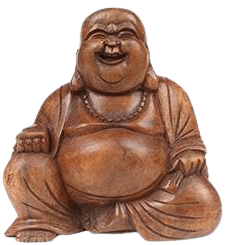
Laughing Buddha
But what is so alarming about laughter?
Laughter kills fear, and without fear there can be no faith, because without fear of the Devil there is no more need of God.
The Name of the Rose, Umberto Eco (1980)
Why do we laugh?
Last summer, the Director was fortunate to spend some time at the Edinburgh Fringe Festival. Making my particularly leisurely way along one particularly cobbled road on a particularly fine evening, I came across a flier advertising Bobby Davro’s comedy show entitled Everything Is Funny If You Can Laugh At It. I went along and had a lovely evening. A far better evening, no doubt, than the evening of kalsarikannit I had been planning. Laughter is one of the strangest and most revealing aspects of human existence. And I have to say that I was pleased to find an ally in the illustrious Mr Davro for my belief that humour knows no boundaries. For me, the best humour erupts unexpectedly, disarms the serious, and points at something beyond mere amusement. But why is it that we can and do laugh? What does laughter signify about the human condition? And why does it sometimes seem more profound than reason itself? These questions and others will no doubt spectacularly fail to be answered in today’s paltry words.
All human beings laugh. The Director, for reasons we need not go into, not so much. Nevertheless, all human beings do laugh, and do so from a very early age. Our friend Nietzsche believed that only human beings laugh. In his usual cheery way in Thus Spoke Zarathustra, he writes, Perhaps I know best why it is man alone who laughs, he alone suffers so deeply that he had to invent laughter. Here he suggests that, properly understood, laughter is often a sign of strength in response to existential suffering. Undoubtedly it is, but Nietzsche had of course never met our friend Richard Dawkins with all his biologist chums, so he may well have been a bit wrong to claim that only human beings laugh.
It turns out that there may well be very good evolutionary reasons (aren’t there always?) for laughter. Evidence suggests that laughter helps with social bonding for example. We all no doubt recall the experiment which revealed rats giggling away when being tickled. All four great ape species are capable of behaviour for which I believe the technical term is ‘messing about’. This suggests that a sense of humour may have been present in our last common ancestor, who would have been cracking all sorts of jokes on the Miocene grasslands around about 13 million years ago. Tough crowd back then I imagine. Even for Bobby Davro.
The Granddaddy of evolution himself Charlie Darwin also got in on the act. In The Descent of Man, he suggests that dogs may have a sense of humour when he writes: If a bit of stick or other such object be thrown to one, he will often carry it away for a short distance; and then squatting down with it on the ground close before him, will wait until his master comes quite close to take it away. The dog will then seize it and rush away in triumph, repeating the same manoeuvre, and evidently enjoying the practical joke. I can very well imagine the scene.
Whilst running around with sticks has its place in the comedic world, the human ability to laugh and joke requires quite developed cognitive abilities. We need the ability to imagine the world from someone else’s perspective, knowledge of social norms, the ability to anticipate others’ responses and to appreciate the violation of other’s expectations. Hang on a sec, isn’t that exactly what Darwin’s dog was doing? Perhaps.
Maybe humour and laughter aren’t unique to us human beings, but I suggest, dear reader, that it is fundamental to what it means to actually be a human being.
The benefits of being able to recognise and use humour have been thoroughly researched and are subsequently well documented. To list a few of the things that humour can do:
get people to listen,
increase long-term memory retention,
improve understanding,
aid in learning
help communicate messages.
improve group cohesiveness,
reduce status differentials
diffuse conflict
build trust
bring people closer together.
increase objectivity
improve focus
trigger new connections
The list does actually go on and on (*see the end of the column). This seems to suggest that if nothing else, the use and teaching of humour should at least be central to any decent school curriculum…
Many writers have wrestled with the question of the existence of humour, and their answers often reveal something of the paradoxical nature of laughter: it is both deeply human and yet suggestive of something transcendent, a momentary suspension of logic in which we glimpse a greater truth.
G.K. Chesterton, never one to miss a good paradox, suggested that angels can fly because they take themselves lightly. This seemingly whimsical observation points to something quite serious: weightiness, whether in the form of excessive solemnity, ego, or despair, ties us down. Laughter, by contrast, allows us to transcend the burdens of existence.
Chesterton saw humour as a form of humility. He argued that the ability to laugh, especially at oneself, was not a sign of frivolity but of wisdom. In Orthodoxy, he wrote it is the test of a good religion whether you can joke about it. He was not endorsing irreverence but rather the idea that true faith, true philosophy, and true humanity should not be brittle. If an idea or an ideology cannot withstand humour, it is likely not as strong as it purports to be. Theologian and philosopher, Søren Kierkegaard chimes with this, seeing laughter as something which is deeply entwined with faith; both require a leap beyond rationality. Often without the aid of a safety net.
For Chesterton, humour was not merely a diversion; it was a form of resistance. He believed that joy was the proper response to life’s absurdity, a defiant answer to the pessimism of his age. He puts it thusly: A strange thing called the sun has risen; a strange thing called man has arisen, and is walking about; a stranger thing still, a thing called laughter, has betaken itself to human lips.
Laughing at one’s own foolishness is a very strong Buddhist feature. Buddhist stories often use humour as a means of breaking through the constraints of logical thought; a requirement if one is to be open to the numinous quality of existence. The stories point to the idea that the deepest truths are often not accessible through direct intellectual effort but are instead apprehended in flashes of insight, often accompanied by laughter. Try this one on for size and let me know how you get on:
One day a young Buddhist on his journey home came to the banks of a wide river. Staring hopelessly at the great obstacle in front of him, he pondered for hours on just how to cross such a wide barrier. Just as he was about to give up his pursuit to continue his journey he saw a great teacher on the other side of the river.
The young Buddhist yells over to the teacher, “Oh wise one, can you tell me how to get to the other side of this river?”
The teacher ponders for a moment, looks up and down the river and yells back, “My son, you are on the other side.”
My Irish father, not exactly a follower of the Buddhist tradition would love to tell a similar story which went something like this:
I was stopped one day by an Englishman, who was obviously lost. And he asks me directions to Drumscollop.
I looks him in the eye and reply, “Well, Sir, I wouldn’t start from here.
Maybe Dad was more of a Buddhist than either of us realised!
Old friend of the column, Iain McGilchrist writes about humour from a neurophysiological point of view in his work on the brain’s hemispheric differences. He argues that the right hemisphere, which grasps context, metaphor, and paradox, is far more attuned to humour than the left, which understands only rigid categorisation. In this view, humour is not just a social or psychological phenomenon, it’s a neurological one, reflecting the brain’s capacity to hold contradictions in balance. It is his thesis that we live in a world increasingly dominated by left-brain thinking. Perhaps this is what caused Mancunian chaunter, Morrissey to opine, that joke isn’t funny any more. Left brain jokes really aren’t.
Mikhail Bakhtin, the Russian literary theorist, saw laughter as fundamentally subversive. In medieval carnivals, societal hierarchies were temporarily overturned, and laughter ruled the streets. This, Bakhtin argued, was no mere indulgence but a necessary correction, a way to puncture the pretensions of the powerful and remind everyone of their shared humanity.
In a sense, all good humour is carnivalesque. Mark Twain wielded satire as a weapon, writing the human race has one really effective weapon, and that is laughter. George Orwell, too, recognised the revolutionary power of humour, noting that every joke is, at its core, a tiny revolution.
Humour, at its best, reflects this balance between the absurd and the profound. It is what allows us to take life seriously without succumbing to despair. It is what reminds us, in the midst of our deepest struggles, that the universe is not merely tragic but also gloriously, defiantly, comic.
So why do we laugh? Perhaps because, as Chesterton suspected, the real joke is that we ever stopped.
Until next week, Happy Reading/Laughing
*

Given the subject for today’s column, perhaps I should leave you with a few of the Director’s favourite short funnies.
Do you think if ‘one’ Domino’s Pizza shop were to close down, all the rest would have to follow?
I decided to sell my vacuum cleaner… well it was just collecting dust.
ID is a strange abbreviation. I is short for I, and D is short for dentification
Why do dogs always race to the door when the doorbell rings? It’s almost never for them.