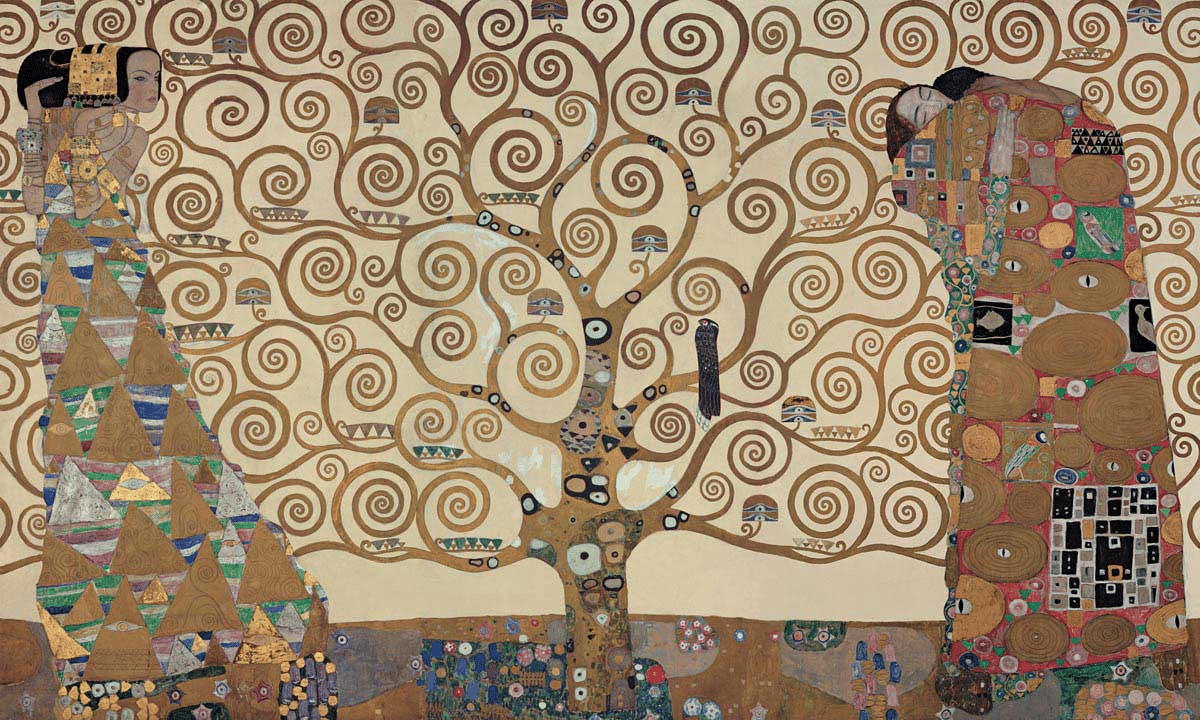
The Tree of Life by Gustav Klimt, 1905
Mind over Motor
At this time of year, as the nights draw in and the mercury falls, the Director enjoys returning to some old favourite reads. Yesterday I was fortunate enough to have the time to start in again on E M Forster’s, The Machine Stops. As you know, the story’s central message is a warning against blind faith in technological progress and the consequences of disconnecting from nature, genuine human relationships, and independent thought. Forster critiques the dehumanising potential of technology and emphasises the importance of creativity, personal freedom, and authentic experiences. Spoiler alert! When the Machine eventually fails, society collapses, highlighting the fragility of a world built on technological dependence. Coincidentally, this week, the Head of GCHQ’s National Cyber Security Centre (NCSC), Richard Horne, pointed out that we have collectively ‘bet the farm’ on technology’ and so we ought to be more vigilant about protecting the farm from hostile actors. In his first major speech in role he highlighted a dangerous combination of the UK’s growing dependency on technology and adversaries who are conspiring to use it against us.
Whilst Mr Horne warns of the threats posed by an over reliance on technology from a security point of view, I am reminded more and more frequently of Forster’s prescient tale in the quotidian experience of my teaching. Only this morning I asked some students to write a poem, and then proceeded to watch 90% of the class to ask Chat GPT to do it for them.
The average Tiffinian wants to see a poem, for example, as a mechanism that can be fully ‘explained’ and ‘understood’. If only they could see that it is not anything of the kind but more akin to a unique organism, well then whole new vistas of understanding and grades would be on view.
Now I know what a wonderful tool technology can be but it did get me thinking what our relationship to it is and why technology has permeated so much of our existence. A kind of impossible question to answer for a bear of such small brain as I. But if you were to insist, my answer would run along the following lines: we believe that technology is created in our own image. We embrace technology because we think we human beings are also machines. In fact, everything is mechanical.
Now, of course this is a very silly idea. So today’s paltry words are on why we are nothing like a machine. And perhaps why thinking that way is pretty dangerous, all things considered.
There are reasons why the mechanistic approach is so attractive. The devil after all must be alluring otherwise he wouldn’t get very far. I think we all have a liking for things being explained in terms of simple mechanisms because it’s a nice boost to think that we really understand and know something. This leads us to believe we can control whatever the thing is we believe we know.
But just to get us started a few reasons why we are not machine:
You can turn a computer off and turn it back on ten years later and it will probably still work. You can’t do that with a living organism. Probably not anyway. Don’t tell Walt Disney in his cryogenic chamber. Not that you ever could anyway. But I digress…
a machine can’t love
a machine can’t feel awe
a machine can’t feel emotions
a machine hasn’t got a body
a machine can’t know it’s going to die
a machine has no memory (yes, it has data banks but it doesn’t have memory which implies a consciousness)
a machine can’t look forward to the end of things
So a machine is completely different from an organism. But why then is it such a pervasive and persuasive way of thinking about what we (and the cosmos) are? Well, here we must return to our old friend: metaphor. A metaphor as we know can be a very useful and illuminating way of seeing something. And the best metaphors work to carry across deeper understandings of whatever is being described. But all metaphors break down at some point and quite a few of them have a ‘sell by date’ too, beyond which they ought not really to be used.
Now my experience with the Tiffinian’s adoption of the metaphor of the human being (and everything else) as some kind of a machine, derives from their understanding of science. Biology, in particular, seems to utilise this metaphor. Now obviously, the Director knows nothing of this and many other matters, but I am tickled somewhat by the idea that it’s the biologist, not the physicist who is captured by the metaphor of the organism as a machine. Physicists who are dealing with inanimate stuff tend to see an animated world. In my experience anyhow.
At the risk of upsetting dear old Richard Dawkins, I think I’ll offer my twopenny’orth on this and see where it takes us.
I think it all starts with DNA. I am aged enough to remember the claims that were made about the ‘mapping’ of the human genome. Once we’d sorted that out, we were going to be able to do wonderful things to make everybody’s lives better and disease-free and anxiety-free and pain-free and all the rest of it. I even recall that we were going to be able to grow non metaphorical wings, if that’s what we fancied.
But it turns out, as far as my reading takes me, that the genome is not a very good blueprint after all. The information there is so vanishingly small it can’t conceivably be the blueprint for even relatively simple things. For example, you could, if you were so inclined, cut the head off a nematode worm and it will grow a new head. And that head will have the memories that the old head had. Where do those memories come from?
The human brain in utero develops on average 4,000 new neurons every second and when cleverer people than I look at the brain and realise how complexly it is constructed, and how important it is that different neurons are in the area they are, they do not know where the blueprint for that is. It’s certainly not in the genome. Apparently. There’s no example of a machine that generates the instructions to make itself in the process of becoming itself. The instructions for a machine must pre-exist the making of that machine. It’s quite true that you could get one machine to make another but there is no case in which a machine which has no instructions at the outset builds itself and one of the things it builds in the course of building itself is what we thought was the set of instructions for building itself. If you get me.
So the DNA sequence is not a simple code or a blueprint. Firstly it must be understood three-dimensionally but also as we have discussed before, we need to remember that everything needs a context. Instructions can never be absolute but must be contextually understood. I am told that the same genes in different places achieve quite different things. The same protein may be coded for by different DNA but also the same DNA may code for very different proteins. We think there are about 1,200,000 proteins being made in the human body but if we’ve only got 26,000 genes clearly they’re going to have to produce many different proteins under different circumstances.
So, rather than a machine, the human being looks more like a complex whole in which context is all important; in which the parts and the whole relate in a way which is not just a sequential cause and effect but the whole thing coming into being as one. As you know, as the body comes into being, its organs and parts are not made and then put together, they get differentiated in the making of the whole organism. Take that Dr Frankenstein!
As we have discussed before, an organism is more a process than a thing. Like a stream or a waterfall or a tornado, it has imprecise boundaries which is another thing that makes a difference between the animate and the inanimate. Yeats asked us to consider the distinction between the dancer and the dance. Try it out and let me know how you get on.
As Robert Browning knew, which is why he was a big fan of the dramatic monologue, if you listen carefully to the language people use they will often reveal something more true than the mere superficial content of their words. Even at school, I recall thinking that our biology teachers clearly couldn’t really believe what they said they did believe. Although in theory they were talking about things as machines, they used a different kind of language to talk about these organisms; language which suggested that there were a number of things going on which clearly were not typical of the inanimate world. References to, for example, coordinating functions, processes, developments, elements that are said to regulate control, guide, induce, impose order or at times disorder, arrange, restructure, develop, adapt, respond, attempt, stimulate, inhibit, suppress and transmit. I remember sitting in many a biology class thinking, none of this goes on when we are describing what happens with rocks.
And as for genetics, well here we get, even from Prof. Dawkins, the recognising and interpreting of signals, the distinguishing of relevant from irrelevant information, the way in which things are adopted, erased, extracted from a code, the ability to communicate or exhibit intentions
respond etc. And then there is the idea of the purpose in this organism that has targets that may recruit other molecules for a certain end, things that assist in processes, aim at certain outcomes, have goals and achieve tasks etc. So undeniably we’ve got an idea of something full of value-laden ideas. Again, we don’t talk about rocks like that.
And what if the response from Prof. Dawkins and his pals is ‘these are just metaphors’?
Well, that’s where I come in.
Until next week, Happy Reading/Being What You Are
This week the Director’s postbag was full of a reader’s tip. So, special thanks to Bob Coast for the following:
A Reader’s Tip #8
Tired of boiling water every time you cook pasta?
Boil a few gallons at the beginning of each week and freeze it for later.