Lost in Translation
“Translation is not a matter of words only: it is a matter of making intelligible a whole culture.”
Anthony Burgess
“When words are scarce they are seldom spent in vain.”
William Shakespeare (Richard II)
Today, I wanted to use some of my paltry words to share a thought or two on articles kindly passed along to me by two esteemed colleagues, Mr Bryan-Williams and Mr O’ Reilly. The first: The fall of Eng Lit. What is the cause, is it a problem – and if so, what can we do about it? by Daisy Christodoulou. The second: The ‘more human than human’ phenomenon: how non-experts judge the authorship of AI-generated poetry, a recent study reported on in New Scientist which looked at AI generated poetry. I wondered if there might be some overlaps between the two and whether there might be anything to be said about them worth the candle.
We shall see.
Daisy Christodoulou’s article discusses the decline of English literature in education and the rise of mathematics as a more popular subject. The below graph is illustrative of how English literature and maths have basically replaced each other on the chart of most studied A-levels.
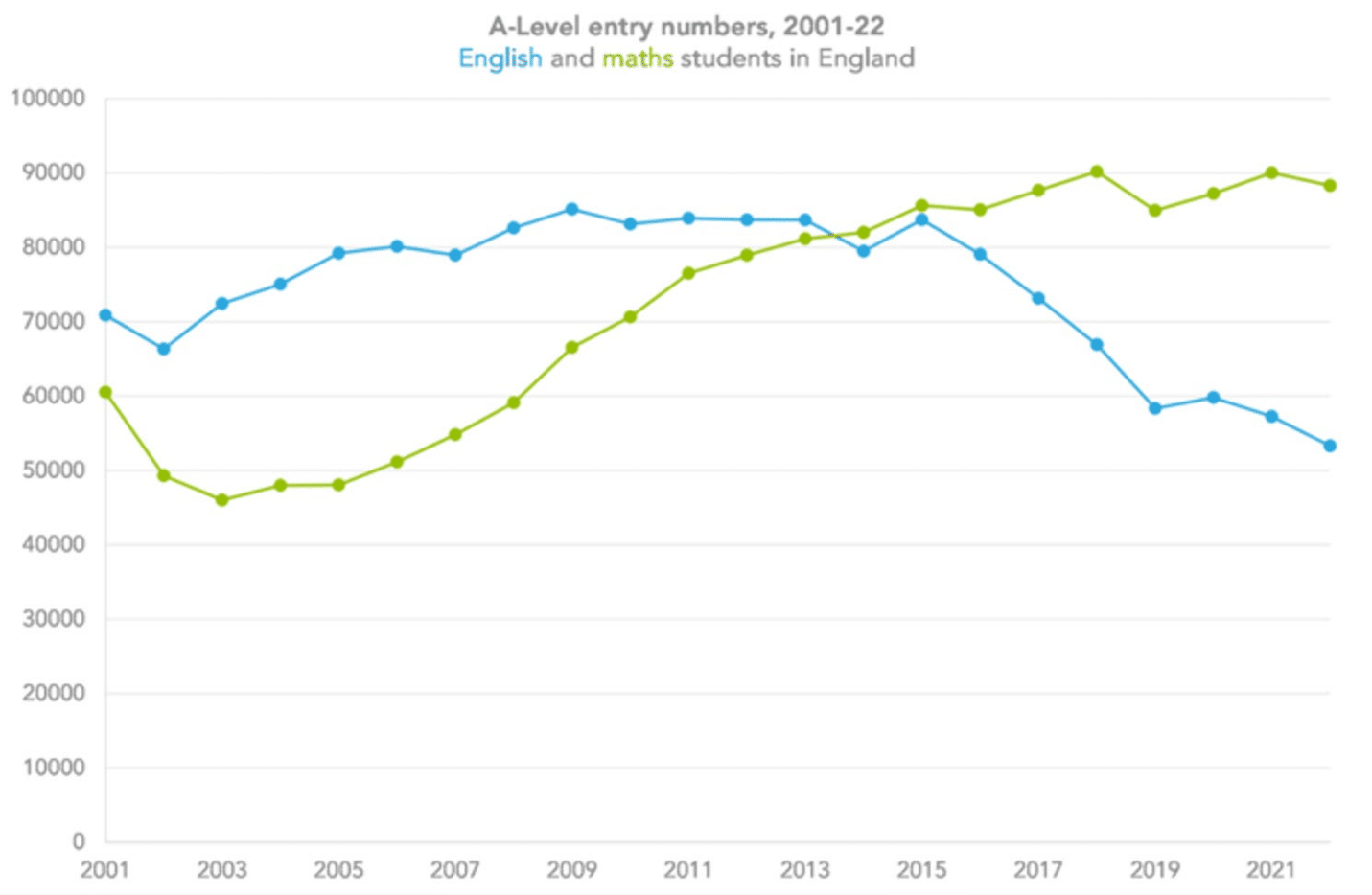
Between you, me and the gatepost, I had put this decline down to the quality of my A Level teaching, so I confess to a sense of relief to read that it wasn’t completely responsible. In the article two other factors are discussed:
- Economic pressures: Students today are more focused on choosing subjects that promise a higher financial return, with maths being perceived as offering better career prospects.
- Decline in reading habits: With the rise of smartphones, social media, and digital distractions, fewer people are reading regularly, leading to fewer students pursuing humanities subjects. (This is of course something we have discussed in this column on several many occasions).
Ms Christodoulou quite rightly acknowledges the importance of both maths and literature arguing that while maths has practical utility and a growing importance, literature also has significant value, not just in transmitting information but in expanding the ability to think as well as our ability for critical thinking. The challenge, she argues, is to demonstrate the utility and beauty of literature, even if students may no longer be as naturally drawn to long, complex, challenging texts.
Two possible solutions are offered: either adapting to the changing trends by incorporating more multimedia and shorter texts into the curriculum, or doubling down on the difficulty and value of traditional, lengthy texts. Concern is expressed however that the decline of English Literature reflects broader cultural and educational shifts and there is pessimism about its future role in education. Ultimately, the author fears that literature may become a marginalised subject, much like Classics or cricket in modern education, which could mark the end of its cultural prominence.
The title of the second study captures the essence of the research. In summary, here are its conclusions:
- Participants struggled to differentiate between AI-generated poems and those created by humans.
- When participants were not told whether the poems were AI or human-authored, they rated the AI-generated poems higher across various criteria such as creativity, emotional impact, and originality.
- Participants often found AI-generated poems easier to understand compared to the more complex works by human poets. This accessibility contributed to their higher ratings of AI poetry. Conversely, the complexity of human-written poems sometimes led to them being misjudged as AI-created.
- When participants were told a poem was AI-generated, they rated it lower compared to when they believed it was written by a human.
- The study concludes that poetry, once considered a domain where AI struggled to emulate human creativity, is now an area where AI can achieve “human-like” or even superior results.
So there we are. But…maybe…we could think about the study’s conclusions differently…
- Most people struggle to know what a poem is in the first place. Lovely as he is, I’m not going to ask my hairdresser to tell me whether he prefers the Ruy Lopez to the e6 Sicilian. He doesn’t play chess.
- How on earth are we measuring creativity, emotional impact, and originality?
- In a similar way ‘easier to understand’ and ‘more complex’ are labels beset with all sorts of subjective interference. Quite rightly. And the fact that participants preferred the easier ‘poems’ potentially tells us something more interesting about the participants rather than AI’s ability to write poetry.
- Well, obviously.
- Again, this seems to tell us more about what some mistakenly think human creativity is rather than shedding any light on what it actually is.
AI can simulate very well. If we believe that poetry is something that can be successfully simulated, then we will believe that AI can write poetry. But it can’t and it never will.
Allow me to explain.
Many years ago the Director lived for a while in Argentina. Part of the reason for being there was that I didn’t want to live my life never having gained a decent fluency in a language other than English. And so by the time I left, I could pretty much speak and read Castellano.
Now, the thing is, when you learn a language you’re not just learning a set of tokens which can then be exchanged/translated for the tokens of another language. As Anthony Burgess puts it above, you’re learning a whole way of being; thinking and feeling etc. I can feel that whenever I speak Castellano.
That is precisely what poetry is like. When we really read a poem it has the potential to have profound physiological effects. It is possible to detect changes in tension in muscle groups depending on the rhythm of what you’re reading, so it affects your skeletal muscle. It affects the skin and can make the hair stand on end. It can bring tears to eyes, quicken the pulse and raise blood pressure. In other words, it has enormous physiological effects that have profound meaning. And that is why things can’t just be paraphrased. As our friend Iain McGilchrist puts it, ‘a computer will never write or understand a poem until it has blood coursing through its chips’.
Poetry fundamentally deals with metaphor. One of the most common complaints about poetry which I have heard from students throughout my time as a teacher is, “Why can’t poets just say what they mean?” Much of my time therefore is directed towards trying to explain that poets do say what they mean. Rather than being some fancy, annoying, ornamental, literary device that unnecessarily complicates meaning, metaphors are fundamental to the way our minds work.
All meaning is ultimately metaphorical especially in the realm of philosophy and science where metaphors abound. Metaphor is how we understand something in terms of something else that we think we understand. It is a way of bringing into focus various connections between things which then come to be meaningful.
I think a little look at four specific aspects of language might be very useful here:
- Semantics – vocabulary, the building blocks of meaning
- Syntax – the way in which those building blocks of language are put together
- Prosody – the inflection of what we’re saying which radically changes meaning and might include irony, humour and our friend metaphor. Essentially stuff which plays around with the meaning. If you don’t actually take prosody into account, you won’t understand what is being meant.
- Pragmatics – perhaps the most important feature of all. This is concerned with what this utterance means in context. The same phrase or same word uttered on a different occasion, in a different way, in a different setting could have a vast range of meanings including ones that are opposite to one another.
Robots and language learning models are really very good at 1 and 2. They have extremely rich semantics and a more sophisticated grasp of syntax than probably any of us. But they are terrible at 3 and 4.
When meaning is either unusual, unexpected, complex or highly implicit then the non-robotic human being is in a different league. And let’s face it, the things which make life interesting and give meaning to our existence are always going to have to be expressed in metaphorical terms.
Robots apprehend but they do not comprehend. It’s why they can’t write poetry. And perhaps why the average Tiffinian decries poets for not saying what they mean.
Whenever we make something explicit in a sentence, we’ve reduced all that penumbra of potential meanings, connections and layers of feeling to one simple statement. And we must beware those who seek to reduce everything to non-ambiguous, clear or black and white statements.
Life and everything in it is ambiguous or ambivalent. Anyone who tells you it isn’t, is either lying or trying to sell you something. Metaphor is the way we access and express this wonderful complexity. If my Castellano was as good as it used to be I’d give the following thought by Spanish philosopher and essayist, José Ortega y Gasset in its original but it’s not so I can’t. Here’s the translation:
The metaphor is perhaps the most fruitful power of man. Its efficacy verges on magic, and it seems a tool for creation which God forgot inside one of His creatures when He made him.
I shall leave the last words of this column to American poet Billy Collins who, strangely enough, I first met in New York. I think it’s a poem which wonderfully expresses what I have been labouring to express. I promise you that it says what it means.
Introduction to Poetry by Billy Collins
I ask them to take a poem
and hold it up to the light
like a colour slide
or press an ear against its hive.
I say drop a mouse into a poem
and watch him probe his way out,
or walk inside the poem’s room
and feel the walls for a light switch.
I want them to waterski
across the surface of a poem
waving at the author’s name on the shore.
But all they want to do
is tie the poem to a chair with rope
and torture a confession out of it.
They begin beating it with a hose
to find out what it really means.
Until next time, Happy Reading/enjoying all the poetry
There were no tips from readers in the Director’s mailbox this week so I leave you with something perhaps to think about.
Something to think about #1
One of the following statements is not true
Margaret Atwood invented a remote-controlled pen.
The Romans made tea towels out of asbestos.
Bears are descended from whales.