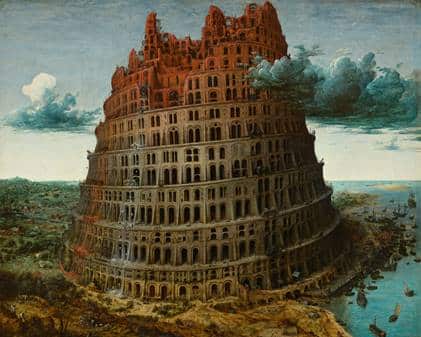
The Tower of Babel – Pieter Bruegel the Elder
“Colourless, green ideas sleep furiously.”
“Man has an instinctive tendency to speak as we see in the babble of our young children while no child has an instinctive tendency to bake, brew or write.”
The Descent of Man, and Selection in Relation to Sex, Charles Darwin, 1871
The experimental psychologist, Steven Pinker, took this quote as the inspiration for his book The Language Instinct: How the Mind Creates Language. I’m not the greatest fan of Steven Pinker at the best of times but he’s definitely a person worth listening to. Here are some few paltry words about what I think about what I think he’s thinking about on this topic.
Language is what most conspicuously distinguishes humans from other species. It is essential to human cooperation. And we accomplish amazing things by sharing our knowledge through words. The story of the Tower of Babel reminds us that humans accomplish great things because they can exchange information about their knowledge and intentions via the medium of language. And language has been found in every society ever studied by anthropologists. No one has ever discovered a human society that lacks complex language.
But, as with all interesting things, there are questions, like for example… Where does language come from? How did it evolve in this particular species? How does the brain do language?
Language comes so naturally to us that we forget what a strange and miraculous gift it is. And we can even become blasé about it, to the extent that we don’t want to cherish it and use it as best we possibly can. I think of Year 11s last thing on a Friday afternoon, for example…
So, what is language? I don’t know, but as with all such things it might be worth stopping off at Science Town.
Scientists studying how language works include grammar, the assembly of words, phrases and sentences; phonology, the study of sound; semantics, the study of meaning; and pragmatics, the study of the use of language in conversation. Those interested in language also study how it is processed in real time: psycholinguistics; how it is acquired by children: language acquisition and how it is computed in the brain: neurolinguistics. We haven’t time to look into all these areas today but we might touch on a few with the Director’s clumsily broad brushstrokes.
But firstly it’s important not to confuse spoken language with written language. Unlike spoken language, which is found in all human cultures throughout history, alphabetic writing where each mark on the page stands for a vowel or a consonant, appears to have been invented only once in all of human history by the Canaanites just under four thousand years ago. And as Darwin pointed out, children have no instinctive tendency to write, but have to learn it through construction and schooling. And I should know.
Another thing not to confuse language with is thought. I confess at this point that I did think that thoughts were done in language. To be fair to myself, many other people believe that they think in language. However psychologists are there to point out that there are many kinds of thought that don’t actually take place in the form of sentences. Babies communicate without speech, for example. I put this down in myself to a poor understanding of Wittgenstein’s Private Language argument. But this is for another column, another time.
For that matter, even when you understand language, what you come away with is not in itself the actual language that you hear. Another important finding in cognitive psychology is that long-term memory for verbal material records the gist or the meaning or the content of the words rather than the exact form of the words. Whenever I ask students to recall what I have said, I am not actually asking them to recall what I said at all. That is not the way memory works. What sticks in memory is far more abstract than the actual sentences, something that we might call meaning or content or semantics. In fact, when it even comes to understanding a sentence, the actual words are the tip of an enormous iceberg of a very fast, unconscious, non-linguistic processing that’s necessary even to make sense of the language itself.
Here’s an example of what I mean. Let’s take this classic bit of poetry, from the 20th Century poet, Shampoo Bottle:
Wet hair,
lather, rinse,
repeat.
In order to understand that language, you have to know that when you repeat, you don’t wet your hair a second time because its already wet, and when you get to the end of it and you see “repeat,” you don’t keep repeating over and over in some kind of bizarre hair washing infinite loop. Repeat here means, “repeat just once.”
This tacit knowledge is not language. We all know that language can affect thought but no one believes that language is the same thing as thought and that all of our mental life consists of reciting sentences.
So if language isn’t thought, then what is it? Well let’s look at how it works.
Pinker divides language into a few component parts:
Firstly, words. These are the basic components of sentences that are stored in a part of long-term memory. The basic principle of a word was identified by Swiss linguist, Ferdinand de Saussure, when he called attention to the arbitrariness of the sign. Take for example the word “duck.” The word “duck” doesn’t look like a duck or walk like a duck or quack like a duck, but I can use it to get you to think the thought of a duck because all of us at some point in our lives have memorised that association between that sound and that meaning. And we’re very good at doing that. Research suggests that the average secondary school student has a vocabulary which equates to learning a new word every two hours from the age of one. But we also can combine words into meaningful sentences which takes us to the second component of language: Grammar.
Any discussion of grammar must take in the work of Noam Chomsky, who more or less set the agenda for these types of discussions. Even though he was wrong about his main conclusion (another column) Chomsky noted that the main puzzle that we have to explain in understanding language is creativity, namely the ability to produce and understand new sentences.
Just about any sentence that you produce or understand is a brand new combination produced for the first time perhaps in your life, perhaps even in the history of the species. The question is, therefore, how do we do that? Chomsky has a few insights.
Insight #1 When we know a language, we haven’t just memorised a very long list of sentences, but rather have internalised a grammar, or algorithm, or recipe for combining elements into brand new assemblies.
Insight #2 languages have a syntax which can’t be identified with their meaning. Consider the following sentence: “Colourless, green ideas sleep furiously.” Well, what’s the point of that sentence? The point is that it is very close to meaningless. On the other hand, any English speaker can instantly recognise that it conforms to the patterns of English syntax. Compare, for example, “furiously sleep ideas dream colourless,” which is also meaningless, but we perceive as a kind of word salad rather than feeling like a sentence.
Insight #3 Syntax doesn’t consist of a string of word by word associations. Again if you look at for example, colourless and then green in “colourless green ideas sleep furiously,” how often have you heard colorless and green in succession? Probably never unless you were reading this column out loud, or having it read to you by a favourite nephew. Green and ideas, those two words just don’t occur together, similarly ideas and sleep, sleep and furiously. Every one of the so-called transition probabilities is very close to zero, nonetheless, the sentence as a whole can be perceived as a well-formed English sentence.
Language, like my family, has long distance dependencies.
The word in one position in a sentence can dictate the choice of the word several positions further along. For example, if you begin a sentence with “either,” somewhere down the line, there has to be an “or.” If you have an “if,” generally, you expect somewhere down the line there to be a “then.”
As I frequently tell my students, sentences can be made difficult to understand if they have too many long distance dependencies. It puts a strain on the short-term memory of the reader or listener who is trying to understand them. Do they listen? I direct you to my Q5s podcast. https://open.spotify.com/show/1X9Rwqa7xBsRv64goNVv7r
So much for the rules that go into defining what are possible sequences of language. Those sequences have to get into the brain during speech comprehension and they have to get out during speech production.
We haven’t got time here to go into the whole business of the mechanics involved with the fact that we can actually speak; tracheas and larynxes and all that. But it is an interesting fact first noted by Darwin that the larynx over the course of evolution has descended in the throat so that every particle of food going from the mouth through the oesophagus to the stomach has to pass over the opening into the larynx with some probability of being inhaled leading to the danger of death by choking. Why did we evolve a mouth and throat that leaves us vulnerable to choking? Well, a plausible hypothesis is that it’s a compromise that was made in the course of evolution to allow us to speak. Presumably our ability to speak had some survival advantage that compensated for the disadvantage in choking.
What about the flow of information in the other direction, that is from the world into the brain, the process of speech comprehension?
Speech comprehension turns out to be an extraordinarily complex computational process which I don’t understand but does, I know, involve our old friend, ‘context’. We are generally unaware of how unambiguous language is. In context, we effortlessly and unconsciously derive the intended meaning of a sentence. For this reason, a computer, no matter how smart, could not possess human comprehension of language. It can have the knowledge of the words and rules but not all the different combinations of possibilities of meaning.
Take a sentence as simple as “Mary had a little lamb,” you might think that that’s a perfectly simple unambiguous sentence. But now imagine that it was continued with “with mint sauce.” You realise that “have” is actually a highly ambiguous word.
People will always understand language so much better than computers because of something called ‘Pragmatics’ which is how people understand language in context using their knowledge of the world and their expectations about how other speakers communicate.
The most important principle of Pragmatics is called “the cooperative principle,” namely; assume that your conversational partner is working with you to try to get a meaning across truthfully and clearly. And our knowledge of Pragmatics, like our knowledge of syntax and phonology and so on, is deployed effortlessly, but involves many intricate computations.
For example, if I were to say, “If you could pass the salt, that would be super.” You understand that as a polite request meaning, give me the salt. You don’t interpret it literally as a rumination about some hypothetical affair, you just assume that the person wanted something and was using that string of words to convey the request politely.
We bring to bear on language understanding a vast store of knowledge about human behaviour, human interactions and human relationships.
It’s what makes language eternally fascinating because it speaks to fundamental questions of the human condition. It’s at the centre of a number of different concerns of thought, of social relationships, of human biology, of human evolution, that all speak to (no pun intended) what’s special about the human species. Language is the most distinctively human talent. Language is a window into human nature, and most significantly, the vast expressive power of language is one of the wonders of the natural world.
Until next time Happy Reading/Being Miraculous!
A Reader’s Tip #2
Not sure how bumpy is bumpy?
A teaspoon placed in a glass on the back seat of your car makes a useful audible gauge for road bump severity.