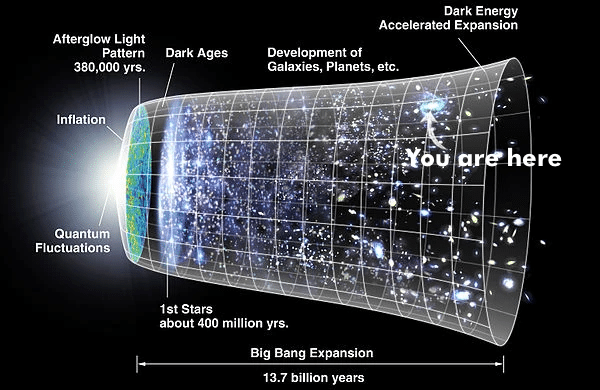
In Douglas Adam’s wonderful book, The Hitchhiker’s Guide to the Galaxy there is a machine called the Total Perspective Vortex. In the Guide it is described to have been invented by Trin Tragula as a way to annoy his wife who was always telling him that he needed to have “a sense of perspective.”
As the Guide explains – since every piece of matter in the Universe is in some way affected by every other piece of matter in the Universe, it is in theory possible to extrapolate the whole of creation every sun, every planet, their orbits, their composition and their economic and social history from, say, one small piece of fairy cake.
When Tragula used the machine on his wife, it destroyed her mind and thereby proved his point that if life was going to live in such a vast Universe, one thing it could not afford to have was a sense of perspective.
The Vortex machine comes to be used as a torture and execution device. The victim is placed inside the machine and given just one momentary glimpse of the entire unimaginable infinity of creation, and somewhere in it a tiny little marker, a microscopic dot on a microscopic dot, which says “You are here.”
At a certain point in the story the character Zaphod Beeblebrox enters the machine which proceeds to tell him that he is a really terrific and great guy. How Zaphod thrives after being exposed to the infinities of the universe unlike all other previous victims, I shall let you discover.
The Romantics had a word for their own concept of the inwardly transfiguring power of being in relation to the infinities of the universe: the sublime.
The popular understanding of the sublime today is largely inherited from The Romantics who considered Sublimity to entail Grandeur and the horror which Grandeur inspires, as opposed to Beauty. This understanding comes mainly from Edmund Burke who in his 1757 A Philosophical Enquiry into the Origin of Our Ideas of the Sublime and Beautiful, contrasted the beautiful (in which harmony and proportion gave the beholder the sense of an ordered whole) with the sublime (in which the very lack of this sense evoked a productive and pleasant terror). Famously Burke drew on Milton’s Paradise Lost as the best example of somebody doing the sublime really well. So, he knew his stuff.
There is no time here to go into such things but essentially the sublime is a feeling that arises from our apprehension of vast size or force, especially in nature
It might, at this point, be worth mentioning that the word Sublime is, as you will know, a Latin derived word meaning ‘exalted’ or ‘elevated’. We also have sublimis which may be understood as meaning ‘up to the threshold’
So, why all this business of the wonder or lack of it, when it comes to us and the contemplation of the world around us. Well the spark of this week’s Director’s paltry words was ignited by a conversation with an esteemed colleague earlier in the week. Said colleague was telling me how she was talking to a class about the difficulties of portraying strong human emotion in writing. She recalled to the class how she had recently felt moved and humbled by spending time recently in an ancient forest. What struck my colleague was the utter incomprehension of such an experience writ large on the faces of the students in front of her.
And it got me to thinking that we could do with some more wonder in and at the world.
As I may have mentioned before, what is at the heart of being human and what makes life worth living is what cannot be calculated, controlled, or bought and sold. Such an idea is pretty much constantly under assault these days, even upon the hallowed ground of Tiffin.
Philosopher and author, Patrick Curry (Art and Enchantment: How Wonder Works), has some interesting things to say about the business of wonder, or as he puts it: enchantment. So maybe a couple of reflections on these before we go.
He regards enchantment as a fundamental human experience; one which he suggests doesn’t just give life its meaning but rather is the meaning. And perhaps most importantly we cannot control or create a sense of wonder or enchantment. Rather, as my colleague was trying to explain to her students, what we need to realise is that the world we have is already enchanting.
One of the ways of realising this is through the business of metaphor. Rather than being disconnected from the world and one another, which seems to these tired eyes, more and more the way of the world ( have a look at any bus stop queue) enchantment or wonder is to do with making connections. And, wouldn’t you know it, this is precisely where metaphor comes into the picture…
These connections are partly created and partly discovered through metaphor. Metaphor is a connection. As you know, literally the word means carrying across from one thing to another or one place to another. The result of metaphor is a new kind of revelatory truth. I could mention here James Joyce’s notion of epiphany but we don’t have the time. The point is that metaphor allows us to reach a Transcendence by not taking us off into some other plane of existence but by going deeply into where we already are.
Aldous Huxley’s perfectly ordinary bowl of flowers on the desk in front of him was also the meaning of life. Henry Miller had an experience of Broadway as Paradise and in that moment it did become Paradise it however did not stop being Broadway.
In metaphor, things both are and aren’t, and they’re also ontological. In other words their way of being alive is not just epistemological; they are not about something so simple as knowing.
But, as the Tiffin class would say, it’s just not accurate to represent Broadway as Paradise, or a bowl of flowers as the meaning of life. That’s just wrong and so pointless. Our job is to point out that these semi-scientific naturalistic objections are completely inappropriate in this context.
Enchantment is about a way of being in and of the world. It’s not about representation, it’s about presence. The value of enchantment or wonder is akin to Truth in the sense that we’re not talking about its instrumental value, its use value or its exchange value but its intrinsic value. It has worth in and of itself, whether it’s any use to you or not, and it’s beyond any possible calculation. And we all know how fond the Tiffinian is of their calculator. Historian and economist Max Weber remarked that the primary weapon of disenchantment is the belief that all things in principle can be calculated.
Enchantment shows that up for the lie it is. All things cannot be calculated. Especially not the best things.
Weber referred to Enchantment being ‘concrete magic’. By this he meant enchantment was
at one in the same time material, a very precise set of circumstances – the concrete part. And on the other hand completely, inevitably, mysterious, spiritual and unfathomable – the magic part.
What we have been trained for so long to separate as completely as possible, we should better understand as being indissoluble and indissolubly wedded together.
We must leave it there, but next time you are asked, “Well yeah, that’s all very well but which is it? Is it material or psychological? Is it spiritual or practical? Or my most FAQ; is it subjective or objective? Well you must point out that these are a set of destructive questions which cannot be answered and should be refused because they don’t apply to what we’re talking about.
Easier said than done. But the way you attend to the world creates the world you inhabit, and I know where I’d rather live.
And of course we know that science is essentially a faith-based enterprise. In the words of Alfred North Whitehead, Science repudiates philosophy; it has never sought to justify its faith.
Until next time, Happy Reading/Being Enchanted!
Director’s Tip #8
Stop toast going soggy
Tap each slice all over with a teaspoon immediately it pops out of the toaster.